

Introduction
AI in News Industry
The news industry is evolving rapidly, and ai in news industry is playing a major role in this transformation. From breaking news reporting to personalized content delivery, AI is changing how news is created, distributed, and consumed.
Traditional journalism relied heavily on manual processes such as research, writing, editing, and publishing. While effective, these processes are time-consuming, resource-intensive, and often difficult to scale in a fast-paced digital environment. Today, with the rise of digital media platforms and real-time content demand, news organizations need faster, smarter, and more efficient systems.
Artificial intelligence provides exactly that. By leveraging technologies such as machine learning, natural language processing, and data analytics, news platforms can automate content creation, analyze large volumes of data, and deliver highly personalized news experiences to users.
AI is already being used by leading media organizations to generate news articles, summarize reports, detect fake news, and optimize content distribution. This shift is not just improving operational efficiency but also enhancing user engagement and content relevance.
For businesses, startups, and media companies, adopting AI is no longer optional. It has become a strategic necessity to stay competitive, reduce costs, and meet the growing expectations of digital audiences.
In this guide, we will explore how AI is transforming the news industry, including real-world use cases, key benefits, challenges, implementation strategies, and future trends. We will also cover how businesses can build AI-powered news platforms and leverage intelligent solutions for long-term growth.

Looking to Build an AI-Powered News Platform?
We help media companies and startups develop intelligent news apps with automation, personalization, and real-time updates.
Get Free ConsultationWHAT IS AI IN NEWS INDUSTRY
What is AI in News Industry and How AI Works in News Industry
AI in the news industry refers to the use of advanced technologies such as machine learning, natural language processing, and data analytics to automate, enhance, and optimize news production and distribution processes.
In simple terms, AI enables news organizations to create, analyze, and deliver content faster and more efficiently than traditional methods. It helps journalists and media companies handle large volumes of information, identify trends, and produce accurate content in real time.
AI systems can collect data from multiple sources, process it instantly, and generate structured news reports. For example, financial reports, sports updates, and weather news can be automatically created using AI-driven tools without manual intervention. This significantly reduces the time required to publish news.
Natural language processing plays a key role in understanding and generating human language. It allows AI to write articles, summarize long reports, translate content into multiple languages, and even detect sentiment in news stories.
Machine learning algorithms continuously improve based on data. They analyze user behavior, engagement patterns, and content performance to recommend personalized news to readers. This helps media platforms deliver relevant content and improve user experience.
AI is also used for fact-checking and misinformation detection. By analyzing patterns and verifying sources, AI systems can identify fake news and improve content reliability. This is especially important in today’s digital landscape, where misinformation spreads rapidly.
In modern newsrooms, AI acts as a support system rather than a replacement for journalists. It automates repetitive tasks, provides insights, and allows professionals to focus on storytelling, analysis, and investigative reporting.
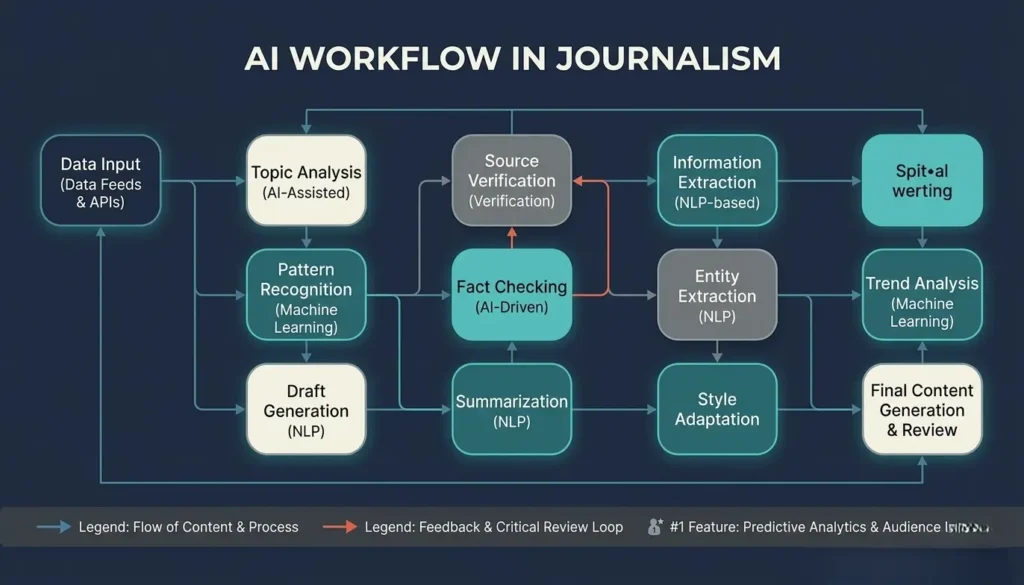
Key Technologies Behind AI in News Industry
AI in journalism is powered by several core technologies that work together to deliver intelligent solutions.
Machine Learning in News Media
Machine learning helps analyze large datasets, identify patterns, and predict trends. It is widely used for recommendation systems, audience analysis, and content optimization.
Natural Language Processing for Journalism
Natural language processing enables AI to understand, interpret, and generate human language. It is used for automated news writing, summarization, translation, and sentiment analysis.
Computer Vision in News Platforms
Computer vision allows AI to analyze images and videos. It is used for content tagging, visual recognition, and video analysis in media platforms.
Data Analytics and Predictive Intelligence
AI-powered analytics tools help news organizations understand audience behavior, measure performance, and predict trends. This supports better decision-making and strategy planning.
Artificial intelligence is not just a tool for automation. It is a transformative technology that is reshaping how the news industry operates. By integrating AI into their workflows, media organizations can improve efficiency, enhance content quality, and deliver better experiences to their audience.
Businesses that adopt AI early gain a competitive advantage by staying ahead of trends and adapting to changing user expectations.
EVOLUTION OF NEWS INDUSTRY WITH AI
Evolution of News Industry with Artificial Intelligence: Before vs After AI Transformation
The news industry has undergone a significant transformation over the past decade, and AI in the news industry has been one of the key driving forces behind this change. To understand its real impact, it is important to compare how news operations worked before AI and how they function today.

News Industry Before AI: Manual, Time-Consuming, and Limited Scalability
Before the adoption of artificial intelligence, news production was largely manual and dependent on human effort.
Journalists had to gather information from multiple sources, verify facts, write reports, edit content, and publish stories manually. This process required time, coordination, and significant resources.
Breaking news often faced delays due to the time required for verification and content creation. Additionally, covering large volumes of data such as financial reports, sports statistics, or election results was challenging and prone to human error.
Content distribution was also limited. News was delivered through traditional channels such as newspapers, television, and static websites, with minimal personalization for users.
Audience engagement was not deeply analyzed, and decisions were often based on assumptions rather than data-driven insights.
News Industry After AI: Automated, Data-Driven, and Scalable
With the integration of artificial intelligence, the news industry has become faster, smarter, and more scalable.
AI systems can collect and process data in real time, enabling news organizations to publish stories instantly. Automated journalism tools can generate articles for structured data topics such as finance, sports, and weather within seconds.
Content personalization has improved significantly. AI analyzes user behavior, preferences, and engagement patterns to deliver customized news feeds tailored to individual users.
AI-powered recommendation engines ensure that readers receive relevant content, increasing engagement and retention.
Real-time analytics allow news organizations to track performance, identify trends, and optimize strategies instantly. This helps in improving content quality and audience reach.
AI also enhances content distribution by optimizing headlines, formats, and publishing times for maximum visibility.
Key Differences: Before vs After AI in News Industry
The transformation brought by artificial intelligence can be clearly seen across multiple aspects of the news industry.
Content creation has shifted from manual writing to automated and AI-assisted generation, enabling faster production.
News reporting has evolved from delayed publishing to real-time updates powered by AI systems.
Audience targeting has improved from generic content delivery to personalized news experiences based on user preferences.
Data analysis has advanced from limited insights to real-time, AI-driven analytics and predictive intelligence.
Operational efficiency has increased significantly, reducing costs and improving scalability.
The evolution of the news industry with artificial intelligence represents a fundamental shift in how information is created and consumed.
Organizations that adopt AI-driven systems can produce content faster, deliver personalized experiences, and operate more efficiently. On the other hand, businesses that rely solely on traditional methods may struggle to compete in a rapidly changing digital landscape.
Artificial intelligence is not just improving journalism. It is redefining the entire news ecosystem.
LATEST TRENDS IN AI IN NEWS INDUSTRY
Latest Trends in Artificial Intelligence in News Industry (2025–2026)
Artificial intelligence in the news industry is evolving rapidly, with new technologies and innovations reshaping how news is created, verified, and distributed. As digital consumption continues to grow, news organizations are adopting AI-driven solutions to stay competitive, improve efficiency, and deliver better user experiences.
Understanding the latest trends in AI helps businesses, media companies, and startups identify opportunities and build future-ready platforms.

Generative AI for Automated News Writing
One of the most significant trends is the rise of generative AI in journalism.
AI models can now generate news articles, summaries, and headlines based on structured data and real-time inputs. This is widely used in areas such as financial reporting, sports updates, and weather news.
Generative AI allows news organizations to produce large volumes of content quickly while maintaining consistency and accuracy.
AI-Powered News Personalization
Personalization has become a core focus in modern news platforms.
AI analyzes user behavior, reading patterns, and preferences to deliver customized news feeds. Instead of showing the same content to all users, platforms provide tailored experiences that increase engagement and retention.
This trend is particularly important for digital news apps and platforms that rely on user engagement.
AI-Based Fact-Checking and Misinformation Detection
With the rise of fake news and misinformation, AI is playing a crucial role in content verification.
AI systems can analyze sources, detect inconsistencies, and flag potentially misleading information. These tools help journalists verify facts faster and maintain credibility.
This trend is essential for maintaining trust in digital media.
AI in News Summarization and Content Optimization
AI is widely used to summarize long articles into short, easy-to-read formats.
This is especially useful for mobile users who prefer quick updates. AI tools can generate summaries, highlight key points, and optimize content for better readability.
Content optimization also includes headline suggestions, keyword recommendations, and format improvements.
AI-Powered Video and Audio News Content
The demand for video and audio content is increasing, and AI is enabling faster production.
AI tools can convert text into video scripts, generate voiceovers, and create short-form video content for platforms like YouTube and social media.
Speech-to-text technology is also used to transcribe interviews and generate written content.
AI-Driven Recommendation Engines
Recommendation engines are becoming more advanced with AI.
These systems analyze user interactions and suggest relevant content, improving user experience and increasing time spent on platforms.
AI-driven recommendations are a key factor in the success of modern news apps and digital platforms.
AI in Newsroom Automation
AI is transforming newsroom operations by automating repetitive tasks.
From content tagging and categorization to publishing and distribution, AI reduces manual effort and improves efficiency.
This allows journalists to focus on high-value tasks such as investigative reporting and storytelling.
Ethical AI and Responsible Journalism
As AI adoption grows, ethical considerations are becoming more important.
News organizations are focusing on transparency, fairness, and accountability in AI-driven systems. Ensuring that AI-generated content is accurate and unbiased is critical for maintaining trust.
This trend highlights the need for responsible AI implementation in journalism.
The latest trends in artificial intelligence in the news industry show that AI is not just enhancing journalism but redefining it.
From automated content creation to personalized experiences and real-time analytics, AI is shaping the future of media. Businesses that adopt these trends early can gain a competitive advantage, improve efficiency, and deliver better user experiences.
PROBLEMS IN NEWS INDUSTRY WITHOUT AI
Major Challenges in the News Industry Without AI
Despite technological advancements, many news organizations still rely on traditional workflows that limit efficiency, scalability, and accuracy. Without artificial intelligence, the news industry faces several operational, financial, and user experience challenges that impact overall performance.
Understanding these challenges is essential to see why AI is becoming a necessity rather than an option.

Slow News Production and Publishing Delays
Operational Impact
-> Manual research, writing, editing, and publishing processes slow down news production. Journalists need time to gather information, verify sources, and prepare content.
Financial Impact
-> Delays in publishing can lead to missed opportunities, especially in competitive markets where speed is critical.
User Experience Gap
-> Readers expect real-time updates, and delays reduce engagement and trust.
Scalability Issue
-> Handling high volumes of news content becomes difficult without automation.
Difficulty in Handling Large Volumes of Data
Operational Impact
-> News organizations deal with massive amounts of data from multiple sources. Processing and analyzing this data manually is time-consuming.
Financial Impact
-> Requires larger teams and higher operational costs.
User Experience Gap
-> Important insights may be missed, leading to less relevant content.
Scalability Issue
-> Limited ability to scale data-driven journalism.
Challenges in Fact-Checking and Misinformation Detection
Operational Impact
-> Manual fact-checking is slow and prone to errors.
Financial Impact
-> Incorrect information can damage brand reputation and lead to loss of credibility.
User Experience Gap
-> Users may lose trust in unreliable sources.
Scalability Issue
-> Difficult to verify large volumes of content quickly.
Lack of Personalization in News Delivery
Operational Impact
-> Traditional systems deliver the same content to all users.
Financial Impact
-> Lower engagement leads to reduced ad revenue and subscriptions.
User Experience Gap
-> Users prefer personalized content based on their interests.
Scalability Issue
-> Impossible to manually personalize content for millions of users.
High Dependency on Manual Workflows
Operational Impact
-> Journalists spend significant time on repetitive tasks such as formatting, tagging, and publishing.
Financial Impact
-> Higher labor costs and inefficiencies.
User Experience Gap
-> Less focus on high-quality storytelling and investigative journalism.
Scalability Issue
-> Limited ability to expand operations without increasing resources.
Content Distribution and Reach Limitations
Operational Impact
-> Manual distribution strategies limit reach and effectiveness.
Financial Impact
-> Reduced visibility affects revenue generation.
User Experience Gap
-> Content may not reach the right audience at the right time.
Scalability Issue
-> Difficult to optimize distribution across multiple platforms.
Limited Real-Time Analytics and Insights
Operational Impact
-> Traditional systems provide delayed or limited data insights.
Financial Impact
-> Poor decision-making affects marketing and growth.
User Experience Gap
-> Content may not align with user preferences.
Scalability Issue
-> Inability to optimize strategies at scale.
Increasing Competition in Digital Media
Operational Impact
-> High competition requires faster and more efficient systems.
Financial Impact
-> Businesses may lose market share without innovation.
User Experience Gap
-> Users shift to platforms offering better experiences.
Scalability Issue
-> Difficult to compete with AI-driven platforms.
The challenges in the news industry without artificial intelligence highlight the limitations of traditional systems. As the demand for real-time, personalized, and scalable content continues to grow, relying on manual processes is no longer sustainable.
Artificial intelligence provides a clear path to overcome these challenges by automating workflows, improving accuracy, and enabling data-driven decision-making. Businesses that fail to adopt AI risk falling behind in an increasingly competitive digital landscape.
Facing Challenges in Scaling Your News Platform?
Automate content, improve accuracy, and deliver personalized news experiences with AI solutions.
Talk to Our Experts
AI SOLUTIONS FOR NEWS INDUSTRY
AI Solutions for News Industry: Automation, Personalization, and Intelligent News Platforms
Artificial intelligence in the news industry is not just about solving problems. It provides powerful, scalable solutions that transform how news is created, verified, distributed, and consumed.
Modern AI solutions enable media companies to automate workflows, improve accuracy, personalize user experiences, and scale content production efficiently. By integrating AI technologies, news organizations can move from manual operations to intelligent, data-driven systems.
Automated News Writing and Content Generation
AI-powered content generation is one of the most impactful solutions in journalism.
Using natural language processing and machine learning, AI systems can generate news articles from structured data sources such as financial reports, sports statistics, and weather updates.
These systems ensure consistency, speed, and accuracy while reducing manual effort. Journalists can focus on analysis and storytelling while AI handles repetitive writing tasks.
AI-Based Fact-Checking and Verification Systems
Fact-checking is critical in journalism, and AI significantly improves this process.
AI systems analyze data sources, detect inconsistencies, and verify information in real time. These tools help identify fake news, reduce misinformation, and improve content reliability.
By automating verification processes, news organizations can maintain credibility and build trust with their audience.
Personalized News Recommendation Engines
AI-powered recommendation systems analyze user behavior, preferences, and engagement patterns to deliver personalized content.
These systems ensure that users receive relevant news based on their interests, improving engagement and retention.
Personalization is essential for modern digital platforms, where user experience plays a key role in success.
AI News Summarization and Content Optimization
AI tools can summarize long articles into short, easy-to-consume formats.
This is particularly useful for mobile users and audiences with limited time. AI also helps optimize headlines, improve readability, and enhance content structure.
Content optimization ensures better visibility, engagement, and user satisfaction.
Speech-to-Text and Interview Automation
AI-powered speech recognition technology converts audio and video content into text.
This is widely used for transcribing interviews, press conferences, and live events. It speeds up the content creation process and improves efficiency.
Journalists can quickly convert spoken information into publishable content.
AI-Powered Content Distribution and Scheduling
AI helps optimize content distribution by analyzing audience behavior and identifying the best times and platforms for publishing.
Automated scheduling ensures that news reaches the right audience at the right time, improving visibility and engagement.
This solution is essential for managing multi-platform distribution strategies.
AI-Based Content Moderation and Filtering
AI systems monitor user-generated content, comments, and interactions to detect harmful or inappropriate content.
These systems help maintain a safe and positive environment for users while ensuring compliance with platform guidelines.
Content moderation is critical for protecting brand reputation and user trust.
Predictive Analytics and Trend Forecasting
AI enables news organizations to analyze historical data and predict future trends.
This helps in identifying trending topics, planning content strategies, and staying ahead of competitors.
Predictive analytics allows businesses to move from reactive to proactive decision-making.
AI-Powered News Platforms and Mobile Applications
Modern news platforms are increasingly powered by AI.
Businesses can develop AI-driven mobile and web applications that offer personalized feeds, real-time updates, and intelligent content recommendations.
These platforms improve user experience, increase engagement, and support scalable growth.
This is where services like AI news app development, mobile app development, and web app development play a critical role in building advanced digital news solutions.
AI solutions in the news industry provide a complete ecosystem for automation, personalization, and optimization.
By adopting these technologies, news organizations can improve efficiency, enhance content quality, and deliver better user experiences. Businesses that invest in AI-driven solutions gain a competitive advantage and position themselves for long-term success.
Ready to Implement AI in Your News Platform?
We build scalable AI-powered news apps, platforms, and automation systems tailored to your business needs.
Start Your Project
REAL-WORLD EXAMPLES OF AI IN NEWS INDUSTRY
Real-World Examples of Artificial Intelligence in News Industry
Artificial intelligence in the news industry is not just a concept. It is already being used by leading global media organizations to improve efficiency, automate workflows, and enhance content delivery.
These real-world examples demonstrate how AI is transforming journalism and how major companies are leveraging technology to stay competitive.
Associated Press – Automated News Reporting
Associated Press is one of the pioneers in using AI for journalism.
The organization uses AI systems to generate automated news reports, especially in areas such as financial earnings and sports updates. By automating repetitive reporting tasks, they have significantly increased the volume of content produced without compromising accuracy.
This allows journalists to focus on more complex and investigative stories.
Reuters – AI for News Automation and Data Analysis
Reuters uses AI to analyze large datasets, generate insights, and automate content production.
Their AI-driven tools help journalists process information quickly and create data-driven reports. AI is also used for content tagging, categorization, and improving newsroom efficiency.
This enables faster news delivery and better decision-making.
BBC – Personalized Content and AI Research
BBC has been actively experimenting with AI to improve content personalization and audience engagement.
AI systems analyze user behavior to recommend relevant content. BBC also explores AI for voice assistants, automated subtitles, and content optimization.
This enhances user experience and accessibility across platforms.
The New York Times – AI for Recommendations and Content Optimization
The New York Times uses AI-powered recommendation systems to personalize content for readers.
Their algorithms analyze user preferences and engagement patterns to deliver tailored news experiences. AI is also used for optimizing headlines, improving content visibility, and increasing reader retention.
This helps in driving subscriptions and user engagement.
AI-Powered Digital News Platforms (Modern Use Case)
Many modern digital news platforms and startups are built entirely on AI-driven systems.
These platforms use AI for:
- Real-time news aggregation
- Automated content generation
- Personalized news feeds
- AI-based analytics
This demonstrates how AI is not only supporting traditional media but also enabling new business models in the news industry.
Real-world examples show that artificial intelligence is already an integral part of modern journalism.
Leading media organizations are using AI to automate processes, improve efficiency, and deliver better user experiences. Businesses that adopt similar strategies can build scalable, intelligent, and competitive news platforms.
AI is not replacing journalism. It is empowering it.
AI USE CASES IN NEWS INDUSTRY
AI Use Cases in News Industry: Real Applications in Modern Journalism
Artificial intelligence in the news industry is being applied across multiple areas, from content creation to distribution and audience engagement. These use cases demonstrate how AI is transforming traditional journalism into a fast, scalable, and data-driven ecosystem.
Understanding these applications helps businesses and media organizations identify opportunities to implement AI effectively.
Automated Breaking News Generation
AI systems can generate breaking news updates in real time by analyzing data from multiple sources.
For example, financial earnings reports, sports scores, and election results can be automatically converted into structured news articles within seconds.
This allows news organizations to deliver timely updates and stay ahead in competitive environments.
AI-Powered News Aggregation
AI is widely used to collect and organize news from various sources.
News aggregation platforms use AI algorithms to filter relevant content, categorize topics, and present information in a structured format.
This helps users access diverse content from multiple sources in one place.
Personalized News Feeds
AI-driven recommendation systems analyze user behavior, reading history, and preferences to deliver personalized news feeds.
Each user receives content tailored to their interests, improving engagement and retention.
Personalization is a key factor in modern news platforms and digital media applications.
AI-Based Content Summarization
AI tools can summarize long articles into short and concise formats.
This is especially useful for mobile users who prefer quick updates. Summarization helps users consume more content in less time while maintaining key information.
Fake News Detection and Content Verification
AI plays a critical role in identifying misinformation.
By analyzing patterns, sources, and content consistency, AI systems can detect fake news and flag suspicious content.
This helps maintain credibility and trust in digital media.
Speech-to-Text and Interview Processing
AI-powered speech recognition converts audio and video into text.
Journalists can quickly transcribe interviews, press conferences, and live events, reducing manual effort and speeding up content production.
AI in Video News Creation and Editing
AI tools are used to create and edit video content for news platforms.
These systems can generate video scripts, add subtitles, and create short-form content for social media and digital platforms.
This supports the growing demand for video-based news.
Content Tagging and Categorization
AI automatically tags and categorizes news articles based on topics, keywords, and context.
This improves content organization, searchability, and recommendation accuracy.
AI-Powered Audience Analytics
AI analyzes user engagement, behavior, and content performance to provide actionable insights.
News organizations can use this data to optimize strategies, improve content quality, and increase audience retention.
AI in Content Distribution and Optimization
AI optimizes how content is distributed across platforms.
It determines the best time to publish, the most effective channels, and the type of content that performs well.
This ensures maximum reach and visibility.
The use cases of artificial intelligence in the news industry highlight its versatility and impact across the entire content lifecycle.
From creation to distribution and analysis, AI enables news organizations to operate more efficiently and deliver better experiences to their audience.
Businesses that leverage these use cases can build scalable, intelligent, and future-ready news platforms.
BENEFITS OF AI IN NEWS INDUSTRY
Key Benefits of Artificial Intelligence in News Industry for Media Companies and Businesses
Artificial intelligence in the news industry is transforming how media organizations operate, create content, and engage with audiences. By leveraging AI technologies, news companies can achieve higher efficiency, better accuracy, and improved user experiences.
The benefits of AI go beyond automation. They enable businesses to scale operations, reduce costs, and deliver personalized content that meets the expectations of modern audiences.
Faster News Production and Real-Time Publishing
AI significantly reduces the time required to create and publish news.
Automated systems can generate articles within seconds, allowing news organizations to deliver real-time updates. This is especially important in fast-paced environments where speed is critical.
Faster publishing improves competitiveness and ensures timely information delivery.
Improved Content Accuracy and Fact-Checking
AI-powered tools enhance accuracy by analyzing data, verifying sources, and identifying inconsistencies.
This reduces the risk of misinformation and improves the reliability of news content.
Accurate reporting builds trust and strengthens brand credibility.
Personalized User Experience
AI enables personalized news delivery based on user behavior and preferences.
Readers receive content that matches their interests, increasing engagement and satisfaction.
Personalization also improves retention and encourages users to spend more time on platforms.
Cost Reduction and Operational Efficiency
AI reduces the need for manual work by automating repetitive tasks.
This lowers operational costs and improves efficiency. News organizations can achieve more with fewer resources, making operations more sustainable.
Scalability and Content Expansion
AI allows businesses to scale content production without increasing resources.
News platforms can generate large volumes of content across multiple categories and formats.
This supports growth and expansion into new markets.
Enhanced Audience Engagement
AI-driven recommendation systems and personalized content improve user engagement.
Interactive features such as chatbots and real-time updates keep users connected and involved.
Higher engagement leads to better performance and increased revenue opportunities.
Better Decision-Making with Data Insights
AI provides real-time analytics and insights into user behavior and content performance.
News organizations can make data-driven decisions, optimize strategies, and improve outcomes.
This reduces guesswork and increases efficiency.
Multi-Platform Content Distribution
AI helps optimize content distribution across websites, mobile apps, and social media platforms.
This ensures that content reaches the right audience at the right time, maximizing visibility and impact.
Competitive Advantage in Digital Media
Businesses that adopt artificial intelligence gain a competitive edge.
AI enables faster operations, better targeting, and more effective content strategies, allowing companies to stay ahead in a competitive market.
The benefits of artificial intelligence in the news industry highlight its role as a transformative technology.
Organizations that leverage AI can improve efficiency, enhance user experiences, and achieve sustainable growth. Adopting AI is not just about keeping up with trends. It is about building a future-ready media business.
ROI OF AI IN NEWS INDUSTRY
ROI of AI in News Industry: Cost Savings, Revenue Growth, and Business Impact
Artificial intelligence in the news industry is not just a technological upgrade. It is a strategic investment that delivers measurable business results.
For media companies, digital publishers, and startups, the return on investment (ROI) of AI comes from increased efficiency, reduced operational costs, improved audience engagement, and new revenue opportunities.
Understanding the ROI of AI helps businesses make informed decisions and justify their investment in intelligent systems.

Reduction in Operational Costs
AI reduces the need for manual processes such as content creation, editing, tagging, and distribution.
By automating these tasks, news organizations can operate with smaller teams while maintaining high productivity.
This leads to significant cost savings in the long term.
Increased Content Production Efficiency
AI enables faster content creation and publishing.
News platforms can generate and distribute large volumes of content without increasing resources. This improves efficiency and allows businesses to cover more topics and categories.
Higher output directly contributes to increased reach and visibility.
Improved Audience Engagement and Retention
AI-driven personalization ensures that users receive relevant content.
This increases engagement, time spent on the platform, and user retention.
Higher engagement leads to better performance metrics and improved monetization opportunities.
Growth in Advertising and Subscription Revenue
Personalized content and targeted recommendations improve ad performance.
AI helps deliver relevant ads to the right audience, increasing click-through rates and conversions.
Additionally, better user experience encourages users to subscribe to premium content, driving recurring revenue.
Faster Decision-Making with Real-Time Insights
AI provides real-time analytics and performance data.
News organizations can quickly identify trends, optimize strategies, and make informed decisions.
Faster decision-making improves efficiency and reduces risks.
Scalability Without Increasing Costs
AI allows businesses to scale operations without proportional cost increases.
News platforms can expand content production, reach new audiences, and enter new markets without significantly increasing resources.
This creates a sustainable growth model.
Enhanced Content Quality and Accuracy
AI tools help improve content accuracy through data analysis and verification.
Higher quality content builds trust, attracts more users, and strengthens brand reputation.
This contributes to long-term growth and success.
Automation of Revenue-Generating Workflows
AI automates processes such as content distribution, ad optimization, and audience targeting.
These automated workflows improve efficiency and maximize revenue potential.
Competitive Advantage and Market Positioning
Organizations that adopt AI early gain a strong competitive advantage.
They can deliver better user experiences, operate more efficiently, and respond quickly to market changes.
This positions them as leaders in the digital media space.
The ROI of artificial intelligence in the news industry goes beyond cost savings. It creates a foundation for long-term growth, scalability, and innovation.
Businesses that invest in AI-driven solutions can unlock new revenue streams, improve operational efficiency, and deliver better user experiences.
AI is not just an expense. It is a growth engine for modern news platforms.
Want to Increase ROI with AI in News Industry?
Reduce costs, improve engagement, and scale your platform with our AI-driven solutions.
Request Free Strategy
AI IN NEWS INDUSTRY ACROSS DIFFERENT COUNTRIES
AI in News Industry Across Global Markets: Trends and Adoption
As AI in the news industry continues to expand globally, businesses across different regions are investing in AI-powered news platforms, mobile applications, and digital publishing systems to stay competitive in the digital landscape.
Each country has unique user behavior, content consumption patterns, and technological requirements. For example, markets like the United States and United Kingdom focus on advanced personalization, subscription-based models, and data-driven news platforms, while regions such as India and Southeast Asia prioritize mobile-first experiences, regional language support, and scalable content delivery.
To successfully build and scale AI-driven news platforms, businesses require region-specific development expertise. This is where customized solutions like mobile app development services in the USA and app development company in the UK play a critical role in delivering high-performance and user-centric applications.
Similarly, companies targeting North American markets can leverage mobile app development services in Canada, while businesses focusing on emerging markets can benefit from scalable and cost-effective solutions like mobile app development services in India.
By combining artificial intelligence with region-specific mobile and web development strategies, businesses can create powerful news platforms that deliver personalized content, real-time updates, and seamless user experiences across global markets.
These solutions typically include:
- AI-powered news app development (iOS and Android)
- Web app development for digital news platforms
- Machine learning-based recommendation engines
- Backend systems for scalable content management
- AI-driven automation for content creation and distribution
Partnering with an experienced development team ensures that businesses can build scalable, intelligent, and future-ready news platforms tailored to their target audience and market needs.
AI in News Industry in the United States
The United States is one of the leading markets for AI adoption in journalism and media.
Major news organizations are using AI for automated reporting, personalized content delivery, and advanced analytics. AI-driven recommendation systems and subscription models are widely used to improve user engagement and revenue.
The US market focuses heavily on innovation, data-driven decision-making, and scalable digital platforms.
AI in News Industry in the United Kingdom
In the United Kingdom, AI is being used to enhance newsroom efficiency and improve content distribution.
Media companies are adopting AI for fact-checking, audience analytics, and personalized news delivery. There is also a strong focus on ethical AI and responsible journalism to maintain trust and credibility.
AI in News Industry in Europe
European countries are increasingly adopting AI in digital media and journalism.
The focus is on data privacy, content accuracy, and regulatory compliance. AI is used for multilingual content generation, audience segmentation, and cross-border news distribution.
This region emphasizes transparency and responsible AI usage.
AI in News Industry in India
India is experiencing rapid growth in digital media and AI adoption.
News platforms are using AI for regional language content, personalized feeds, and mobile-first experiences. AI-powered applications help deliver content to diverse audiences across different languages and regions.
The growth of digital platforms and mobile usage makes AI a key driver of innovation in India.
AI in News Industry in Australia and Canada
In Australia and Canada, AI is being used to improve content quality, automate workflows, and enhance audience engagement.
Media companies are focusing on personalization, analytics, and multi-platform distribution to stay competitive in digital environments.
AI in Emerging Markets (Asia, Africa, Middle East)
Emerging markets are adopting AI to address challenges such as scalability, accessibility, and content distribution.
AI is used to deliver news in regional languages, improve accessibility, and reach wider audiences through mobile platforms.
These regions present significant opportunities for growth and innovation in AI-driven media solutions.
The adoption of artificial intelligence in the news industry varies across regions, but the overall trend is clear. AI is becoming a global standard for modern journalism.
Businesses that understand regional differences and adapt their strategies accordingly can expand their reach, improve user engagement, and build scalable solutions for global markets.
AI enables news organizations to operate beyond geographical boundaries and deliver content to audiences worldwide.
AI TOOLS FOR NEWS INDUSTRY
Top AI Tools for News Industry and Journalism Platforms
Artificial intelligence in the news industry is powered by a wide range of tools that help automate content creation, improve accuracy, enhance personalization, and optimize distribution.
These AI tools are widely used by media companies, journalists, and digital platforms to streamline workflows and deliver better user experiences. Understanding these tools helps businesses choose the right technologies and build efficient AI-powered news systems.
AI Tools for Automated News Writing
AI-powered writing tools use natural language processing to generate articles, summaries, and reports.
These tools are commonly used for:
- Financial news
- Sports updates
- Weather reports
They help reduce manual effort and improve content production speed.
AI Tools for Content Summarization
Summarization tools convert long articles into short, easy-to-read formats.
This is useful for mobile users and platforms that focus on quick content consumption. These tools improve readability and user engagement.
AI Tools for Fact-Checking and Verification
AI-based verification tools analyze data sources and detect inconsistencies.
They help identify fake news, verify information, and ensure content accuracy. This is essential for maintaining credibility in journalism.
AI Tools for Personalization and Recommendation
Recommendation engines analyze user behavior and preferences to deliver personalized content.
These tools improve engagement, retention, and user satisfaction by providing relevant news feeds.
AI Tools for Speech-to-Text and Transcription
Speech recognition tools convert audio and video into text.
They are widely used for:
- Interview transcription
- Press conference documentation
- Content generation from audio
This significantly speeds up content creation workflows.
AI Tools for Video and Audio Content Creation
AI tools help create video and audio content from text.
They can:
- Generate voiceovers
- Create short-form videos
- Add subtitles automatically
This supports the growing demand for multimedia content.
AI Tools for Content Moderation
AI moderation tools monitor user-generated content, comments, and interactions.
They help detect harmful or inappropriate content and ensure compliance with platform guidelines.
AI Tools for Analytics and Performance Tracking
AI-powered analytics tools provide insights into user behavior, engagement, and content performance.
These tools help businesses make data-driven decisions and optimize their strategies.
AI Tools for Content Distribution and Scheduling
AI helps automate content scheduling and optimize publishing times.
These tools ensure that content reaches the right audience at the right time, improving visibility and performance.
AI tools are the foundation of modern news platforms. They enable automation, improve efficiency, and enhance user experiences across the entire content lifecycle.
However, simply using tools is not enough. Businesses need to integrate these tools into a unified system that aligns with their goals and audience needs.
This is where custom AI development, mobile app development, and web platform development become essential for building scalable and intelligent news solutions.
HOW TO IMPLEMENT AI IN NEWS INDUSTRY
How to Implement Artificial Intelligence in News Industry: Step-by-Step Strategy for Businesses
Implementing artificial intelligence in the news industry requires a clear strategy, the right technology, and a structured approach. Many businesses struggle not because AI is complex, but because they lack a proper implementation roadmap.
Whether you are a startup, media company, or digital publisher, following a step-by-step approach ensures successful AI adoption and long-term scalability.
Step 1: Identify Business Goals and Use Cases
The first step is to clearly define what you want to achieve with AI.
Businesses should identify key challenges such as slow content production, lack of personalization, or inefficient workflows. Based on these challenges, they can select relevant AI use cases like automated news writing, recommendation systems, or content summarization.
A clear objective ensures focused implementation and better results.
Step 2: Analyze Data and Content Requirements
AI systems rely heavily on data.
News organizations must evaluate their data sources, content formats, and data quality. Structured and well-organized data improves the accuracy and performance of AI models.
This step also includes defining how data will be collected, stored, and processed.
Step 3: Choose the Right AI Technologies
Selecting the right technologies is critical for successful implementation.
Businesses should consider:
- Machine learning for predictions and analytics
- Natural language processing for content generation and understanding
- Recommendation engines for personalization
- Speech recognition for transcription
Choosing the right technology stack ensures scalability and performance.
Step 4: Design Scalable Architecture
A scalable system architecture is essential for handling large volumes of content and users.
This includes:
- Backend systems for data processing
- Cloud infrastructure for scalability
- APIs for integration
- Content management systems
A strong architecture supports long-term growth and flexibility.
Step 5: Develop AI-Powered News Platforms
Once the foundation is ready, businesses can start building AI-driven solutions.
This includes:
- AI-powered news mobile apps (iOS and Android)
- Web platforms for digital publishing
- AI-based content automation systems
- Personalized recommendation engines
This is where services like mobile app development, web app development, backend development, and AI development services play a key role in building scalable platforms.
Step 6: Train and Test AI Models
AI models need to be trained using real data.
Businesses should test models for accuracy, performance, and reliability. Continuous testing ensures that the system delivers high-quality results.
Step 7: Integrate AI into Existing Workflows
AI should be integrated into existing newsroom workflows rather than replacing them completely.
This includes:
- Content creation
- Editing and publishing
- Distribution
- Analytics
Integration ensures smooth adoption and minimal disruption.
Step 8: Monitor Performance and Optimize
AI systems require continuous monitoring and improvement.
Businesses should track performance metrics such as:
- Content engagement
- User retention
- System accuracy
Based on insights, systems can be optimized for better results.
Step 9: Ensure Compliance and Ethical AI Usage
AI implementation must follow ethical guidelines and data privacy regulations.
Businesses should ensure:
- Transparency in AI-generated content
- Data security
- Fair and unbiased algorithms
This builds trust and protects brand reputation.
Implementing artificial intelligence in the news industry is not a one-time process. It is an ongoing journey that requires continuous improvement and adaptation.
Businesses that follow a structured approach can successfully adopt AI, improve efficiency, and build scalable, future-ready news platforms.
Partnering with an experienced development team can further simplify the process and ensure successful implementation.
CHALLENGES OF AI IN NEWS INDUSTRY
Challenges of Artificial Intelligence in News Industry: Risks, Limitations, and Ethical Concerns
While artificial intelligence in the news industry offers significant benefits, it also comes with challenges and limitations that businesses must consider before implementation.
Understanding these challenges helps media companies and digital platforms adopt AI responsibly, minimize risks, and build reliable systems.
Risk of Misinformation and AI-Generated Errors
AI systems rely on data and algorithms, which means they can sometimes produce inaccurate or misleading information.
If not properly monitored, AI-generated content may include errors or misinterpret data. This can damage credibility and trust.
Human oversight is essential to ensure accuracy and reliability.
Lack of Human Judgment and Context
AI lacks the human ability to understand context, emotions, and nuanced storytelling.
Journalism often requires critical thinking, ethical judgment, and interpretation, which AI cannot fully replicate.
AI should be used as a support tool rather than a replacement for journalists.
Data Dependency and Quality Issues
AI systems depend on high-quality data to function effectively.
Incomplete, biased, or incorrect data can lead to poor results and inaccurate predictions.
Ensuring data quality is a major challenge for many organizations.
High Initial Investment and Implementation Complexity
Implementing AI requires investment in technology, infrastructure, and expertise.
For some businesses, especially startups, the initial cost and complexity can be a barrier.
However, the long-term ROI often justifies the investment.
Ethical Concerns and Bias in AI
AI systems can reflect biases present in the data they are trained on.
This can lead to unfair or biased content, which may impact credibility and audience trust.
Ensuring fairness and transparency in AI systems is essential.
Data Privacy and Security Risks
Handling large amounts of user data raises privacy and security concerns.
Businesses must comply with data protection regulations and ensure secure data management practices.
Failure to do so can result in legal issues and loss of trust.
Resistance to Adoption in Traditional Newsrooms
Some journalists and organizations may resist adopting AI due to fear of job displacement or lack of understanding.
Change management and proper training are necessary to ensure smooth adoption.
Dependence on Technology and System Reliability
AI-driven systems depend on technology infrastructure.
System failures, bugs, or downtime can disrupt operations and affect content delivery.
Reliable infrastructure and maintenance are critical.
The challenges of artificial intelligence in the news industry highlight the importance of responsible implementation.
AI should be used to enhance human capabilities rather than replace them. By addressing these challenges and adopting best practices, businesses can build reliable, ethical, and efficient AI-driven news platforms.
Organizations that balance technology with human expertise will achieve the best results.
COST OF AI IN NEWS INDUSTRY
Cost of AI in News Industry: Development, Implementation, and Scaling
The cost of implementing artificial intelligence in the news industry depends on multiple factors, including the complexity of the solution, the features required, and the scale of the platform.
For businesses, understanding the cost structure is essential to plan investments, allocate resources, and maximize return on investment.
AI is not a one-size-fits-all solution. Costs vary based on business goals, technical requirements, and level of customization.
Key Factors Affecting AI Development Cost
Several factors influence the cost of AI implementation in the news industry.
Project Complexity
Simple solutions such as content summarization or basic automation require lower investment, while advanced systems like personalized recommendation engines or full AI-powered news platforms involve higher costs.
Features and Functionality
The number of features directly impacts development cost. Advanced features such as real-time analytics, AI-based personalization, and automated content generation increase complexity.
Data Requirements
AI systems require large volumes of data for training and optimization. Data collection, processing, and storage can add to the overall cost.
Technology Stack
The choice of technologies such as machine learning frameworks, cloud infrastructure, and APIs affects the development cost.
Integration Requirements
Integrating AI with existing systems, content management platforms, and third-party tools increases complexity and cost.
Estimated Cost Breakdown
While exact costs vary, here is a general estimate based on different levels of AI implementation:
Basic AI Integration
Includes simple automation features such as content summarization or tagging.
Estimated Cost: Low to Medium
Mid-Level AI Solutions
Includes recommendation systems, personalization, and analytics.
Estimated Cost: Medium
Advanced AI News Platforms
Includes full AI-powered systems with automation, personalization, analytics, and scalability.
Estimated Cost: High
Cost of AI-Powered Mobile and Web Development
Building AI-driven news platforms involves multiple components:
- Mobile app development (iOS and Android)
- Web app development for digital publishing
- Backend systems for content management
- AI and machine learning integration
The cost depends on the level of customization and scalability required.
Businesses looking to build advanced solutions often invest in custom app development, backend development, and AI development services to ensure long-term success.
Ongoing Costs and Maintenance
AI systems require continuous maintenance and updates.
This includes:
- Model training and optimization
- System monitoring
- Infrastructure costs
- Feature enhancements
Ongoing investment ensures that the system remains accurate, efficient, and up-to-date.
Cost vs Value: Long-Term Perspective
While the initial investment in AI may seem high, the long-term benefits often outweigh the costs.
AI reduces operational expenses, improves efficiency, and generates new revenue opportunities. Businesses that adopt AI early gain a competitive advantage and achieve sustainable growth.
The cost of artificial intelligence in the news industry should be viewed as an investment rather than an expense.
By choosing the right strategy, technology, and development partner, businesses can build scalable and efficient AI-driven news platforms that deliver strong returns over time.
CASE STUDIES
AI in News Industry Case Studies: Real-World Solutions and Development Experience
Building AI-powered solutions for the news industry requires deep expertise in mobile app development, artificial intelligence, and scalable system architecture.
While every project is unique, many AI-driven features used in modern news platforms are similar to solutions developed across industries such as education, content platforms, and digital media.
Below are real-world case studies and solution capabilities that demonstrate how AI can be successfully implemented in news platforms.
Case Study 1: AI-Powered Content Automation and Personalized Learning System (Adaptable to News Platforms)
We developed an advanced AI-powered platform designed to deliver personalized learning experiences using intelligent automation and user behavior analysis.
Key Features Implemented
- AI Copilot system for answering user queries in real time
- AI-based content generation and summarization
- Personalized content delivery based on user preferences
- Voice and text input for interactive user experience
- Automated flashcard and content creation system
- Performance tracking and analytics
How This Applies to News Industry
These capabilities can be directly adapted to build AI-powered news platforms:
- AI Copilot → AI news assistant for answering user queries
- Content generation → Automated news writing
- Personalization → Customized news feeds
- Analytics → Audience behavior tracking
Business Impact
- Increased user engagement
- Faster content delivery
- Improved personalization
- Scalable platform architecture
Case Study 2: AI-Based Content Management and Automation Platform
We developed a scalable system that manages large volumes of content, automates workflows, and improves operational efficiency.
Key Features Implemented
- Content upload and management system
- AI-based tagging and categorization
- Automated content processing workflows
- Admin dashboard with analytics and reporting
- Multi-platform support (mobile + web)
How This Applies to News Industry
This solution can be adapted for:
- News content management systems
- Automated content categorization
- Multi-platform publishing
- Real-time analytics dashboards
Business Impact
- Reduced manual effort
- Improved content organization
- Faster publishing workflows
- Better decision-making
Case Study 3: AI-Powered Mobile Application with Real-Time Content Delivery
We developed a high-performance mobile application that delivers real-time content, personalized experiences, and interactive features.
Key Features Implemented
- Real-time content updates
- Personalized dashboard
- AI-based recommendations
- Offline content access
- Notification and engagement system
- Gamification elements for user retention
How This Applies to News Industry
This can be transformed into:
- AI-powered news mobile apps
- Personalized news feeds
- Real-time breaking news alerts
- User engagement systems
Business Impact
- Increased user retention
- Higher engagement rates
- Improved user experience
- Scalable mobile platform
Case Study 4: AI-Driven Content Transcription and Processing System
We implemented a system that converts audio and video content into structured text using AI.
Key Features Implemented
- Speech-to-text conversion
- AI-based summarization
- Content extraction from recordings
- Automated transcript generation
How This Applies to News Industry
- Interview transcription
- Press conference documentation
- Video-to-article conversion
- Faster content creation workflows
Business Impact
- Reduced manual effort
- Faster content production
- Improved efficiency
These case studies demonstrate that AI solutions are not limited to a single industry. The same technologies used in education, content platforms, and digital systems can be adapted to build powerful news platforms.
By leveraging proven AI capabilities, businesses can accelerate development, reduce risks, and create scalable, intelligent news solutions.
Have a Similar Idea for an AI News Platform?
Let’s build a powerful, scalable solution tailored to your business goals.
Discuss Your Project
AI DEVELOPMENT SERVICES FOR NEWS INDUSTRY
AI Development Services for News Industry: Build Scalable and Intelligent News Platforms
Artificial intelligence in the news industry requires more than just tools. It requires the right strategy, technology, and development expertise to build scalable and high-performing platforms.
Businesses looking to adopt AI need end-to-end development solutions that cover mobile applications, web platforms, backend systems, and AI integration. With the right approach, companies can transform traditional news operations into intelligent, automated, and data-driven systems.
AI-Powered News App Development (iOS and Android)
We develop high-performance mobile applications that deliver real-time news, personalized content, and seamless user experiences.
Our solutions include:
- AI-powered recommendation engines
- Real-time news updates and notifications
- Personalized user dashboards
- Offline content access
- Scalable architecture for high traffic
These applications help businesses engage users, improve retention, and deliver content efficiently.
Web and Digital News Platform Development
We build scalable web platforms for digital publishing and news distribution.
Our web solutions include:
- AI-driven content management systems
- Personalized news feeds
- Multi-platform content distribution
- SEO-optimized content structure
- High-performance and secure architecture
These platforms ensure smooth operations and improved user experiences.
Custom AI Solutions for News Industry
We develop custom AI solutions tailored to specific business needs.
This includes:
- Automated news content generation systems
- AI-based fact-checking tools
- Content summarization engines
- Recommendation systems
- Predictive analytics solutions
Custom AI solutions help businesses achieve efficiency, accuracy, and scalability.
Machine Learning and Data Analytics Integration
We integrate machine learning models and analytics systems to enable data-driven decision-making.
Our solutions include:
- Audience behavior analysis
- Content performance tracking
- Trend prediction and forecasting
- Real-time analytics dashboards
This helps businesses optimize strategies and improve outcomes.
Backend Development and Scalable Infrastructure
A strong backend is essential for handling large volumes of data and users.
We provide:
- Scalable backend architecture
- Cloud-based infrastructure
- API development and integration
- Secure data management systems
This ensures reliability, performance, and scalability.
AI Integration with Existing News Systems
We help businesses integrate AI into their existing platforms without disrupting operations.
This includes:
- Integration with CMS systems
- Workflow automation
- Data migration and optimization
- Performance enhancement
This allows organizations to upgrade their systems efficiently.
End-to-End Development and Support
We provide complete development services from planning to deployment and maintenance.
Our process includes:
- Requirement analysis
- UI/UX design
- Development and testing
- Deployment and launch
- Ongoing support and optimization
This ensures a smooth and successful implementation.
Developing AI-powered solutions for the news industry requires a combination of technology expertise and industry understanding.
By partnering with an experienced development team, businesses can build intelligent platforms that automate workflows, improve user engagement, and drive long-term growth.
AI is not just a feature. It is the foundation of modern news platforms.
Build Your AI-Powered News Platform Today
Partner with our expert team to develop scalable, intelligent, and future-ready news applications.
Get Free Consultation
FUTURE OF AI IN NEWS INDUSTRY
Future of Artificial Intelligence in News Industry (2026–2030): Trends, Innovations, and Opportunities
Artificial intelligence in the news industry is evolving rapidly, and its future holds significant opportunities for innovation, automation, and growth. As technology advances, AI will become more integrated into every aspect of journalism, from content creation to audience engagement.
Between 2026 and 2030, AI is expected to play a central role in shaping the future of news platforms, enabling businesses to deliver faster, smarter, and more personalized experiences.

AI-Generated Journalism at Scale
AI will continue to improve its ability to generate high-quality news content.
In the future, AI systems will be capable of producing more complex articles with better context, accuracy, and structure. Automated journalism will expand beyond structured data to cover broader topics.
This will enable news organizations to scale content production significantly.
Hyper-Personalized News Experiences
Personalization will become more advanced and precise.
AI will analyze deeper user behavior patterns, preferences, and engagement data to deliver highly customized news experiences. Each user will receive a unique content feed tailored to their interests.
This will improve engagement, retention, and user satisfaction.
AI-Powered News Assistants and Chat Interfaces
AI-driven assistants will become a standard feature in news platforms.
Users will be able to interact with AI systems to ask questions, get summaries, and explore topics in a conversational manner.
This will transform how users consume news and interact with content.
Integration of AI with Video, Audio, and Immersive Content
AI will play a major role in creating multimedia content.
Future platforms will combine AI with video, audio, and immersive technologies to deliver interactive news experiences.
This includes AI-generated videos, voice-based content, and immersive storytelling formats.
Advanced Fake News Detection and Content Verification
AI systems will become more effective in detecting misinformation.
Future tools will use advanced algorithms to verify sources, analyze patterns, and ensure content authenticity.
This will help maintain trust and credibility in digital media.
AI-Driven Newsroom Automation
Newsrooms will become more automated with AI handling repetitive and data-driven tasks.
This will allow journalists to focus on creative and investigative work, improving the overall quality of journalism.
Automation will improve efficiency and reduce operational costs.
Global AI-Powered News Ecosystems
AI will enable news platforms to operate globally with ease.
Content will be automatically translated, localized, and distributed across different regions. This will allow businesses to reach international audiences and expand their presence.
Ethical AI and Responsible Journalism
As AI adoption increases, ethical considerations will become more important.
Future systems will focus on transparency, fairness, and accountability. Ensuring ethical AI usage will be critical for maintaining trust.
The future of artificial intelligence in the news industry is not just about automation. It is about creating intelligent, scalable, and user-centric ecosystems.
Businesses that invest in AI today will be better positioned to adapt to future trends, innovate faster, and stay ahead of competition.
AI will continue to redefine journalism, making it more efficient, personalized, and impactful.
FAQ – AI IN NEWS INDUSTRY
Frequently Asked Questions About AI in News Industry
What is artificial intelligence in the news industry?
Artificial intelligence in the news industry refers to the use of technologies such as machine learning, natural language processing, and data analytics to automate news production, improve content accuracy, and enhance user experiences. It enables news organizations to process large volumes of data and deliver real-time, personalized content.
How is AI used in journalism and news platforms?
AI is used in journalism for automated news writing, content summarization, fact-checking, audience analysis, and personalization. It helps news platforms deliver relevant content, improve efficiency, and enhance user engagement.
What are the main benefits of AI in the news industry?
The main benefits include faster content production, improved accuracy, personalized user experiences, cost reduction, scalability, and better decision-making through data insights. AI also helps news organizations stay competitive in the digital landscape.
Can AI replace journalists?
No, AI cannot fully replace journalists. While AI can automate repetitive tasks and assist in content generation, human judgment, creativity, and ethical decision-making remain essential in journalism. AI works as a support system rather than a replacement.
How does AI help detect fake news?
AI uses data analysis, pattern recognition, and source verification to identify misinformation. It can detect inconsistencies, analyze credibility, and flag suspicious content, helping news organizations maintain accuracy and trust.
What are the challenges of AI in the news industry?
Challenges include the risk of misinformation, lack of human context, data dependency, high implementation costs, ethical concerns, and data privacy issues. Proper implementation and human oversight are required to overcome these challenges.
How much does it cost to implement AI in the news industry?
The cost depends on the complexity of the solution, features, and scale of implementation. Basic AI solutions are more affordable, while advanced platforms require higher investment. However, AI provides long-term ROI through efficiency and scalability.
How can a business start using AI in the news industry?
Businesses can start by identifying key challenges, selecting relevant use cases, and implementing AI solutions step by step. Partnering with an experienced AI development company can help ensure successful implementation and faster results.
What are the best AI tools for news platforms?
AI tools for news platforms include content generation tools, summarization tools, recommendation engines, analytics platforms, and fact-checking systems. These tools help automate workflows and improve efficiency.
What is the future of AI in the news industry?
The future of AI in the news industry includes advanced automation, hyper-personalization, AI-powered assistants, and global content distribution. AI will continue to play a key role in transforming journalism and digital media.