Looking for AI development services or AI consulting company expertise? This guide demonstrates our proven track record building AI-powered applications across industries, helping you understand how businesses use AI today and how we can help implement AI solutions for your specific needs.
Introduction – How AI Quietly Became Part of Our Everyday Business
Imagine this: It is 2015. You walk into a hospital, and a doctor diagnoses your condition based on years of medical school training and intuition. You open your bank app, and it asks you for a password; nothing more. You walk into a retail store, and a salesperson recommends products based on guesswork.
Now fast-forward to 2026. That same hospital uses an AI system that detects early-stage cancer from a scan with 94% accuracy; before a human eye ever sees it. Your bank flags a fraudulent transaction in real time, blocking the attack in milliseconds. The retail store knows your size, your style preferences, and what you bought three months ago; and it suggests exactly what you need before you even search.
This is not science fiction. This is the real world of artificial intelligence in business today.
Across every industry; from healthcare and education to construction and spirituality; AI is no longer a futuristic concept. It is a business essential. Companies that adopt AI are cutting costs, growing revenue, serving customers better, and outpacing every competitor that hesitates.
In this comprehensive guide, we break down how AI is being used in 20+ industries, what challenges it solves, what measurable results it delivers, and how you can position your business to benefit from it. Whether you are a startup founder, a corporate executive, or a developer looking to build the next AI-powered product; this guide has everything you need.
| $15.7T AI’s projected global GDP impact by 2030 (PwC) |
| 77% Companies piloting AI globally in 2026 (Gartner) |
| $15.7T AI’s projected global GDP impact by 2030 (PwC) |
| 10x Avg. ROI improvement with AI-powered automation |
What is Artificial Intelligence and Why It Matters for Your Business
Artificial intelligence has evolved from experimental technology to essential business infrastructure transforming how companies operate worldwide. Understanding what is artificial intelligence and how artificial intelligence works is now critical for business survival in the digital age.
This comprehensive guide examines real-world AI examples and artificial intelligence use cases across major industries, based on verified implementations and measurable business outcomes. Whether you’re exploring AI solutions for business, evaluating AI development services, or seeking custom AI solutions for your organization, you’ll find practical insights grounded in current market realities.
We’ll explore applications of AI in real life across healthcare diagnostics, financial fraud detection, retail personalization, manufacturing optimization, and eight additional industries. Each section includes real world AI examples, business outcomes, and implementation considerations based on organizations successfully deploying artificial intelligence solutions today.
What Actually Is Artificial Intelligence?
Let’s start with the basics. You’ve probably heard a lot of fancy definitions of artificial intelligence, but here’s what it really means in everyday terms:
Artificial intelligence is teaching computers to do things that normally require human thinking.
Think about what you do every day at work. You look at information, make decisions, solve problems, understand what people are saying, and learn from your experiences. AI helps computers do similar things; but much faster and at a much larger scale.
For example, imagine you own a clothing store. Every day, you notice what customers buy, what they look at but don’t buy, and which items sell together. Over time, you get better at recommending products because you understand your customers. This is human intelligence at work.
Now imagine having a computer that can do this for thousands of customers at once, remembering every single detail perfectly, and making personalized recommendations for each person. That’s artificial intelligence.
The key difference: AI doesn’t replace human judgment; it helps you make better decisions faster.
How Does AI Actually Work?
You don’t need to understand the complex mathematics behind AI (we handle that), but it helps to understand the basic idea.
Think of AI like teaching a child. When you teach a child to recognize dogs, you don’t give them a rulebook with measurements and formulas. Instead, you show them examples: “This is a dog. That’s a dog too. This one is also a dog, even though it looks different.” After seeing enough examples, the child learns to recognize dogs on their own; even dogs they’ve never seen before.
AI works similarly. We show the computer thousands of examples, and it learns patterns. Then it can recognize similar patterns in new situations. This process is called “machine learning” because the machine is literally learning from examples, just like humans do.
The magic happens when AI learns from your specific business data. It doesn’t just know general information; it learns about your customers, your operations, your challenges. This makes it incredibly powerful for solving your unique problems.
What Is Artificial Intelligence in Business: AI Technology Explained
Artificial intelligence enables computer systems to perform tasks that typically require human intelligence; analyzing data patterns, making predictions, understanding language, recognizing images, and learning from experience. Understanding what is artificial intelligence starts with recognizing AI as a collection of technologies working together to solve business problems.
The Real Business Value of AI (Not Just Hype)
Let’s be honest; there’s a lot of hype around AI. Companies promise it will solve every problem and replace every worker. That’s not realistic, and we won’t pretend it is.
Here’s what AI actually does really well:
1. AI Handles Repetitive Tasks So Humans Can Focus on Important Work
Think about your business. How much time do you and your team spend on repetitive tasks? Answering the same customer questions over and over. Processing paperwork. Data entry. Scheduling. These tasks are important, but they don’t require your unique human skills.
AI excels at these repetitive tasks. It never gets tired, never makes errors from boredom, and works 24/7. This frees your team to focus on work that actually needs human creativity, empathy, and judgment.
For example, one hotel we worked with spent hours every day answering basic guest questions: “What time is breakfast?” “Where’s the gym?” “How do I get to the airport?” We built an AI chatbot that handles these questions instantly, any time of day. Now the human staff can focus on making guests feel special something AI can’t do.
2. AI Finds Patterns Humans Would Miss
Your business generates tons of data every day sales records, customer behavior, inventory levels, employee schedules, and more. Hidden in this data are valuable patterns, but they’re impossible for humans to spot because there’s just too much information.
AI can analyze millions of data points and find patterns that help you make better decisions. It might notice that customers who buy Product A on Tuesdays are likely to buy Product B on Thursdays. Or that equipment tends to break down exactly 45 days after a specific warning sign appears. These insights are gold for your business.
3. AI Personalizes Experiences at Scale
Imagine you own a bookstore with one customer. You could recommend perfect books because you know their taste. Now imagine you have 10,000 customers. How do you give each one personalized recommendations?
AI makes this possible. It remembers what each customer likes, learns from their behavior, and makes personalized suggestions for everyone simultaneously. This is why Amazon’s recommendations feel so accurate; they’re using AI to give millions of customers a personalized shopping experience.
4. AI Works 24/7 Without Breaks
Your business doesn’t stop when you go home, but your employees do (as they should). AI fills this gap. It can answer customer questions at 3 AM, process orders on weekends, and monitor systems on holidays.
This doesn’t replace your team; it extends your business hours without burning out your people.
How Artificial Intelligence Works in Business Context
In business contexts, AI software solutions process vast amounts of information to identify opportunities, automate decisions, and generate insights that drive competitive advantage. Companies leverage AI solutions for business to reduce operational costs, improve customer experiences, accelerate decision-making, and create new products and services.
The business value comes not from AI technology alone, but from applying these AI applications to specific problems: detecting fraudulent transactions in milliseconds, personalizing product recommendations for millions of customers simultaneously, predicting equipment failures before they occur, or diagnosing diseases from medical images with superhuman accuracy.
Modern artificial intelligence solutions encompass multiple technologies working together:
- Machine Learning Applications: Algorithms that improve through experience, enabling predictive analytics and data-driven decision making without explicit programming for every scenario.
- Natural Language Processing (NLP): Understanding and generating human language for chatbots, document processing, and AI-driven customer service.
- Computer Vision Technology: Interpreting visual information for quality control, medical imaging, and visual search applications.
- Intelligent Automation: Combining AI-driven decision making with process automation to handle complex workflows efficiently.
- Predictive Analytics: Forecasting future outcomes based on historical patterns, enabling proactive business strategies.
These AI tools for enterprises work together to create comprehensive AI solutions for different industries, demonstrating the practical benefits of artificial intelligence across every business function.
At its core, AI in business follows a simple pattern: Collect data → Train a model → Make predictions or decisions → Improve over time. But the practical application is far more nuanced.
The AI Business Value Chain
- Data Collection: Every customer interaction, transaction, and operational event generates data.
- Data Processing: AI systems clean, organize, and structure this raw data.
- Model Training: Algorithms identify patterns in historical data.
- Inference & Decision-Making: The trained model applies those patterns to new, real-time data.
- Continuous Improvement: As more data flows in, the model refines its accuracy.
The most successful AI implementations do not just automate tasks; they enhance human decision-making, reduce costly errors, unlock new revenue streams, and create experiences that customers love. Let us now explore exactly how this plays out in each industry.
How Different Industries Are Using AI Right Now
Now let’s get specific. We’ll walk through different industries and show you exactly how AI is helping businesses like yours. For each industry, we’ll share real examples, explain the actual benefits, and show you what’s possible.
AI in Healthcare: Artificial Intelligence Use Cases Transforming Medical Care
The AI in healthcare industry faces a crisis of scale: too many patients, not enough doctors, rising costs, and diagnostic errors that cost lives. AI is the most powerful tool available to solve all of this simultaneously.
| $188B AI in healthcare market by 2030 (Grand View Research) | 40% Reduction in diagnostic errors with AI support | 30% Cost savings in hospital operations via AI automation |

Healthcare: How AI Saves Lives and Reduces Burnout
If you work in healthcare, you already know the challenges. Doctors and nurses are overwhelmed with paperwork. Staff shortages mean everyone is stretched thin. Diagnostic errors happen because even the best doctors can miss things when they’re tired or rushed. Medical costs keep rising, and patients expect better care for less money.
Current Challenges in Healthcare
- Physician burnout and staff shortages at global scale
- Diagnostic errors causing preventable deaths and complications
- Overwhelmed emergency departments with poor patient prioritization
- Manual, paper-based administrative workflows consuming 34% of clinician time
- Drug discovery timelines averaging 12–15 years at enormous cost
- Inadequate mental health support infrastructure for growing demand
- Patient non-compliance leading to preventable readmissions
AI isn’t a magic solution, but it’s making a real difference. Here’s how:
Helping Doctors Diagnose Diseases Earlier and More Accurately
Imagine a radiologist looking at X-rays. They might review 50 chest X-rays in a day, searching for signs of pneumonia, tumors, fractures, or other problems. After hours of staring at scans, even the most skilled doctor’s eyes get tired. They might miss a small shadow that could be an early tumor.
Now add AI to this process. The AI looks at every X-ray alongside the doctor. It’s been trained on millions of X-rays and learned what pneumonia looks like, what tumors look like, what’s normal and what’s not. When it spots something suspicious, it flags it for the doctor to review carefully.
The AI doesn’t replace the doctor’s judgment; doctors still make the final decision. But it acts like a tireless second pair of eyes that never gets fatigued, never gets distracted, and has seen more cases than any human possibly could.
Studies show this approach catches 40% more early-stage cancers. That’s 40% more people who get treatment before it’s too late. That’s lives saved, simply by having AI double-check the doctor’s work.
Predicting Which Patients Need Urgent Attention
Hospitals face a difficult challenge: they have limited staff and resources, but they need to give the right attention to the right patients at the right time. Miss an early warning sign, and a patient could deteriorate rapidly. Over-react to every minor symptom, and you overwhelm your staff.
AI helps solve this by constantly monitoring patient data; vital signs, lab results, medication responses, and more. It learns patterns that indicate a patient is about to take a turn for the worse, often before human observers notice the subtle signs.
For example, AI might notice that a patient’s heart rate has been slowly increasing over 12 hours, their blood pressure is trending slightly down, and their breathing pattern has changed just a bit. Individually, none of these things would alarm a nurse. But AI has seen this exact combination before in thousands of past cases, and it knows this pattern often leads to serious complications within the next 6 hours.
The AI alerts the medical team: “This patient needs attention now.” The team intervenes early, preventing a crisis. The patient goes home healthy. This is happening in hospitals around the world, and it’s reducing emergency situations by 25%.
Cutting Paperwork Time in Half
Ask any doctor what they hate most about modern medicine, and many will say: paperwork. Doctors spend almost as much time filling out forms, writing notes, and dealing with insurance codes as they do actually seeing patients. This is frustrating for doctors and bad for patients who need more face time with their physician.
AI is changing this through something called “ambient documentation.” Here’s how it works: An AI system quietly listens to the conversation between doctor and patient. As they talk about symptoms, medical history, and treatment plans, the AI understands the conversation and automatically writes the medical notes.
After the appointment, instead of spending 15 minutes typing everything up, the doctor spends 2 minutes reviewing and approving the AI-generated notes. That’s 13 minutes saved per patient. Over a day, that’s hours of time returned to patient care.
Doctors tell us this is life-changing. As one physician said: “I finally feel like a doctor again, not a data entry clerk.”
Speeding Up Drug Development
Developing a new drug traditionally takes 10-15 years and costs over a billion dollars. Why so long? Because researchers need to test millions of possible drug molecules to find ones that might work. Then they need to test them for safety. Then they need to run clinical trials. Most candidates fail at each stage.
AI dramatically speeds up the early stages. Instead of physically mixing chemicals and testing them one by one in a lab, AI can simulate millions of possibilities on a computer. It predicts which molecules are most likely to work, which might have dangerous side effects, and which are worth testing in the real world.
What used to take years now takes months. What used to require testing millions of options now focuses on the most promising thousands. This means new treatments reach patients faster and at lower cost.
During the pandemic, AI helped identify potential COVID-19 treatments in weeks instead of years. While human researchers still did the critical work, AI helped them focus their efforts on the most promising directions.
How AI Solves Healthcare Challenges
AI-Powered Diagnostics
Machine learning models trained on millions of medical images can detect cancer, retinal diseases, cardiovascular conditions, and neurological disorders with accuracy matching or exceeding specialist physicians. Google’s DeepMind has demonstrated AI detecting over 50 eye diseases with 94% accuracy. Radiology AI tools from companies like Zebra Medical Vision are already analyzing CT scans in seconds, flagging urgent cases automatically.
Predictive Patient Care
AI analyzes a patient’s vitals, history, and behavioral data to predict deterioration hours before clinical symptoms appear. Hospitals using predictive AI models have reduced ICU mortality by up to 20% by enabling earlier intervention.
AI Medical Assistants & Chatbots
24/7 virtual health assistants handle appointment booking, symptom triage, medication reminders, and mental health check-ins. This reduces the administrative burden on clinical staff while improving patient engagement and adherence.
Drug Discovery Acceleration
AI platforms like AlphaFold (DeepMind) and BenevolentAI are compressing drug discovery timelines from 12 years to as few as 2–3 years by predicting protein structures, identifying candidate molecules, and simulating clinical trials virtually.
Robotic Surgery Assistance
AI-assisted surgical robots provide enhanced precision, reduced tremor, real-time analytics during procedures, and post-operative outcome prediction all reducing complication rates and hospital stays.
Administrative Automation
NLP-powered systems extract data from medical records, auto-generate clinical documentation, process insurance claims, and handle prior authorizations; saving clinicians an average of 2–3 hours per day.
Business Benefits of AI in Healthcare
- 40–60% reduction in administrative overhead
- 30% improvement in patient satisfaction scores
- Up to 50% faster diagnostics for critical conditions
- Significant reduction in costly readmission rates
- Expanded reach through telehealth AI assistants
Real Impact: Numbers That Matter
Let’s be specific about what this means for healthcare businesses:
For hospitals, AI-powered systems reduce administrative work by 30-50%. That’s less money spent on paperwork and more resources available for patient care. Hospital readmission rates drop by 18-25% because AI helps identify and prevent complications before patients leave. This saves money and, more importantly, prevents suffering.
For diagnostic centers, AI assistance improves accuracy by 40% for certain conditions. This means fewer misdiagnoses, fewer unnecessary procedures, and better outcomes for patients. Radiologists can review more cases without sacrificing quality, improving throughput by 25-40%.
For medical billing companies, AI automates coding and insurance claims, reducing errors by 50% and speeding up payment cycles. This means healthcare providers get paid faster and spend less time fighting with insurance companies.
Is your healthcare organization still relying on manual processes?
Let us help you design and build an AI-powered health solution.
AI Use Cases in Education
Education is no longer confined to classrooms and textbooks. AI is personalizing learning at scale, making world-class education accessible to anyone with a smartphone regardless of geography or income.
| $80B EdTech AI market projected by 2030 | 45% Improvement in learning outcomes with personalized AI | 3.7B People globally underserved by quality education |

Current Challenges in Education
- One-size-fits-all teaching ignores individual learning speeds and styles
- Teacher shortages in rural and developing markets
- Language barriers blocking access to quality learning content
- Poor student engagement and high dropout rates in online learning
- Inability to scale quality education without exponential cost increases
- Lack of real-time feedback for students studying independently
- Content overload making it difficult to identify what to study first
How AI Solves Education Challenges
Personalized Learning Paths
AI education platforms analyze how each student learns their pace, strengths, weaknesses, and preferred formats and dynamically adapt the curriculum in real time. Instead of every student watching the same lecture, AI serves each learner exactly what they need next. This has been shown to improve knowledge retention by 30–45% compared to traditional methods.
AI-Powered Tutoring
AI tutors provide instant, contextually relevant explanations on any topic at any time of day. Unlike human tutors, they never get impatient, can explain concepts in multiple ways, and are available at 3am before an exam. Platforms like Khan Academy’s Khanmigo and similar tools are already showing this at scale.
Multilingual Content Delivery
NLP-powered translation and localization engines convert educational content into any language, with culturally appropriate examples; making premium content accessible globally. AI voice synthesis can even deliver lessons in regional dialects and accents.
Smart Content Summarization
AI can process entire textbooks, research papers, or video lectures and generate concise summaries, flashcards, quiz questions, and key concept maps dramatically reducing study time while increasing comprehension.
Automated Assessment & Feedback
AI grading engines evaluate essays, code submissions, math problem-solving, and even spoken-language exercises providing detailed, rubric-aligned feedback instantly. This frees educators to focus on mentorship rather than marking.
Engagement & Retention Analytics
Machine learning models track learner engagement signals video pause points, quiz retry rates, session duration to predict dropout risk and trigger personalized interventions before a student disengages.
Education Industry Portfolio App’s which we developed for our client’s:
| AI TV – AI-Powered Educational Video Platform (Android) | Pagino – AI Book Learning App (iOS & Android) | BookToBrain – AI Book Insight App (iOS) |
| We developed AI TV, an innovative Android application that revolutionizes how people consume educational video content. The platform uses AI to curate, categorize, and recommend educational videos tailored to each user’s learning profile. AI TV transforms passive video-watching into an active, personalized learning journey making quality education accessible and engaging for learners of all ages. | Pagino is an AI-powered reading and learning application available on both iOS and Android. It transforms traditional book reading into an intelligent, interactive experience: summarizing key ideas, generating practice questions, tracking reading progress, and providing AI-curated recommendations for the next best book to read based on your learning goals. Pagino makes book learning faster, smarter, and more impactful. | BookToBrain takes non-fiction books and transforms them into structured, AI-distilled learning experiences. Using advanced NLP and summarization AI, BookToBrain extracts the most valuable insights from any book and delivers them in digestible formats; saving hours of reading time while maximizing the value extracted from world-class authors and their ideas. |
| Play Store: https://play.google.com/store/apps/details?id=com.aitv.pro | Play Store: https://play.google.com/store/apps/details?id=com.getpagino.app App Store: https://apps.apple.com/us/app/pagino/id6751410940 | App Store: https://apps.apple.com/us/app/book-to-brain/id6749952776 |
Business Benefits of AI in Education
- 3–5x improvement in student engagement on AI-personalized platforms
- 50% reduction in time-to-competency for skill acquisition
- Dramatically reduced content production costs through AI generation tools
- Scalable to millions of learners without proportional cost increases
- Higher course completion rates and better learning outcomes
Building an AI-Powered EdTech Platform?
Let’s create intelligent learning solutions tailored for your growth.
AI Use Cases in Travel & Tourism
Travel is one of the most data-rich industries on earth and AI is using that data to create hyper-personalized, seamless, and memorable travel experiences that were previously impossible to deliver at scale.

Current Challenges in Travel
- Information overload making destination research overwhelming
- Generic recommendations failing to match individual traveler preferences
- Safety concerns for solo travelers, especially in unfamiliar destinations
- Language barriers hindering authentic local experiences
- Inefficient itinerary planning wasting valuable vacation time
- Missed hidden gems due to reliance on mainstream tourist guides
How AI Solves Travel Challenges
AI-Powered Destination Discovery
Computer vision and geolocation AI help travelers discover the best photography spots, hidden local gems, and unique experiences in any destination going far beyond what traditional travel guides offer. AI systems analyze thousands of user photos, ratings, and visit patterns to surface the most photogenic and rewarding locations.
Personalized AI in Travel Planning
AI trip planners learn your AI travel style; adventure vs. relaxation, budget vs. luxury, solo vs. group and generate complete, optimized itineraries in seconds. They factor in real-time data: weather forecasts, crowd levels, local events, and transportation availability.
AI Solo Travel Companions
AI-powered travel buddy apps provide real-time safety tips, local cultural guidance, translation assistance, emergency support access, and community connection for solo travelers dramatically reducing the anxiety and risk associated with solo travel.
Dynamic Pricing & Booking Optimization
Airlines, hotels, and OTAs use ML models to predict demand, optimize pricing in real time, and identify the lowest-fare windows. Travelers using AI-powered booking tools save an average of 15–25% on travel costs.
Multilingual Customer Support
AI chatbots and voice assistants handle traveler inquiries 24/7 in any language; from booking modifications to emergency rebooking, visa requirements, and local recommendations.
Travel & Tourism Industry Portfolio App’s which we developed for our client’s:
| Photospot – AI Travel Photography & Planning App (Web, iOS & Android) | Ekaki – AI Solo Travel Buddy App (iOS & Android) |
| We developed Photospot, an innovative AI travel platform Photospot that helps travelers discover the most visually stunning and unique photography spots at any destination worldwide. Using computer vision and geolocation AI, Photospot curates a feed of real user-generated travel photos linked to precise GPS coordinates so any traveler can find and visit the most beautiful spots effortlessly. Available on web, iOS, and Android. | Ekaki is our AI-powered solo travel companion application designed specifically for independent travelers. The app provides personalized destination recommendations, real-time local insights, safety guidance, cultural tips, and a community of fellow solo travelers all powered by AI. Ekaki makes solo travel safer, smarter, and more connected than ever before. |
| Web App: https://app.photospot.us/photo-spots-feed App Store: https://apps.apple.com/us/app/photospot-for-travel-planning/id6461773115 Play Store: https://play.google.com/store/apps/details?id=com.photospot.android | App Store: https://apps.apple.com/in/app/ekaki-solo-travel-buddy/id6746527971 Play Store: https://play.google.com/store/apps/details?id=com.tripbudzz.android |
Business Benefits of AI in Travel
- 25–40% increase in booking conversion rates
- 20–30% reduction in customer service costs via AI agents
- Higher customer satisfaction and repeat booking rates
- New revenue from hyper-personalized upselling and cross-selling
Planning to Build an AI Travel Application?
We’ve already delivered AI-powered travel platforms. Let’s discuss your idea.
AI Use Cases in Finance & Banking
Finance was one of the first industries to embrace AI and it remains the sector where AI delivers some of its most measurable and dramatic returns on investment.
| $130B AI in banking & finance projected by 2027 | $32B Annual fraud losses prevented by AI systems globally | 70% Faster loan approvals using AI underwriting |
Current Challenges in Finance
- Sophisticated financial fraud evolving faster than traditional detection systems
- Slow, manual loan underwriting processes disadvantaging customers
- Regulatory compliance complexity costing billions annually
- High customer churn due to generic, impersonal banking experiences
- Inefficient investment management delivering poor risk-adjusted returns
- Financial exclusion of underbanked populations due to lack of credit history
How AI Solves Finance Challenges
Real-Time Fraud Detection
Machine learning models analyze thousands of transaction signals simultaneously location, device, behavior patterns, time of day, spending history to identify fraudulent activity with 99%+ precision and block suspicious transactions in under 100 milliseconds. Banks using AI fraud detection have reduced fraud losses by 50–80%.
AI Credit Scoring & Lending
Alternative credit scoring models use non-traditional data; rental payment history, utility bills, social behavior patterns, and even smartphone usage to evaluate creditworthiness for people with no traditional credit history. This extends financial services to billions of underbanked individuals globally.
Algorithmic Trading & Portfolio Management
AI-driven quantitative trading systems analyze market patterns, news sentiment, macroeconomic indicators, and social media signals to make trading decisions at speeds and frequencies impossible for human traders. Robo-advisors now manage over $1 trillion in assets globally.
Regulatory Compliance Automation (RegTech)
NLP systems monitor regulatory updates across hundreds of jurisdictions, automatically assess compliance gaps, generate required reports, and flag potential violations reducing compliance costs by 30–50%.
AI Financial Advisors
Conversational AI financial planners provide personalized budgeting advice, investment recommendations, tax optimization strategies, and retirement planning democratizing access to professional financial guidance for everyone.
Customer Experience Personalization
Banks using AI analyze spending patterns to proactively offer relevant products; a mortgage offer when someone starts researching homes, a travel card when booking flights turning reactive banking into proactive financial partnership.
Business Benefits of AI in Finance
- 50–80% reduction in fraud-related losses
- 30% lower operational costs through automation
- 2–3x improvement in customer acquisition through better targeting
- Faster time-to-market for new financial products
- Dramatically improved regulatory compliance posture
AI Use Cases in Retail & E-Commerce
In retail, the difference between a good customer experience and a great one is now measured by how well AI understands each individual shopper. The retailers winning today are the ones who have made AI the backbone of their operations.
| 35% Of Amazon’s revenue attributed to AI recommendations | 20% Average inventory cost reduction with AI forecasting | 40% Higher cart conversion with AI personalization |
Current Challenges in Retail
- Inventory overstock or stockouts costing billions in lost sales annually
- Generic shopping experiences failing modern consumers who expect personalization
- High cart abandonment rates on e-commerce platforms
- Slow search and discovery experiences frustrating online shoppers
- Rising customer acquisition costs making retention critical
- Supply chain disruptions causing unpredictable stockouts
- Returns management costs eroding margins
How AI Solves Retail Challenges
AI-Powered Product Recommendations
Collaborative filtering and deep learning recommendation engines analyze purchase history, browsing behavior, demographic signals, and real-time session data to serve hyper-relevant product suggestions. Amazon’s recommendation engine alone drives approximately 35% of total company revenue.
Visual Search & Discovery
Computer vision allows shoppers to search products by uploading a photo ‘find me this exact jacket.’ Pinterest Lens, Google Lens, and retailer-integrated visual search tools are increasing product discovery rates by 30–50% over text search.
Demand Forecasting & Inventory Optimization
ML models trained on years of sales data, seasonality patterns, economic indicators, and social trends predict product demand with remarkable accuracy enabling retailers to maintain optimal inventory levels, reduce excess stock by 20–30%, and virtually eliminate stockouts of high-demand items.
Dynamic Pricing
AI pricing engines monitor competitor pricing, demand signals, inventory levels, and customer price sensitivity in real time adjusting prices dynamically to maximize revenue and margins while remaining competitive.
AI-Powered Customer Service
Intelligent chatbots handle 80% of routine customer service inquiries; order status, returns, sizing questions, product comparisons freeing human agents for complex situations that require empathy and judgment.
Personalized Email & Marketing Automation
AI marketing platforms segment customers by behavior, predict optimal send times, personalize email content for each individual, and optimize ad bidding in real time delivering 6x higher email transaction rates than generic campaigns.
Business Benefits of AI in Retail
- 30–50% improvement in recommendation click-through rates
- 20–35% reduction in customer service operational costs
- Significant reduction in returns through better size/fit recommendations
- Higher customer lifetime value through personalized engagement
Want to build AI-powered retail or e-commerce capabilities?
From recommendation engines to inventory AI; our team can build it.
AI Use Cases in Fashion
Fashion has always been personal but it has rarely been intelligent. AI is changing that, enabling fashion brands and apps to understand individual style at a level no personal stylist ever could.

Current Challenges in Fashion
- Massive overproduction causing $500B+ in annual waste globally
- Shoppers struggling to find clothing that matches their personal style
- Returns costing fashion retailers up to 20–25% of revenue
- Seasonal trend prediction still largely guesswork
- Lack of personalization in fast fashion
- Climate and wardrobe mismatch creating impractical outfit choices
How AI Solves Fashion Challenges
AI Personal Style Analysis
Computer vision and style AI analyze a user’s existing wardrobe, body shape, color preferences, and lifestyle context to generate personalized style scores, outfit recommendations, and shopping suggestions. This is vastly more accurate and efficient than traditional personal shopping services.
Virtual Try-On Technology
Augmented reality combined with AI body mapping allows shoppers to virtually try on clothes in real time dramatically reducing return rates as customers have a much clearer expectation of how garments will look and fit.
Weather-Based Style Recommendations
AI systems that integrate real-time weather data with a user’s wardrobe and style preferences can suggest the most appropriate and stylish outfits for any given day’s weather removing the daily frustration of ‘what do I wear?’ while ensuring practical comfort.
AI Trend Forecasting
Natural language processing and image recognition tools analyze social media, runway shows, street fashion photography, and search trends to predict emerging fashion trends months before they peak giving brands a critical head start in production planning.
Sustainable Fashion Intelligence
AI helps brands optimize production quantities based on predicted demand, reducing overproduction and waste. It also helps consumers make more sustainable choices by highlighting the environmental impact of their fashion decisions.
Fashion Industry Portfolio App’s which we developed for our client’s:
| Stylescore – AI Fashion & Style Rating App (iOS & Android) | Climapal – AI Weather & Wardrobe App (iOS & Android) |
| We developed Stylescore, an innovative AI-powered fashion application that helps users understand and improve their personal style. Using advanced computer vision and style AI, Stylescore analyzes outfit photos and provides detailed style scores, personalized fashion recommendations, and actionable style improvement tips. It is like having a professional fashion stylist in your pocket; available 24/7. | Climapal is our AI-powered wardrobe intelligence application that bridges the gap between weather and fashion. The app uses real-time weather data combined with AI style algorithms to recommend the most appropriate outfit from your wardrobe for any day’s weather conditions. Climapal eliminates the daily wardrobe dilemma while ensuring users always look great and stay comfortable; no matter the forecast. |
| Play Store: https://play.google.com/store/apps/details?id=com.checkmate.style_score App Store: https://apps.apple.com/us/app/stylescore-fashion-style/id6737565934 | App Store: https://apps.apple.com/zm/app/climapalai/id6747355341 Play Store: https://play.google.com/store/apps/details?id=com.climapal.android |
Business Benefits of AI in Fashion
- 30–40% reduction in product returns through better fit/style matching
- Significant reduction in overproduction waste and associated costs
- Higher customer satisfaction and brand loyalty scores
- New data-driven revenue from AI-curated personal styling services
Building in the Fashion or Lifestyle Space?
We’ve already launched successful AI-powered fashion platforms. Let’s explore what we can create for your brand.
AI Use Cases in Construction
Construction is one of the world’s oldest industries and one of the most resistant to digital transformation. But AI is proving too powerful to ignore, delivering real cost savings and safety improvements even in this highly physical sector.
| $1.6T Annual global construction waste and inefficiency | 35% Projects delivered on time and on budget (pre-AI baseline) | 20% Safety incident reduction with AI monitoring |

Current Challenges in Construction
- Projects routinely delivered late and over budget; industry average is 80% overrun
- Safety incidents and fatalities at unacceptably high rates
- Manual site inspection processes that are slow, inconsistent, and error-prone
- Material waste from poor planning and imprecise work
- Communication failures between architects, engineers, contractors, and clients
- Documentation and compliance tracking consuming enormous administrative resources
How AI Solves Construction Challenges
AI Site Inspection & Quality Control
Computer vision systems mounted on drones, fixed cameras, or mobile devices scan construction sites continuously identifying structural defects, safety violations, and quality issues in real time, far more consistently and thoroughly than periodic human inspections.
Predictive Project Management
ML models analyze historical project data, weather forecasts, supply chain status, and current progress to predict schedule delays and budget overruns weeks before they materialize enabling proactive corrective action.
BIM (Building Information Modeling) + AI
AI enhances Building Information Modeling by automatically detecting design conflicts, optimizing structural layouts, simulating construction sequences, and reducing change orders saving enormous time and cost during the planning phase.
Safety Monitoring with Computer Vision
Real-time AI video analysis monitors whether workers are wearing proper PPE (hard hats, vests, harnesses), detects unauthorized personnel in hazardous zones, and alerts supervisors immediately to developing dangerous situations.
Automated Document Management
AI extracts data from contracts, blueprints, RFIs, and change orders organizing, indexing, and making them instantly searchable. This eliminates costly documentation errors and ensures compliance records are always current.
Construction Industry Portfolio App’s which we developed for our client’s:
| Scalar Inspect – AI Construction Inspection App (Web, iOS & Android) |
| We developed Scalar Inspect, a comprehensive AI-powered construction inspection platform used by construction professionals in the Netherlands and beyond. The platform enables field inspectors to conduct digital site inspections, capture annotated photos, generate professional inspection reports, and track defects and compliance issues — all through an intuitive mobile application backed by intelligent data processing. Scalar Inspect transforms the quality and efficiency of construction site inspections. |
| Website: https://www.scalarinspect.nl/ Play Store: https://play.google.com/store/apps/details?id=com.scalar.app.android App Store: https://apps.apple.com/in/app/scalar-inspect/id6504861227 |
Business Benefits of AI in Construction
- 15–25% reduction in project costs through better planning and fewer errors
- 20–30% improvement in on-time delivery rates
- Significant reduction in workplace safety incidents and liability costs
- Faster, more accurate client reporting and compliance documentation
In the Construction Technology Space?
Scalar Inspect is proof we understand this industry. Let’s build your AI-powered construction solution.
AI Use Cases in Manufacturing
Manufacturing is at the heart of Industry 4.0 the fourth industrial revolution. AI is the intelligence layer that transforms physical production systems into self-optimizing, predictive machines.
Current Challenges in Manufacturing
- Unplanned equipment downtime costing the industry $50B+ annually
- Quality defects only detected at the end of production lines too late and too costly
- Energy waste from inefficient process management
- Supply chain disruptions causing production stoppages
- Worker safety risks from repetitive, hazardous environments
How AI Solves Manufacturing Challenges
Predictive Maintenance
IoT sensors collect real-time data from equipment vibration, temperature, pressure, acoustic signatures and ML models predict component failures before they occur. Manufacturers using predictive AI maintenance reduce unplanned downtime by 30–50% and extend equipment life by 20–40%.
Computer Vision Quality Control
AI vision systems inspect products at speeds and precision levels impossible for human inspectors detecting microscopic surface defects, dimensional deviations, and assembly errors on production lines running at thousands of units per hour. This moves quality control from the end of the line to every point in the process.
AI-Optimized Production Scheduling
ML algorithms balance machine capacity, worker availability, order priorities, energy costs, and supply constraints to generate optimal production schedules maximizing output while minimizing waste and cost.
Energy Management AI
AI systems monitor and optimize energy consumption across manufacturing facilities adjusting HVAC, lighting, and equipment power draw in real time based on production needs and energy pricing. Manufacturers have achieved 10–20% energy cost reductions through AI energy management.
Supply Chain AI
AI demand forecasting, supplier risk monitoring, and logistics optimization tools ensure manufacturing operations have the right materials, at the right time, at the right price reducing carrying costs and production stoppages.
Business Benefits of AI in Manufacturing
- 30–50% reduction in unplanned downtime
- 60–90% improvement in defect detection rates
- 10–20% energy cost reduction
- Significant improvement in supply chain resilience
AI Use Cases in Food & Nutrition
Food is deeply personal. What we eat affects our health, energy, mood, and longevity. AI is now making it possible to provide truly personalized nutritional guidance at scale; understanding not just what you eat, but what you should eat.

Current Challenges in Food & Nutrition
- Generic diet advice failing to account for individual biology, preferences, and goals
- Calorie and nutrient tracking being too manual and time-consuming for sustained use
- Food waste at home and restaurant level reaching crisis proportions
- Difficulty translating nutritional science into practical, tasty meal plans
- Allergy and dietary restriction management being error-prone
How AI Solves Food Challenges
Personalized Nutrition Planning
AI nutrition systems analyze health goals, dietary preferences, allergies, budget, and even blood biomarkers to generate hyper-personalized meal plans that are both nutritionally optimal and genuinely enjoyable to follow. Unlike generic plans, these adapt dynamically as the user’s goals evolve.
AI Food Recognition & Calorie Tracking
Computer vision food recognition apps allow users to photograph their meals and receive instant, accurate nutritional information making calorie and macro tracking effortless and sustainable for the first time.
AI Recipe Generation
Generative AI creates novel recipes based on available ingredients, dietary requirements, and flavor preferences reducing food waste by maximizing use of existing pantry items and inspiring healthy cooking.
Restaurant & Menu Intelligence
AI systems help restaurant operators optimize menus based on sales data, seasonal ingredient availability, profit margins, and customer preference patterns reducing waste and maximizing profitability.
Business Benefits of AI in Food
- Higher user retention through genuinely personalized, actionable nutrition guidance
- Reduced food waste leading to cost savings for restaurants and consumers
- New revenue streams from premium AI nutrition coaching tiers
AI Use Cases in Fitness & Mental Wellness
Mental health is the defining health crisis of our generation. At the same time, physical fitness is increasingly being approached scientifically. AI is stepping in at both ends making world-class wellness support accessible to everyone.
| $140B Global mental health tech market by 2030 | 1 in 5 Adults experiencing mental health challenges annually | 75% People in low-income countries receive no mental health treatment |

Current Challenges in Fitness & Mental Wellness
- Global shortage of mental health professionals relative to need
- Mental health stigma preventing people from seeking help
- High cost of therapy and fitness coaching making services inaccessible
- Lack of personalization in generic fitness and wellness programs
- Difficulty tracking mental health progress objectively over time
- No early warning systems for mental health deterioration
How AI Solves Wellness Challenges
AI Mental Health Companions
AI-powered mental wellness apps provide 24/7 emotional support, guided CBT (Cognitive Behavioral Therapy) exercises, mood tracking, and mindfulness coaching. While they do not replace clinical therapy, they bridge the critical gap between professional sessions and daily life providing continuous support at a fraction of the cost.
Mood & Emotional Pattern Tracking
Machine learning analyzes journal entries, voice patterns, sleep data, activity levels, and self-reported check-ins to identify emotional patterns, predict mood shifts, and provide personalized insights helping users understand themselves better.
Personalized Fitness Planning
AI fitness systems create dynamic workout programs that adapt in real time based on progress, recovery metrics, schedule availability, and changing goals. This delivers the effectiveness of a personal trainer without the ongoing cost.
Early Mental Health Intervention
AI early warning systems detect behavioral signals associated with depression, anxiety escalation, and burnout alerting users and, with permission, care teams to intervene before crises develop.
Voice & Biometric Mental Health Analysis
Emerging AI systems analyze subtle changes in speech patterns, heart rate variability, sleep quality, and movement data to provide early indicators of mental health changes; transforming passive data into proactive wellness intelligence.
Fitness & Mental Wellness Industry Portfolio App’s which we developed for our client’s:
| SelfApp – AI Mental Health & Self-Care App (iOS & Android) |
| We developed SelfApp (also known as MyTrueValue), a compassionate AI-powered mental health and self-care application. SelfApp helps users build emotional resilience, track their mental wellbeing journey, practice evidence-based self-care exercises, and access supportive AI-guided conversations. The app creates a safe, judgment-free digital space for users to check in with themselves, process emotions, and build sustainable mental health habits making meaningful mental health support accessible to anyone with a smartphone. |
| App Store: https://apps.apple.com/us/app/self-mental-health-self-care/id6470752647 Play Store: https://play.google.com/store/apps/details?id=com.feelgoodcompany.feelgood |
Business Benefits of AI in Wellness
- Dramatically expanded reach serving populations who could never afford traditional therapy
- Higher user engagement through personalized, responsive AI companions
- New B2B revenue through corporate wellness partnerships
- Continuous data insights improving product effectiveness over time
Building a Mental Health or Fitness App?
SelfApp proves we understand this sensitive, high-impact space. Let’s build something that genuinely helps people.
AI Use Cases in Real Estate
Real estate decisions are among the largest financial commitments people make. AI is making those decisions smarter, faster, and more confident for buyers, sellers, agents, and investors alike.

Current Challenges in Real Estate
- Property valuation inconsistency leading to mispriced assets
- Manual search processes failing to match buyers with ideal properties
- High administrative burden on agents from lead management and documentation
- Difficulty predicting neighborhood appreciation trends
- Virtual property tours falling short of in-person experience
How AI Solves Real Estate Challenges
AI Property Valuation (AVMs)
Automated Valuation Models use ML to analyze comparable sales, property characteristics, neighborhood data, economic trends, and market conditions to generate accurate, real-time property valuations. Zillow, Redfin, and similar platforms have built entire businesses on this capability.
Intelligent Property Matching
AI recommendation engines analyze buyer preference data, search history, and behavior to surface hyper-relevant property matches reducing the time buyers spend searching by 30–50% and improving the quality of matched properties.
Predictive Investment Analytics
ML models analyze rental yield data, neighborhood development plans, demographic shifts, school ratings, crime trends, and economic indicators to predict which properties and neighborhoods will appreciate giving investors a data-driven edge.
AI-Powered Virtual Tours
Computer vision and generative AI create photorealistic virtual tours, virtual staging, and renovation visualization tools enabling buyers to experience and emotionally connect with properties remotely.
AI Lead Management for Agents
CRM systems with AI scoring rank and prioritize leads by likelihood to convert, automatically nurture cold leads with personalized content, and optimize agent time allocation dramatically improving sales efficiency.
Business Benefits of AI in Real Estate
- 50% reduction in time-to-close for AI-enabled agencies
- More accurate pricing leading to faster sales and fewer price reductions
- Higher agent productivity through intelligent lead management
AI Use Cases in Logistics & Supply Chain
Every product that exists in the physical world passes through a supply chain. AI is optimizing every node of that chain from factory floor to front door with remarkable results.

How AI Transforms Logistics
AI Route Optimization
ML route optimization algorithms consider traffic patterns, vehicle capacity, delivery time windows, fuel costs, and driver hours to generate the most efficient delivery routes in real time. UPS’s AI routing system (ORION) saves 10 million gallons of fuel annually.
Predictive Demand Forecasting
AI demand planning tools analyze historical sales data, seasonal trends, promotional calendars, economic indicators, and external disruption signals to optimize inventory positioning across the supply chain network.
Autonomous Warehouse Operations
AI-guided robotic systems handle picking, packing, sorting, and inventory management in warehouses operating with greater speed, accuracy, and cost efficiency than human teams.
Supply Chain Risk Management
AI systems monitor global events, supplier financial health, geopolitical developments, and weather patterns to identify supply chain risks before they materialize enabling proactive mitigation strategies.
Last-Mile Delivery Optimization
AI optimizes last-mile delivery the most expensive segment of logistics through dynamic routing, customer preference learning, delivery time prediction, and crowdsourced delivery network management.
Business Benefits of AI in Logistics
- 15–30% reduction in logistics costs
- Significant improvements in delivery speed and reliability
- Better inventory positioning reducing both stockouts and overstock
AI Use Cases in Hospitality
Hospitality is fundamentally about creating memorable experiences. AI enables hotels and restaurants to anticipate guest needs, personalize every interaction, and operate with dramatically greater efficiency.
How AI Transforms Hospitality
Personalized Guest Experience
AI systems analyze guest history, preferences, dietary requirements, and feedback to personalize every aspect of the stay from room temperature and pillow type to restaurant recommendations and in-room entertainment. This creates genuinely memorable experiences that drive repeat bookings and referrals.
AI Revenue Management
Sophisticated ML algorithms optimize room pricing in real time based on demand signals, competitor rates, booking pace, events in the area, and market conditions maximizing RevPAR (Revenue Per Available Room) significantly beyond what manual pricing achieves.
Intelligent Concierge Services
AI chatbots and voice assistants handle guest inquiries, restaurant reservations, activity bookings, local recommendations, and housekeeping requests 24/7 in any language improving service quality while reducing front desk staffing costs.
Predictive Maintenance for Properties
IoT sensors and AI predictive analytics monitor hotel equipment HVAC systems, elevators, kitchen equipment predicting maintenance needs before failures occur, preventing guest disruption and reducing emergency maintenance costs.
Contactless Check-In & Security
Facial recognition and mobile-based AI check-in systems provide seamless, contactless guest arrival experiences also serving as a security layer for access control throughout the property.
Business Benefits of AI in Hospitality
- 10–15% increase in RevPAR through AI dynamic pricing
- Higher Net Promoter Scores through personalized service
- Reduced operational costs through predictive maintenance and service automation
AI Use Cases in Entertainment & Media
Entertainment is about capturing attention and delivering delight. AI has become the invisible engine powering the world’s most successful content platforms and it is now accessible to every creator and media company.

How AI Transforms Entertainment
Content Recommendation Engines
Netflix, Spotify, YouTube, and TikTok have built their competitive moats on AI recommendation systems. Netflix’s recommendation AI drives 80% of content viewed on the platform and saves the company an estimated $1 billion annually in customer retention.
AI Content Creation
Generative AI tools are now capable of writing scripts, composing music, generating artwork, and even creating video content dramatically accelerating production workflows and enabling independent creators to produce professional-quality work.
AI-Powered Video Production
AI handles automated video editing, color grading, subtitle generation, background replacement, and speech-to-text transcription reducing post-production time by 60–80% for media companies.
Personalized Advertising
AI ad targeting systems serve the right creative to the right audience at the right moment dramatically improving advertising ROI for entertainment companies and their advertising partners.
Anti-Piracy AI
Machine learning systems scan the internet continuously for unauthorized distribution of copyrighted content, automatically detecting and initiating takedowns far faster than any human monitoring team.
Business Benefits of AI in Entertainment
- Dramatically higher engagement and retention metrics
- Significant reduction in content production costs
- New revenue through AI-enabled personalization tiers and targeted advertising
AI Use Cases in News & Media
The news industry faces an existential challenge: misinformation is spreading faster than truth, reader trust is declining, and business models are under severe pressure. AI is emerging as both the solution and the challenge.
Current Challenges in News
- Misinformation and ‘fake news’ eroding public trust in media
- Information overload making it impossible to consume news meaningfully
- Business model disruption from social media and declining advertising revenue
- Hyper-partisan editorial curation creating filter bubbles
- Speed vs. accuracy trade-off pressuring editorial standards
How AI Solves News Challenges
AI-Powered Fact-Checking
NLP and machine learning systems cross-reference claims in news articles against verified databases, academic sources, and official records in real time flagging potentially false or misleading statements before publication.
Bias Detection & Editorial Balance
AI sentiment and bias analysis tools assess editorial slant, identifying partisan language and ensuring audiences receive a balanced view of complex issues rebuilding trust in news sources.
Personalized News Curation
AI news platforms learn individual reading preferences, expertise levels, and interests delivering a personalized news feed that is relevant without being trapped in an echo chamber.
Automated Journalism
AI can automatically generate structured news content from data financial reports, sports scores, earnings announcements, weather reports freeing journalists to focus on investigative work and storytelling.
Business Benefits of AI in News
- Higher reader trust and engagement through verified, balanced content
- Reduced operational costs through automated content generation for structured reports
- Premium subscription revenue from AI-curated, ad-free news experiences
AI Use Cases in Social Platforms
Social media platforms live or die by engagement. AI has become the invisible curator of every feed, every connection, and every conversation and increasingly, it is shaping the quality of human digital social life.
How AI Transforms Social Platforms
Content Feed Optimization
AI algorithms analyze engagement patterns, connection graphs, content preferences, and time-of-day behavior to serve each user the most relevant, engaging content driving the average time on platform up by 30–50% compared to chronological feeds.
AI Content Moderation
Machine learning systems detect hate speech, harassment, misinformation, graphic content, and spam at scale reviewing billions of posts per day in real time, far beyond human moderation capacity.
Meaningful Connection Facilitation
AI analyzes shared interests, mutual connections, behavioral compatibility, and value alignment to suggest meaningful social connections moving beyond superficial follower recommendations.
Creator Economy Optimization
AI analytics platforms help creators understand their audience, optimize posting schedules, identify trending content formats, and predict which content types will perform best empowering independent creators to build sustainable audiences.
Social Platforms Industry Portfolio App’s which we developed for our client’s:
| FrankieDigital – AI Social Platform |
| We developed FrankieDigital, an innovative AI-powered social platform designed to facilitate more authentic, meaningful digital connections between people. FrankieDigital uses AI to go beyond surface-level social interactions helping users find communities, conversations, and connections that genuinely align with their values and interests. |
| Website: https://www.frankiedigital.app/ |
Building the Next Social Platform?
We’ve already delivered AI-powered products in this space. Let’s explore intelligent social features that drive engagement and growth.
AI Use Cases in Business & Coaching
Professional coaching and business development have historically been accessible only to the privileged few. AI is democratizing access to high-quality coaching, mentorship, and business intelligence at a fraction of the traditional cost.

How AI Transforms Business & Coaching
AI Business Coaching Platforms
AI coaching platforms provide personalized business strategy advice, leadership development guidance, goal-setting frameworks, and accountability tracking adapting their approach to each individual’s business context, personality, and objectives.
Sales Coaching AI
AI analyzes sales call recordings, identifying successful techniques, objection patterns, and missed opportunities; providing coaches and sales leaders with data-driven insights to improve individual and team performance.
Executive Performance Analytics
AI tools track leadership behaviors, team sentiment, communication patterns, and business KPI correlations to give executives unprecedented self-awareness and data-driven guidance on high-impact areas for improvement.
AI Business Intelligence
Natural language interfaces allow business leaders to query company data conversationally; ‘What were our top-performing product lines in Q3?’ democratizing data access across organizations without requiring SQL expertise.
AI Use Cases in Spirituality Platforms
Spirituality and personal meaning-making are deeply human needs. AI is now helping spiritual communities and organizations reach more people, deliver more consistent experiences, and make their wisdom accessible in new formats.

How AI Transforms Spiritual Platforms
AI-Powered Content Discovery
Recommendation AI helps spiritual seekers discover relevant teachings, lectures, scriptures, and guided practices that align with their current spiritual journey reducing the overwhelm of vast content libraries and ensuring meaningful spiritual progression.
Multilingual Spiritual Content Delivery
NLP translation and voice synthesis tools make spiritual teachings, scriptures, and guided meditations available in hundreds of languages breaking down the geographic and linguistic barriers to spiritual access.
Community Connection Tools
AI-powered platforms help spiritual communities connect members with shared interests, study groups, and local gatherings strengthening spiritual communities beyond geographic boundaries.
Personalized Spiritual Practice Guidance
AI systems analyze a practitioner’s spiritual goals, practice history, and progress to recommend appropriate texts, mantras, meditations, and community activities personalizing the spiritual journey in a supportive, non-judgmental way.
| BVKS – Bhakti Vikasa Swami Platform (Website, iOS & Android) |
| We developed the comprehensive digital platform for Bhakti Vikasa Swami (BVKS), a renowned ISKCON spiritual teacher with a global following. The platform includes a content-rich website, iOS app, and Android app providing devotees worldwide with access to thousands of hours of lectures, books, articles, and spiritual guidance. Using AI content organization and recommendation technology, the platform helps spiritual seekers navigate and benefit from this vast repository of Vedic wisdom. |
| Website: https://bvks.com/ App Store: https://apps.apple.com/in/app/bhakti-vikasa-swami/id1536451261 Play Store: https://play.google.com/store/apps/details?id=com.iskcon.bvks |
AI Use Cases in Utilities & Everyday Apps
Some of the most impactful AI applications are not in enterprise systems they are in everyday apps that people use for personal growth, communication, creativity, and fun.
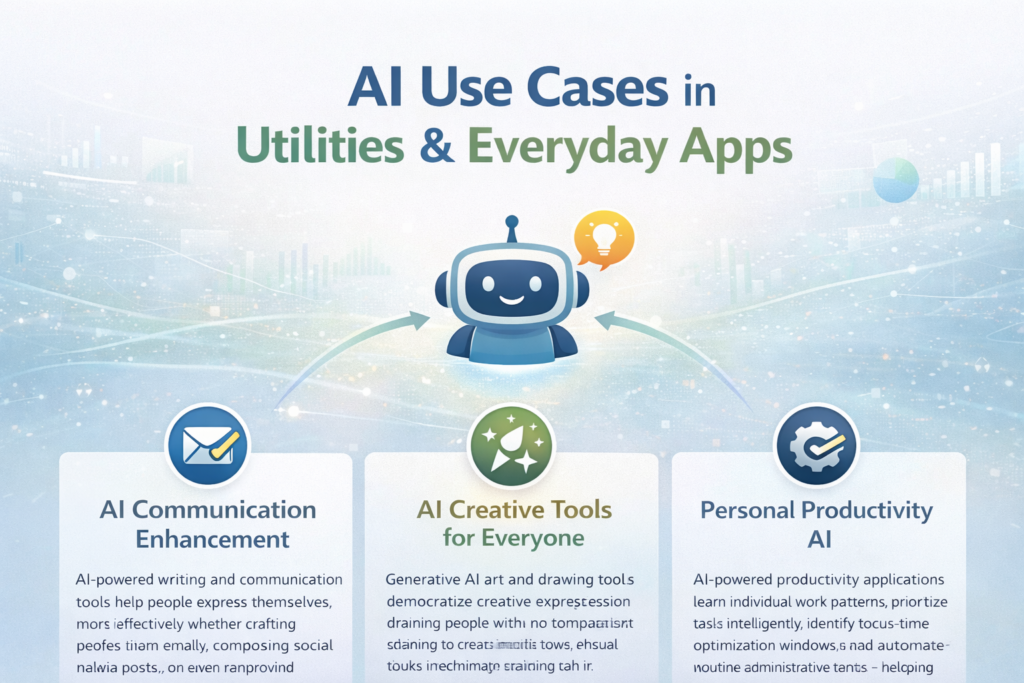
How AI Powers Everyday Utility Apps
AI Communication Enhancement
AI-powered writing and communication tools help people express themselves more effectively whether crafting professional emails, composing social media posts, or even improving personal communication in relationship contexts.
AI Creative Tools for Everyone
Generative AI art and drawing tools democratize creative expression enabling people with no formal artistic training to create remarkable visual works through AI-assisted techniques, guiding hand movements, and style suggestions.
Personal Productivity AI
AI-powered productivity applications learn individual work patterns, prioritize tasks intelligently, identify focus-time optimization windows, and automate routine administrative tasks helping people accomplish more with less effort.
| RizzPro – AI Communication & Flirt Keyboard App (iOS & Android) | DrawToo – AI AR Drawing & Sketch App (iOS & Android) |
| We developed RizzPro, an innovative AI-powered keyboard and communication enhancement app that helps users craft more engaging, confident, and effective messages. Using NLP and contextual AI, RizzPro generates smart, personalized message suggestions that help users communicate with greater confidence in social contexts. | We developed DrawToo, an innovative augmented reality AI drawing application that helps users create beautiful art regardless of their artistic skill level. DrawToo uses AI and AR technology to guide users’ drawing technique, suggest compositions, and overlay digital sketching tools on the real world making artistic creation accessible, fun, and genuinely impressive for everyone. |
| App Store: https://apps.apple.com/us/app/rizzpro-ai-flirt-keyboard/id6501976644 Play Store: https://play.google.com/store/apps/details?id=com.rizzpro.app | Play Store: https://play.google.com/store/apps/details?id=com.arthub.drawtoo App Store: https://apps.apple.com/in/app/ar-drawing-sketch-drawtoo/id6474688225 |
AI Use Cases in SaaS & Enterprise Automation
Enterprise organizations face a unique AI opportunity: the combination of vast proprietary data, complex processes, and significant operational scale means AI can deliver transformative ROI when implemented well.
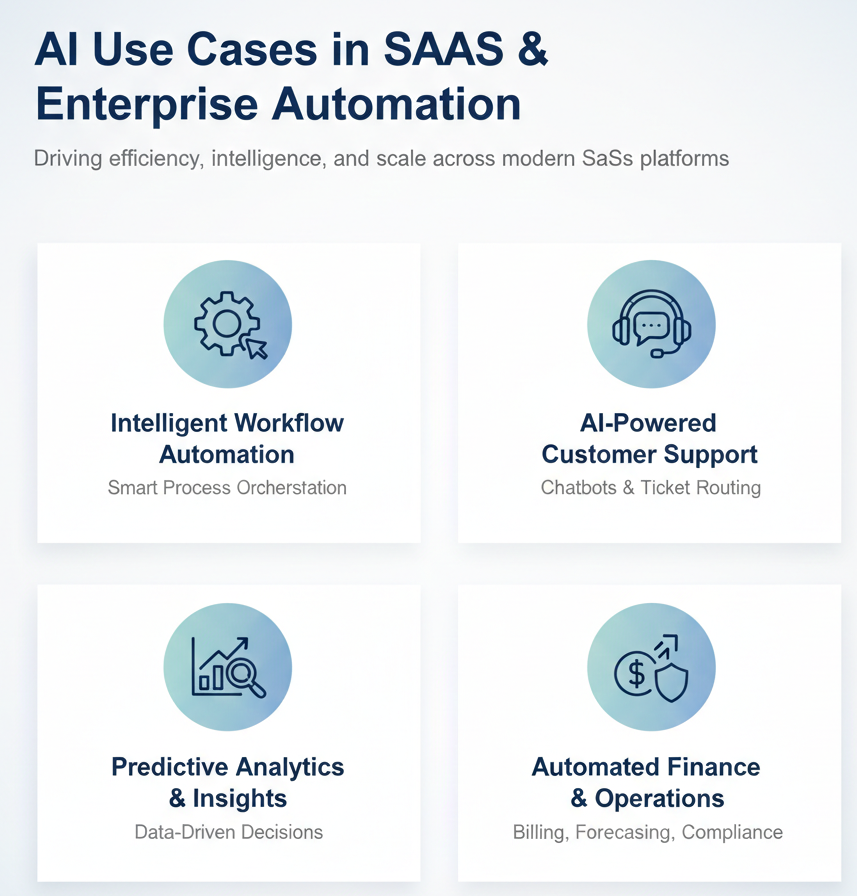
How AI Transforms SaaS & Enterprise Operations
Intelligent Process Automation
AI-powered RPA combines traditional process automation with machine learning handling not just rule-based tasks but also situations requiring judgment, exception handling, and contextual decision-making. This extends automation coverage from simple data entry to complex multi-step business processes.
AI Customer Success Management
ML models predict customer churn risk weeks before cancellation, enabling proactive outreach and retention interventions. SaaS companies using AI churn prediction reduce customer loss rates by 25–35%.
AI-Powered DevOps & Monitoring
AIOps platforms monitor application performance, infrastructure health, and deployment pipelines automatically detecting anomalies, predicting incidents before they occur, and recommending remediation actions.
Enterprise AI Assistants
Large language model-based assistants integrate with enterprise systems CRM, ERP, communication platforms to provide employees with instant access to organizational knowledge, automate information retrieval, and accelerate complex analytical tasks.
AI Security & Threat Detection
Enterprise AI security platforms analyze network traffic, user behavior, application logs, and endpoint data to detect threats in real time identifying sophisticated attacks that evade traditional rule-based security systems.
Business Benefits of AI in Enterprise
- 40–60% improvement in process efficiency through intelligent automation
- 25–35% reduction in customer churn through predictive retention
- Significant security posture improvement and incident response acceleration
- Millions in annual savings from automation of high-volume business processes
Ready to Implement AI Automation Across Your Enterprise?
We design and build enterprise-grade AI solutions customized to your processes.
Additional AI Solutions We Have Delivered
The applications highlighted throughout this guide represent only a selection of our AI portfolio. Below is a complete overview of the AI-powered products our team has designed, built, and launched spanning diverse industries and use cases.
| Application | Industry | Platform & Status |
| AI TV | Education | Android – Live |
| Pagino | Education | iOS + Android – Live |
| BookToBrain | Education | iOS – Live |
| Aprende.ai | Education | Live |
| Kshipra | Medical Education | In Development |
| FrankieDigital | Social | iOS + Android – (Pre-launch) |
| Photospot | Travel | Web + iOS + Android – Live |
| Ekaki | Travel | iOS + Android – Live |
| Stylescore | Fashion | iOS + Android – Live |
| Climapal | Fashion | iOS + Android – Live |
| SelfApp | Mental Health | iOS + Android – Live |
| CuratedFlavor | Food & Nutrition | In Development |
| CookCalAI | Food & Nutrition | QA Phase |
| Scalar Inspect | Construction | Web + iOS + Android – Live |
| RizzPro | Utility / Communication | iOS + Android – Live |
| DrawToo | Utility / Creative | iOS + Android – Live |
| Coacharena | Business / Coaching | Live |
| Purified News | News & Media | In Development |
| BVKS | Spirituality | Web + iOS + Android – Live |
Want to discuss how your business idea could become the next item on this list?
Let’s explore how your business concept can join this list. Our team brings cross-industry AI expertise to every project we build.
The Business ROI of Implementing AI
One question every business leader asks before investing in AI is: ‘What will I actually get back?’ The data is increasingly clear AI delivers some of the highest ROI of any business technology investment available today.
| AI Use Case | Typical ROI | Primary Value Driver |
| Fraud Detection (Finance) | 300–800% | Reduced fraud losses + operational savings |
| Predictive Maintenance (Mfg) | 200–500% | Eliminated unplanned downtime costs |
| AI Personalization (Retail) | 150–400% | Higher conversion + customer lifetime value |
| Intelligent Automation (Ops) | 200–600% | Labor cost reduction + error elimination |
| AI Diagnostics (Healthcare) | 180–350% | Faster diagnosis + reduced complications |
| Demand Forecasting (Supply Chain) | 150–300% | Inventory optimization + waste reduction |
| AI Customer Service (Any industry) | 200–500% | Support cost reduction + 24/7 availability |
| AI Content Personalization (Media) | 100–250% | Engagement improvement + ad revenue growth |
The organizations achieving the highest AI ROI share several characteristics: they start with a clearly defined business problem, use quality training data, involve cross-functional teams in implementation, and commit to continuous improvement rather than treating AI as a one-time deployment.
How to Get Started with AI in Your Business
The biggest barrier to AI adoption is not technology it is not knowing where to begin. Here is a practical, proven framework for getting started:
Step 1: Identify Your Highest-Value Problem Do not start with AI technology; start with a specific, measurable business problem. What is costing you the most money? What is your biggest operational bottleneck? Where are your customers most frustrated? The best AI projects solve real problems, not hypothetical ones.
Step 2: Audit Your Data AI needs data to learn from. Assess what data you currently collect, its quality, and its completeness. The quality of your AI solution will be directly proportional to the quality of your training data.
Step 3: Choose the Right AI Approach Not every problem needs deep learning. Sometimes a simple predictive model, a rule-based chatbot, or an off-the-shelf AI tool is the most appropriate solution. Work with experienced AI developers to identify the right fit.
Step 4: Start Small, Prove Value, Scale Begin with a focused pilot project that can demonstrate clear ROI within 60–90 days. Use the results to build organizational confidence and secure budget for broader AI initiatives.
Step 5: Build for Learning The best AI systems get smarter over time. Design your implementation to continuously collect feedback data, monitor performance, and retrain models; ensuring your AI investment keeps delivering increasing value.
Step 6: Partner with Experienced AI Builders AI development is a specialized skill set. Partner with a team that has delivered AI solutions across multiple industries, understands the technical complexity, and has a track record of successful deployments.
Not Sure Where to Start With AI?
Our AI consultants have guided businesses across 15+ industries. Book your free 30-minute AI strategy session today.
FAQ
These are the questions we hear most often from business leaders exploring AI answered clearly and practically.
What industries benefit most from AI?
Every industry benefits from AI, but healthcare, finance, retail, manufacturing, and logistics currently show the highest measurable ROI from AI adoption. However, education, real estate, hospitality, and entertainment are rapidly catching up as AI tools become more accessible and industry-specific solutions mature.
Is AI only for large enterprises, or can small businesses use it too?
AI is increasingly accessible to businesses of every size. Many powerful AI tools are available as affordable SaaS subscriptions. The key for small businesses is starting with one specific use case; such as AI customer service, predictive inventory, or marketing personalization and scaling from there. Our team has built AI solutions for startups and SMBs with very manageable budgets.
How long does it take to develop an AI application?
It depends entirely on complexity. A focused AI feature such as a recommendation engine or a predictive analytics dashboard can be built and deployed in 8–16 weeks. A comprehensive, multi-feature AI platform may take 6–12 months to build properly. The most important factor is clear requirements and quality data availability from the start.
What is the difference between AI, machine learning, and deep learning?
Artificial intelligence is the broad category any system that mimics human intelligence. Machine learning is a subset of AI where systems learn from data rather than explicit programming. Deep learning is a subset of machine learning that uses neural networks with many layers to process complex patterns in images, audio, and text. Most practical business AI applications today are built on machine learning techniques.
How much does it cost to build an AI application?
The cost of AI mobile app development varies widely based on complexity, features, data requirements, and platform (iOS, Android, web, or all three). A focused AI mobile app can start from $10,000–$80,000 for an MVP. Enterprise AI platforms with complex integrations and custom model training can range from $30,000 to $1M+. We offer transparent project scoping and can build phased solutions that fit realistic budgets.
Is my business data safe when implementing AI?
Data security is a top priority in any serious AI implementation. Responsible AI development includes data encryption, access controls, compliance with GDPR, HIPAA, and other relevant regulations, and clear data governance frameworks. When choosing an AI development partner, always verify their data security practices and compliance credentials.
What AI use cases are most relevant for startups?
Startups typically benefit most from AI that improves customer acquisition, reduces operational costs, and creates competitive differentiation. The most popular startup AI use cases include: AI-powered personalization, intelligent chatbots and support automation, predictive analytics, NLP content tools, and computer vision features. All of these can be implemented incrementally as a startup scales.
Can AI replace human jobs in my industry?
AI is best understood as augmenting human capabilities rather than simply replacing jobs. The most successful AI implementations free humans from repetitive, low-value tasks allowing them to focus on creative thinking, relationship building, strategic decision-making, and empathetic service. While AI does automate some job functions, it also creates new roles in AI oversight, data management, and AI-enhanced service delivery.
How do I know if my business idea is a good candidate for AI?
A business idea is a strong AI candidate if it involves large amounts of data, repetitive decision-making processes, personalization at scale, predictive challenges, or pattern recognition tasks. The best test is to ask: ‘Would having a very smart, fast human doing this task at scale solve a real business problem?’ If yes, there is likely an AI solution worth building.
Where can I see examples of successful AI applications you have built?
Throughout this guide, we have highlighted our portfolio of AI-powered applications across 15+ industries from healthcare education and travel to fashion, mental wellness, construction, and spirituality. Each application demonstrates our team’s ability to translate complex AI concepts into practical, user-friendly products. We invite you to explore the links provided and reach out to discuss how we can build something remarkable for your industry.
Conclusion – The AI Advantage Is Not Optional Anymore
We started this guide with a story about how dramatically the world has changed in just a decade. And the pace of that change is not slowing down it is accelerating.
The only question left is: what will you build?
| 15+ Industries we have built Custom AI solutions for | 19+ Custom AI-powered applications delivered | 100% Client satisfaction on delivered Custom projects | Free Initial consultation; no commitment required |
Artificial intelligence is no longer a competitive advantage reserved for the world’s largest companies. It is becoming the price of admission to compete effectively in almost every industry. The businesses that move now that choose to build AI-powered products, automate their most costly processes, and deliver the personalized experiences their customers increasingly expect will define their markets for the next decade.
The businesses that wait? They will spend those same years watching competitors widen the gap.
Whether you are building a consumer application, transforming enterprise operations, or exploring a brand-new AI product idea the opportunity is real, the technology is ready, and the ROI is proven.