Artificial intelligence in business is transforming how companies operate, automate processes, and make smarter decisions. From improving customer experience to optimizing operations and driving data-driven insights, AI is becoming a core part of modern business strategy.
Businesses across the USA, UK, Europe, and global markets are rapidly adopting AI-powered solutions to reduce costs, increase productivity, and gain a competitive advantage in today’s digital economy.
At Square Infosoft, we help startups, enterprises, and agencies build intelligent AI-powered business solutions that automate workflows, improve efficiency, and scale operations globally.
Artificial Intelligence in Business: Growth, Adoption, and Market Overview
Artificial intelligence in business is no longer a future concept. It is actively transforming how companies operate, make decisions, and scale in today’s competitive market. From startups to large enterprises, businesses are adopting AI to automate processes, improve efficiency, and gain data-driven insights.
In recent years, the rapid growth of technologies such as machine learning, natural language processing, and predictive analytics has enabled businesses to move beyond traditional systems. Companies can now analyze large amounts of data, personalize customer experiences, and optimize operations in real time.
Organizations across the USA, UK, Europe, and global markets are increasingly investing in AI-powered solutions to stay competitive and meet evolving customer expectations. Whether it is improving customer support with AI chatbots, enhancing marketing strategies through personalization, or automating internal workflows, AI is reshaping every aspect of modern business.
What is Artificial Intelligence in Business? Definition, Meaning, and Applications
Artificial intelligence in business refers to the integration of advanced computational technologies such as machine learning, natural language processing, computer vision, and predictive analytics into business processes to automate tasks, enhance decision-making, and improve operational efficiency.
Unlike traditional software systems that follow predefined rules, AI systems learn from data, identify patterns, and continuously improve their performance over time. This ability to learn and adapt makes AI fundamentally different from conventional business tools.
In a business context, artificial intelligence is not limited to automation alone. It acts as a decision-support system that enables organizations to process large volumes of data, extract meaningful insights, and take actions that are faster, more accurate, and more scalable than manual processes.
Role of Artificial Intelligence in Modern Business Operations
Artificial intelligence has evolved from being an experimental technology to becoming a core driver of digital transformation in businesses across industries. Companies are no longer using AI as an optional enhancement but as a strategic necessity to remain competitive in a rapidly changing market.
One of the most significant roles of AI in business is its ability to bridge the gap between data and decision-making. Modern organizations generate massive amounts of data every day, but without AI, much of this data remains underutilized. AI systems analyze this data in real time, helping businesses make informed decisions based on patterns, trends, and predictive insights.
In addition to decision-making, AI plays a crucial role in improving operational efficiency. Tasks that once required significant manual effort, such as data entry, customer support, and reporting, can now be automated using AI-powered systems. This allows businesses to focus more on strategic activities rather than routine operations.
Another critical aspect is customer experience. AI enables businesses to understand customer behavior at a deeper level by analyzing interactions, preferences, and feedback. This allows companies to deliver highly personalized experiences, which directly impacts customer satisfaction and retention.
How AI Works in Business: Data, Machine Learning, and Automation
To fully understand artificial intelligence in business, it is important to look at how these systems function in real-world environments.
AI systems typically operate through a combination of data collection, model training, and continuous optimization.
Initially, data is collected from various sources such as customer interactions, transactions, operational systems, and external platforms. This data is then processed and used to train machine learning models.
Once trained, these models can perform specific tasks such as predicting customer behavior, automating responses, or identifying anomalies. Over time, as more data becomes available, the system continuously improves its accuracy and performance.
This continuous learning capability is what enables AI to adapt to changing business conditions and deliver consistent value.
Core AI Technologies Used in Business (Machine Learning, NLP, Computer Vision)
Artificial intelligence in business is built on a combination of technologies that work together to deliver intelligent outcomes. Understanding these technologies helps businesses make better decisions when implementing AI solutions.
Machine Learning in Business: Use Cases and Applications
Machine learning is the foundation of most AI systems used in business. It enables systems to analyze historical data, identify patterns, and make predictions without being explicitly programmed for each scenario.
In business environments, machine learning is widely used for forecasting, recommendation systems, and customer segmentation. For example, companies use ML models to predict sales trends, identify high-value customers, and optimize pricing strategies.
Natural Language Processing in Business Automation
Natural language processing allows machines to understand, interpret, and respond to human language. This technology is essential for applications such as chatbots, virtual assistants, and automated customer support systems.
In business, NLP is used to handle customer queries, analyze feedback, and even automate internal communication processes. It enables companies to interact with customers and employees in a more natural and efficient way.
Computer Vision Applications in Business
Computer vision focuses on enabling machines to interpret visual information such as images and videos. In business applications, this technology is used for tasks such as quality control, facial recognition, and visual data analysis.
For example, in manufacturing, computer vision systems can detect defects in products, while in retail, they can analyze customer behavior within physical stores.
Predictive Analytics in Business Decision-Making
Predictive analytics combines machine learning and statistical techniques to forecast future outcomes based on historical data. This is particularly valuable for businesses that need to make strategic decisions.
Companies use predictive analytics for demand forecasting, risk assessment, and performance optimization. It allows businesses to anticipate challenges and opportunities before they occur.
Global Adoption of AI in Business Across Industries
Artificial intelligence is being adopted at a rapid pace across businesses worldwide. Organizations in the USA, UK, Europe, and other global markets are investing heavily in AI technologies to improve efficiency, reduce costs, and enhance competitiveness.
Startups are leveraging AI to build innovative products and disrupt traditional industries, while enterprises are using it to optimize large-scale operations and improve decision-making processes.
The widespread adoption of AI is driven by the increasing availability of data, advancements in computing power, and the growing need for automation in business processes. As a result, AI is becoming a standard component of modern business infrastructure rather than a specialized technology.
Real-World AI Implementation in Business
From a practical implementation standpoint, artificial intelligence in business is not just about deploying algorithms. It involves understanding business challenges, selecting the right technologies, and integrating them into existing systems in a way that delivers measurable results.
At Square Infosoft, we approach AI implementation with a focus on real-world business impact. Our solutions are designed to align with business goals, whether it is improving operational efficiency, enhancing customer experience, or enabling data-driven decision-making.
We combine machine learning, NLP, and analytics with scalable application development to create AI-powered systems that are not only technically advanced but also practical and easy to integrate into existing business workflows.
Artificial intelligence in business is not just a technological upgrade. It represents a fundamental shift in how companies operate, compete, and grow in a digital-first world.

By leveraging AI technologies, businesses can move from reactive decision-making to proactive and predictive strategies, ultimately creating more efficient, scalable, and customer-centric operations.
AI Transformation in Business: Before and After Artificial Intelligence
To understand the real impact of artificial intelligence in business, it is important to compare how businesses operated before AI adoption and how they function today with AI-powered systems.
Traditional business operations were largely dependent on manual processes, human decision-making, and limited data analysis. While these systems worked for smaller scales, they often became inefficient, error-prone, and difficult to scale as businesses grew.
With the introduction of artificial intelligence, businesses have shifted toward automation, real-time analytics, and predictive decision-making. This transformation has significantly improved efficiency, accuracy, and scalability across all business functions.

Manual Business Processes vs AI-Powered Automation
Before AI, most business processes relied heavily on manual effort. Tasks such as data entry, reporting, customer support, and operational management required significant human involvement. These processes were not only time-consuming but also prone to errors and inconsistencies.
With AI adoption, businesses can now automate these repetitive tasks using intelligent systems. Automation powered by AI goes beyond simple rule-based systems. It adapts based on data, improves over time, and handles complex workflows with minimal human intervention.
This shift allows businesses to reduce operational workload, minimize errors, and allocate human resources to more strategic and creative tasks.
Traditional Decision-Making vs AI Data-Driven Decision Systems
In traditional business environments, decision-making was often based on experience, intuition, and limited data. While this approach worked in certain scenarios, it lacked consistency and scalability.
AI has transformed decision-making by enabling businesses to rely on data-driven insights. Modern AI systems analyze large datasets in real time, identify patterns, and generate predictive insights that help organizations make informed decisions.
For example, instead of guessing customer preferences, businesses can now use AI to analyze user behavior and predict future actions. This leads to more accurate strategies and better outcomes.
Customer Experience Before AI vs AI-Powered Personalization
Before AI, businesses typically offered a one-size-fits-all approach to customer interactions. Marketing campaigns, product recommendations, and customer support were largely generic, which limited engagement and satisfaction.
AI has completely changed this dynamic by enabling hyper-personalization. Businesses can now analyze individual customer behavior, preferences, and interactions to deliver tailored experiences.
This includes personalized product recommendations, targeted marketing campaigns, and AI-powered customer support systems that provide instant and relevant responses.
As a result, businesses see higher customer satisfaction, increased engagement, and improved retention rates.
Reactive Operations vs Predictive AI Business Systems
Traditional business operations were mostly reactive. Companies would respond to issues only after they occurred, whether it was supply chain disruptions, customer complaints, or operational inefficiencies.
With AI, businesses can move toward proactive operations. Predictive analytics allows organizations to anticipate potential issues before they happen and take preventive actions.
For instance, AI can forecast demand fluctuations, detect anomalies in operations, and identify risks early. This proactive approach reduces downtime, improves efficiency, and enhances overall business performance.
Business Scalability Without AI vs AI-Driven Growth
Scaling a business without AI often requires significant investment in human resources, infrastructure, and time. As operations grow, managing complexity becomes increasingly challenging.
AI enables businesses to scale more efficiently by automating processes and handling large volumes of data without proportional increases in cost or resources.
For example, an AI-powered customer support system can handle thousands of queries simultaneously, something that would require a large team in a traditional setup.
This scalability allows businesses to expand faster and operate more efficiently in global markets.
Operational Costs Before AI vs Cost Optimization Using AI
One of the major challenges in traditional business models is high operational costs driven by manual processes and inefficiencies.
AI helps reduce these costs by automating tasks, optimizing resource allocation, and improving overall efficiency. While there is an initial investment in AI implementation, the long-term cost savings are significant.
Businesses can achieve better results with fewer resources, leading to improved profitability and sustainable growth.
Latest Trends in Artificial Intelligence in Business (2026 and Beyond)
Artificial intelligence in business is evolving at a rapid pace, driven by advancements in machine learning, data processing, and computational power. What started as basic automation has now transformed into intelligent systems capable of decision-making, content generation, and real-time optimization.
Businesses across industries are not just adopting AI but actively integrating it into their core strategies to gain a competitive advantage. Understanding current AI trends is essential for organizations that want to stay ahead in an increasingly data-driven and automated business environment.
Generative AI in Business: Content, Automation, and Innovation
One of the most significant developments in recent years is the emergence of generative AI. Unlike traditional AI systems that analyze and predict outcomes, generative AI can create new content, including text, images, code, and even business strategies.
Businesses are using generative AI for content creation, marketing automation, customer communication, and product development. For example, companies can generate personalized marketing campaigns, automate email responses, and create dynamic product descriptions at scale.
This shift is reducing dependency on manual content creation and enabling faster execution of business operations.
AI Automation in Business Processes and Operations
Automation has always been a key benefit of AI, but modern AI systems have taken automation to a new level. Businesses are now implementing intelligent automation that goes beyond rule-based workflows.
AI-powered automation can handle complex tasks such as processing customer queries, managing supply chains, and analyzing financial data. These systems learn from data and continuously improve their performance, making them more efficient over time.
This trend is particularly important for businesses looking to reduce operational costs and improve productivity without increasing workforce size.
AI Agents in Business: Autonomous Systems and Decision-Making
Another major trend is the rise of AI agents that can perform tasks autonomously with minimal human intervention. These agents are designed to understand goals, process information, and take actions based on predefined objectives.
In business environments, AI agents are used for tasks such as customer support, sales assistance, and workflow management. They can interact with users, gather information, and make decisions in real time.
This represents a shift from AI as a support tool to AI as an active participant in business operations.
Hyper-Personalization Using AI in Customer Experience
Customer expectations have changed significantly, and businesses are now required to deliver highly personalized experiences. AI enables this by analyzing customer behavior, preferences, and interactions in real time.
Companies are using AI to personalize product recommendations, marketing campaigns, pricing strategies, and customer communication. This level of personalization improves customer engagement, increases conversion rates, and enhances overall customer satisfaction.
Hyper-personalization is becoming a key differentiator for businesses in competitive markets.
AI in Business Intelligence and Data Analytics
Data is one of the most valuable assets for modern businesses, and AI is playing a crucial role in transforming how data is analyzed and used.
AI-powered analytics tools can process large datasets, identify trends, and generate actionable insights in real time. This allows businesses to move from descriptive analytics to predictive and prescriptive analytics.
Organizations can now make faster and more accurate decisions, optimize operations, and identify new opportunities based on data-driven insights.
Cloud AI and SaaS-Based AI Solutions for Businesses
The integration of AI with cloud computing and SaaS platforms is making AI more accessible to businesses of all sizes. Companies no longer need to build AI systems from scratch. Instead, they can leverage cloud-based AI services and APIs.
This trend is particularly beneficial for startups and small businesses, as it reduces the cost and complexity of AI implementation. It also enables faster deployment and scalability.
Cloud-based AI solutions are becoming a standard approach for businesses looking to adopt AI efficiently.
Responsible AI in Business: Data Privacy and Ethics
As AI adoption increases, businesses are also focusing on ethical considerations and data privacy. Responsible AI involves ensuring that AI systems are transparent, fair, and secure.
Companies are implementing measures to protect user data, prevent bias in AI models, and ensure compliance with regulations. This is especially important in industries such as finance, healthcare, and education.
Building trust in AI systems is becoming a critical factor for long-term success.
AI Adoption Trends Across Global Industries
AI adoption is no longer limited to technology companies. Businesses across industries, including healthcare, finance, retail, travel, and education, are integrating AI into their operations.
Organizations in the USA, UK, Europe, and global markets are investing heavily in AI to improve efficiency, reduce costs, and enhance customer experience.
This widespread adoption indicates that AI is becoming a foundational technology for modern businesses.
The current trends in artificial intelligence clearly indicate that AI is moving from a support function to a core business driver. Companies that align their strategies with these trends are more likely to achieve sustainable growth and maintain a competitive edge.
Businesses that fail to adapt to these changes may struggle to keep up with evolving market demands and technological advancements.
Ready to Build AI Solutions for Your Business?
Get a free consultation and discover how AI can transform your business operations, improve efficiency, and drive growth.
Get Free AI ConsultationKey Business Challenges Without Artificial Intelligence and Automation
Before the adoption of artificial intelligence in business, organizations relied heavily on manual processes, traditional software systems, and human-driven decision-making. While these approaches worked in earlier stages of business growth, they often become inefficient, costly, and difficult to scale in today’s fast-paced digital environment.
As businesses expand and data volumes increase, these traditional systems struggle to keep up with modern demands. This results in operational inefficiencies, delayed decision-making, and missed opportunities.
Understanding these challenges is essential because it highlights why AI is no longer optional but a necessity for businesses aiming to stay competitive in global markets.

Lack of Automation in Business Processes
One of the most significant challenges businesses face without AI is the lack of automation. Many organizations still depend on manual workflows for tasks such as data entry, reporting, customer support, and internal operations.
Manual processes are not only time-consuming but also prone to human error. As the volume of work increases, maintaining accuracy and consistency becomes increasingly difficult.
From an operational perspective, this leads to reduced productivity and slower execution of business activities. Financially, it increases labor costs and operational expenses. From a scalability standpoint, manual systems limit the ability of businesses to grow efficiently.
Inefficient Decision-Making Due to Limited Data Utilization
Businesses generate vast amounts of data every day, but without AI, much of this data remains underutilized. Traditional systems often lack the capability to process and analyze large datasets in real time.
As a result, decision-making is frequently based on incomplete information, assumptions, or delayed reports. This can lead to inaccurate strategies, missed opportunities, and slower response times.
The inability to leverage data effectively not only affects operational efficiency but also impacts long-term business growth and competitiveness.
Poor Customer Experience and Lack of Personalization
In today’s competitive market, customer expectations are higher than ever. Businesses that fail to deliver personalized experiences often struggle to retain customers.
Without AI, customer interactions are typically generic and not tailored to individual preferences. Marketing campaigns lack precision, customer support responses are delayed, and engagement levels remain low.
This directly impacts customer satisfaction, retention rates, and overall brand perception. In the long run, it leads to lost revenue and reduced customer loyalty.
High Operational Costs and Resource Dependency
Operating a business without AI often involves higher costs due to dependency on manual labor and inefficient processes. Tasks that could be automated require human resources, leading to increased payroll expenses and operational overhead.
Additionally, inefficiencies in processes result in wasted time and resources. Businesses may need to hire more staff to handle increasing workloads, which further increases costs.
This model becomes unsustainable as the business scales, especially in competitive global markets where cost efficiency is a key factor.
Limited Scalability and Growth Constraints
Scalability is one of the biggest challenges for businesses that do not leverage AI. As operations grow, managing increased workloads becomes more complex.
Without automation and intelligent systems, businesses struggle to maintain efficiency while expanding. Processes that work at a small scale often fail when applied to larger operations.
This limits the ability of businesses to grow quickly and compete with organizations that use AI to scale efficiently.
Delayed Response Times and Operational Inefficiencies
In a fast-moving business environment, speed is critical. Without AI, businesses often experience delays in processing information, responding to customer queries, and executing tasks.
These delays can lead to missed opportunities, reduced customer satisfaction, and lower overall performance. Inefficiencies in workflows further compound these issues, making it difficult for businesses to operate effectively.
Inability to Predict Trends and Future Outcomes
Traditional business systems are largely reactive, meaning they respond to events after they occur. Without AI-driven predictive analytics, businesses lack the ability to forecast trends and anticipate future outcomes.
This limits strategic planning and increases the risk of unexpected challenges. Businesses may struggle to adapt to market changes, leading to reduced competitiveness.
Data Management Challenges and Information Overload
As businesses grow, managing large volumes of data becomes increasingly complex. Without AI, organizing, analyzing, and extracting insights from data is a time-consuming process.
Information overload can lead to confusion, errors, and missed insights. Businesses may fail to identify critical patterns or trends that could impact their performance.
Security Risks and Fraud Detection Limitations
Without AI, detecting fraudulent activities and security threats becomes more difficult. Traditional systems often rely on predefined rules, which may not be effective against evolving threats.
AI-powered systems can identify unusual patterns and detect anomalies in real time, but without such systems, businesses remain vulnerable to risks.
This can result in financial losses, data breaches, and damage to brand reputation.
Competitive Disadvantage in a Digital-First Market
Businesses that do not adopt AI risk falling behind competitors who leverage advanced technologies. In a digital-first economy, speed, efficiency, and innovation are key differentiators.
Organizations that rely on traditional systems may struggle to compete with AI-driven companies that can operate faster, make better decisions, and deliver superior customer experiences.
The challenges outlined above clearly demonstrate that traditional business models are no longer sufficient in today’s environment. Artificial intelligence addresses these issues by enabling automation, improving decision-making, and enhancing overall efficiency.
Businesses that recognize these challenges early and invest in AI solutions are better positioned to achieve sustainable growth and maintain a competitive edge.
AI Solutions and Use Cases in Business: Real Applications and Practical Implementation
Artificial intelligence in business is not just a concept. It is actively solving real-world challenges across industries and business functions. From automating repetitive tasks to enabling advanced decision-making, AI is transforming how companies operate and grow.
Businesses today are leveraging AI solutions to improve efficiency, reduce costs, enhance customer experience, and gain a competitive advantage. The real value of AI lies in its ability to address specific business problems with scalable and intelligent solutions.
In this section, we explore how AI is applied in real business environments, the technologies behind these solutions, and the impact they create.
AI-Powered Automation for Business Processes
One of the most widely adopted applications of artificial intelligence in business is process automation. Traditional automation systems rely on fixed rules, but AI-powered automation is dynamic and adaptive.
AI systems can analyze workflows, identify inefficiencies, and automate repetitive tasks such as data entry, invoice processing, report generation, and customer interactions.
For example, businesses can use AI to automate backend operations, reducing manual effort and minimizing errors. Over time, these systems improve their performance by learning from data, making them more efficient and reliable.
From an operational perspective, automation leads to faster execution, reduced workload, and improved accuracy. Financially, it helps businesses reduce operational costs and improve profitability.
AI Chatbots and Virtual Assistants for Customer Support
Customer support is a critical area where AI is making a significant impact. AI-powered chatbots and virtual assistants use natural language processing to understand customer queries and provide instant responses.
Unlike traditional support systems, AI chatbots can handle multiple conversations simultaneously, provide 24/7 support, and continuously improve based on user interactions.
Businesses use AI chatbots to resolve common customer queries, assist with product selection, and provide real-time support. This not only improves customer satisfaction but also reduces the workload on support teams.
In addition, AI systems can analyze customer interactions to identify patterns, enabling businesses to improve their services and address recurring issues.
Personalized Customer Experience Using AI
Personalization has become a key factor in modern business success. AI enables businesses to deliver highly personalized experiences by analyzing customer behavior, preferences, and interactions.
For example, e-commerce platforms use AI to recommend products based on browsing history and purchase patterns. Similarly, businesses use AI to personalize marketing campaigns, email communication, and user experiences.
This level of personalization increases customer engagement, improves conversion rates, and enhances overall satisfaction. It also helps businesses build stronger relationships with their customers.
Predictive Analytics for Business Decision-Making
Predictive analytics is one of the most powerful applications of AI in business. By analyzing historical data, AI systems can forecast future outcomes and trends.
Businesses use predictive analytics for demand forecasting, risk assessment, customer behavior analysis, and financial planning. This allows organizations to make proactive decisions rather than reactive ones.
For example, companies can predict which customers are likely to churn and take preventive actions to retain them. Similarly, businesses can forecast demand to optimize inventory and supply chain operations.
Predictive analytics helps businesses reduce uncertainty and improve decision-making accuracy.
AI in Marketing and Sales Optimization
AI is transforming marketing and sales by enabling data-driven strategies and automation. Businesses use AI to analyze customer data, segment audiences, and optimize campaigns.
AI-powered tools can identify high-value leads, predict customer behavior, and automate marketing processes such as email campaigns and ad targeting.
In sales, AI helps teams prioritize leads, recommend actions, and improve conversion rates. It provides insights that enable sales teams to focus on the most promising opportunities.
This results in more efficient marketing efforts, higher ROI, and improved revenue generation.
AI in Financial Operations and Fraud Detection
Financial management is another area where AI provides significant value. AI systems can analyze financial data, detect anomalies, and identify potential risks.
Businesses use AI for fraud detection, expense management, and financial forecasting. AI algorithms can identify unusual patterns in transactions, helping organizations detect fraudulent activities in real time.
In addition, AI improves financial planning by providing accurate forecasts and insights. This enables businesses to manage resources more effectively and reduce financial risks.
AI in Operations and Supply Chain Optimization
AI is playing a crucial role in optimizing business operations and supply chains. By analyzing data from multiple sources, AI systems can identify inefficiencies and recommend improvements.
Businesses use AI to optimize inventory management, reduce waste, and improve logistics. Predictive models help forecast demand, enabling better planning and resource allocation.
AI also helps in monitoring operations in real time, allowing businesses to respond quickly to changes and disruptions.
This leads to improved efficiency, reduced costs, and better overall performance.
AI in Human Resources and Talent Management
Human resources is another area where AI is making a significant impact. AI systems can automate recruitment processes, analyze candidate profiles, and match them with job requirements.
Businesses use AI for resume screening, interview scheduling, and employee performance analysis. AI also helps in identifying skill gaps and recommending training programs.
This improves the efficiency of HR processes and enables organizations to make better hiring decisions.
Technology Behind AI Business Solutions
All these use cases are powered by a combination of technologies such as machine learning, natural language processing, data analytics, and cloud computing.
These technologies work together to create systems that can learn from data, adapt to changes, and deliver intelligent outcomes.
At Square Infosoft, we combine these technologies to build custom AI solutions tailored to specific business needs. Our approach focuses on practical implementation, scalability, and long-term value.
The real power of artificial intelligence in business lies in its ability to connect problems with solutions. By identifying key challenges and applying the right AI technologies, businesses can achieve significant improvements in efficiency, decision-making, and growth.
AI is not limited to large enterprises. With advancements in technology and cloud-based solutions, businesses of all sizes can leverage AI to transform their operations.
AI Use Cases in Business by Department: Marketing, Sales, HR, Finance, and Operations
Artificial intelligence in business is not limited to a single function. Its true value lies in how it transforms different departments within an organization. Each department has unique challenges, workflows, and data requirements, and AI provides tailored solutions for each of them.
By integrating AI across departments such as marketing, sales, human resources, finance, and operations, businesses can create a more connected, efficient, and data-driven ecosystem.
Understanding these department-level use cases helps organizations identify where AI can deliver the most impact and how it can be implemented effectively.
AI in Marketing: Personalization, Targeting, and Campaign Optimization
Marketing is one of the earliest adopters of artificial intelligence in business. AI enables marketers to move from generic campaigns to highly personalized and data-driven strategies.
AI systems analyze customer behavior, browsing patterns, and engagement data to create detailed customer profiles. Based on these insights, businesses can deliver personalized content, product recommendations, and targeted advertisements.
AI also helps optimize marketing campaigns by analyzing performance in real time. It can adjust targeting, budget allocation, and messaging to improve results continuously.
From a business perspective, this leads to higher engagement, improved conversion rates, and better return on investment.
AI in Sales: Lead Scoring, Forecasting, and Conversion Optimization
Sales teams benefit significantly from AI-powered tools that enhance efficiency and decision-making. One of the most valuable applications is lead scoring.
AI systems analyze customer data to identify high-potential leads based on behavior, engagement, and historical patterns. This allows sales teams to focus their efforts on prospects that are more likely to convert.
In addition, AI improves sales forecasting by analyzing past performance and market trends. This helps businesses plan better and allocate resources more effectively.
AI also supports sales teams with recommendations, insights, and automation, enabling them to close deals faster and more efficiently.
AI in Human Resources: Recruitment, Talent Management, and Employee Insights
Human resources is undergoing a major transformation with the adoption of artificial intelligence. AI simplifies and improves recruitment processes by automating tasks such as resume screening and candidate matching.
Instead of manually reviewing hundreds of applications, HR teams can use AI to identify the most suitable candidates based on skills, experience, and job requirements.
AI also plays a role in employee engagement and performance analysis. It can track employee performance, identify skill gaps, and recommend training programs.
This helps organizations build stronger teams, improve productivity, and retain talent more effectively.
AI in Finance: Fraud Detection, Risk Management, and Financial Forecasting
Finance departments rely heavily on data, making them an ideal area for AI implementation. AI systems can analyze financial transactions, detect anomalies, and identify potential risks.
One of the most critical applications is fraud detection. AI can monitor transactions in real time and flag suspicious activities based on unusual patterns.
AI also improves financial forecasting by analyzing historical data and predicting future trends. This helps businesses plan budgets, manage cash flow, and make strategic financial decisions.
In addition, AI automates routine financial tasks such as invoice processing and expense tracking, improving efficiency and accuracy.
AI in Operations: Process Optimization and Workflow Automation
Operations are at the core of any business, and AI plays a crucial role in improving efficiency and productivity in this area.
AI systems can analyze operational data to identify bottlenecks, inefficiencies, and areas for improvement. Businesses use AI to optimize workflows, manage resources, and improve overall performance.
For example, in supply chain management, AI can forecast demand, optimize inventory levels, and improve logistics planning. This reduces costs and ensures smoother operations.
AI also enables real-time monitoring of operations, allowing businesses to respond quickly to changes and disruptions.
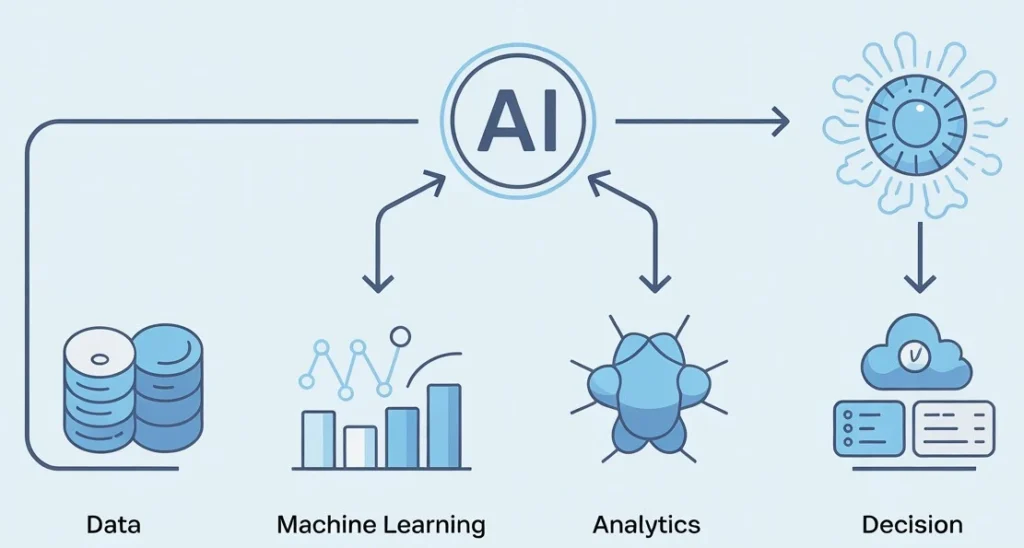
Cross-Department Integration with AI
One of the most powerful aspects of artificial intelligence in business is its ability to connect different departments through shared data and insights.
Instead of operating in silos, departments can use AI to collaborate more effectively. For example, marketing insights can inform sales strategies, while operational data can support financial planning.
This integration creates a unified business ecosystem where decisions are based on comprehensive data rather than isolated information.
Implementing AI at the department level allows businesses to achieve targeted improvements while building a foundation for organization-wide transformation.
Companies that successfully integrate AI across multiple departments gain a significant advantage in terms of efficiency, scalability, and decision-making.
Rather than treating AI as a single solution, businesses should view it as a system that enhances every part of their operations.
Have a project in mind? Let’s discuss your requirements and build a custom AI solution tailored to your business.
Contact Our AI Experts
Artificial Intelligence Across Industries: Real-World Applications and Business Impact
Artificial intelligence in business is not limited to a single industry or use case. Its true potential lies in its ability to transform multiple industries by solving unique challenges and enabling new opportunities.
From education and healthcare to travel, fitness, fashion, and construction, AI is being widely adopted to improve efficiency, enhance customer experience, and drive innovation.
Businesses that understand how AI works across different industries can identify new opportunities, adopt proven strategies, and build scalable solutions that deliver long-term value.
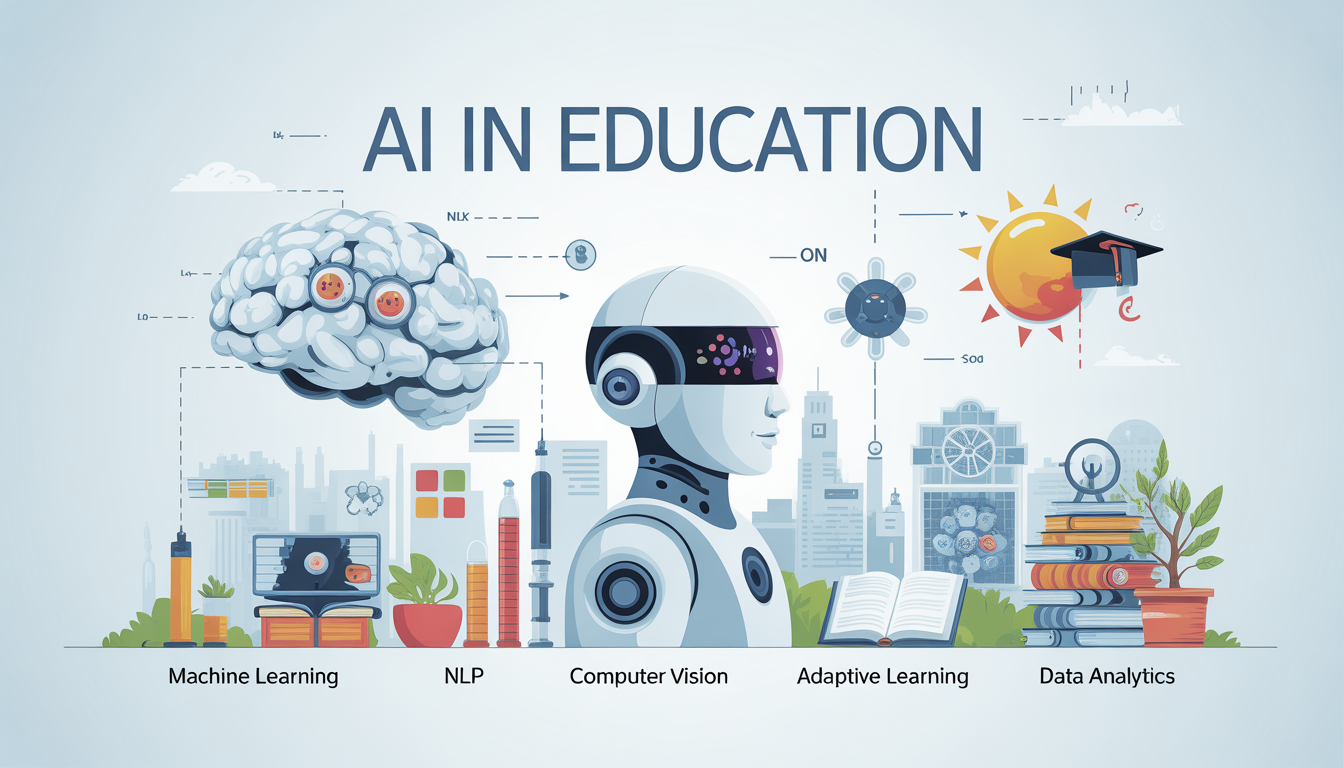
AI in Education Industry
Artificial intelligence is transforming the education sector by enabling personalized learning experiences and improving student engagement.
AI-powered platforms can analyze student performance, identify learning gaps, and provide customized learning paths. Features such as AI tutors, automated assessments, and adaptive learning systems are helping educational institutions deliver more effective and scalable solutions.
For businesses operating in the education domain, AI opens opportunities to build intelligent learning platforms, automate content delivery, and enhance user experience.
👉 Explore more: AI in Education Real Use Cases, Benefits, and Future
AI in Healthcare Industry
In the healthcare industry, artificial intelligence is improving diagnostics, patient care, and operational efficiency.
AI systems can analyze medical data, assist in disease detection, and support healthcare professionals in decision-making. Additionally, AI is used for patient monitoring, predictive analytics, and administrative automation.
For healthcare businesses, AI enables faster and more accurate services, improved patient outcomes, and reduced operational costs.
👉 Explore more: How AI is Transforming the Healthcare Industry
AI in Travel Industry
The travel industry is leveraging AI to enhance customer experience and optimize operations.
AI-powered solutions help in personalized travel recommendations, dynamic pricing, itinerary planning, and customer support through chatbots. Travel companies can also use AI to analyze user preferences and deliver customized travel experiences.
This results in higher customer satisfaction, improved engagement, and increased bookings.
👉 Explore more: 15+ AI Use Cases in Travel Industry
AI in Fitness Industry
Artificial intelligence is transforming the fitness industry by enabling personalized training programs and real-time performance tracking.
AI-powered fitness apps analyze user data to create customized workout plans, monitor progress, and provide recommendations. Features such as virtual trainers and smart tracking systems improve user engagement and motivation.
Businesses in the fitness sector can leverage AI to build innovative solutions that enhance user experience and retention.
👉 Explore more: How AI is Transforming the Fitness Industry
AI in Fashion Industry
In the fashion industry, AI is being used for personalization, trend forecasting, and inventory management.
AI systems analyze customer preferences, browsing behavior, and purchase patterns to recommend products and predict trends. Businesses can also optimize inventory and supply chain operations using AI-driven insights.
This helps fashion brands improve customer experience, reduce waste, and increase sales.
👉 Explore more: AI In Fashion Industry 12 Biggest Challenges
AI in Construction Industry
Artificial intelligence is playing a key role in improving efficiency and safety in the construction industry.
AI systems are used for project planning, risk analysis, resource management, and site monitoring. By analyzing data from various sources, AI helps construction companies make better decisions and reduce project delays.
This leads to improved productivity, reduced costs, and enhanced project outcomes.
👉 Explore more: AI In Construction Applications, Use Cases & Technologies
Comprehensive AI Use Cases Across Industries
While each industry has unique applications, many AI use cases are common across sectors, such as automation, data analytics, personalization, and predictive modeling.
Businesses looking to implement AI can benefit from understanding these cross-industry use cases and adapting them to their specific needs.
👉 Explore all use cases: AI Use Cases Across Industries Guide
Artificial intelligence is not limited by industry boundaries. The same technologies can be adapted and applied in different contexts to solve a wide range of business challenges.
Companies that explore AI applications across industries gain a broader perspective and can implement more innovative and effective solutions.
By leveraging cross-industry insights, businesses can accelerate their AI adoption journey and achieve better results.
Benefits of Artificial Intelligence in Business: Efficiency, Growth, and Competitive Advantage
Artificial intelligence in business is not just about adopting new technology. It is about creating measurable improvements in how businesses operate, compete, and grow. The benefits of AI go beyond automation and extend into areas such as decision-making, customer experience, cost optimization, and scalability.
Organizations that successfully implement AI solutions experience a significant transformation in their operations. These benefits are not limited to large enterprises. Startups, small businesses, and growing companies can also leverage AI to achieve better outcomes and improve overall performance.
Improved Operational Efficiency and Productivity
One of the most immediate benefits of artificial intelligence in business is improved operational efficiency. AI systems can automate repetitive and time-consuming tasks, allowing employees to focus on more strategic activities.
For example, tasks such as data entry, report generation, and customer query handling can be automated using AI-powered systems. This reduces manual workload and minimizes errors.
From a productivity perspective, businesses can achieve more with fewer resources. Teams can focus on innovation, problem-solving, and growth-oriented activities instead of routine operations.
Data-Driven Decision Making
Modern businesses generate large volumes of data, but without AI, this data often remains underutilized. Artificial intelligence enables organizations to analyze data in real time and extract meaningful insights.
AI systems can identify patterns, trends, and correlations that are not easily visible through traditional analysis. This allows businesses to make informed decisions based on data rather than assumptions.
Data-driven decision-making improves accuracy, reduces risks, and enables businesses to respond quickly to changing market conditions.
Enhanced Customer Experience and Personalization
Customer experience has become a key factor in business success, and AI plays a crucial role in improving it. AI enables businesses to understand customer behavior, preferences, and needs at a deeper level.
By analyzing customer data, businesses can deliver personalized experiences such as product recommendations, targeted marketing campaigns, and customized communication.
AI-powered chatbots and virtual assistants also improve customer support by providing instant responses and resolving queries efficiently.
This leads to higher customer satisfaction, increased engagement, and improved retention rates.
Cost Reduction and Resource Optimization
Cost efficiency is a major concern for businesses, and AI provides effective solutions to reduce operational expenses. By automating processes and optimizing resource allocation, businesses can significantly lower their costs.
AI systems reduce the need for manual labor in repetitive tasks, leading to lower staffing costs. They also improve efficiency in areas such as inventory management, supply chain operations, and energy usage.
Over time, these cost savings contribute to higher profitability and better financial performance.
Scalability and Business Growth
Artificial intelligence enables businesses to scale their operations without a proportional increase in resources. Traditional systems often struggle to handle increased workloads, but AI-powered systems can manage large volumes of data and processes efficiently.
For example, an AI-powered customer support system can handle thousands of queries simultaneously, allowing businesses to serve a larger customer base without expanding their support team.
This scalability is essential for businesses that aim to grow rapidly and expand into new markets.
Faster Decision-Making and Real-Time Insights
Speed is a critical factor in today’s business environment. AI enables businesses to process data and generate insights in real time, allowing for faster decision-making.
Instead of waiting for reports and manual analysis, businesses can access real-time dashboards and predictive insights that help them take immediate action.
This improves responsiveness, reduces delays, and enhances overall business performance.
Competitive Advantage in a Digital Market
Businesses that adopt artificial intelligence gain a significant competitive advantage over those that rely on traditional systems. AI enables companies to operate more efficiently, make better decisions, and deliver superior customer experiences.
In competitive markets, these advantages can make a substantial difference in market positioning and growth.
Organizations that invest in AI early are better positioned to adapt to future changes and maintain their leadership in the industry.
Innovation and New Business Opportunities
AI is not only about improving existing processes but also about enabling innovation. Businesses can use AI to develop new products, services, and business models.
For example, AI can be used to create intelligent applications, automate complex workflows, and provide advanced analytics services.
This opens up new opportunities for revenue generation and business expansion.
The benefits of artificial intelligence in business are interconnected. Improvements in efficiency, decision-making, and customer experience collectively contribute to overall business growth and success.
Companies that view AI as a strategic investment rather than a technical upgrade are more likely to achieve long-term value and sustainable growth.
Return on Investment (ROI) of Artificial Intelligence in Business: Cost Savings, Revenue Growth, and Efficiency
For most businesses, adopting artificial intelligence is not just a technological decision. It is a financial and strategic investment. Understanding the return on investment (ROI) of AI in business is essential for evaluating its real value and long-term impact.
While AI implementation requires an initial investment in technology, development, and integration, the benefits it delivers in terms of cost reduction, productivity improvement, and revenue growth often outweigh these costs.
Businesses that approach AI with a clear strategy and measurable goals are more likely to achieve strong ROI and sustainable growth.
Cost Reduction Through Automation and Efficiency
One of the most immediate and measurable returns from artificial intelligence in business is cost reduction. AI systems automate repetitive and labor-intensive tasks, reducing the need for manual intervention.
For example, businesses can automate customer support, data processing, and administrative workflows using AI. This reduces staffing requirements and minimizes human errors.
In addition, AI improves operational efficiency by optimizing resource allocation, reducing waste, and streamlining processes. Over time, these improvements lead to significant cost savings.
Increased Revenue Through Better Decision-Making
AI enables businesses to make more accurate and data-driven decisions, which directly impacts revenue generation.
By analyzing customer behavior, market trends, and historical data, AI systems can identify opportunities for growth and optimization. Businesses can use these insights to improve pricing strategies, target the right audience, and optimize sales processes.
For example, AI can help identify high-value customers, predict purchasing behavior, and recommend personalized offers. This leads to higher conversion rates and increased revenue.
Improved Productivity and Workforce Efficiency
AI significantly improves productivity by automating routine tasks and supporting employees with intelligent insights.
Instead of spending time on repetitive activities, employees can focus on strategic and creative tasks that add more value to the business.
AI-powered tools also provide recommendations and insights that help employees perform their roles more effectively. This leads to higher efficiency, better performance, and improved overall output.
Faster Time-to-Market and Business Agility
In competitive markets, speed is critical. AI helps businesses accelerate processes and reduce time-to-market for products and services.
For example, AI can automate product development processes, analyze market data, and optimize supply chains. This allows businesses to respond quickly to market changes and customer demands.
Faster execution not only improves competitiveness but also enables businesses to capture opportunities more effectively.
Risk Reduction and Improved Accuracy
AI systems improve accuracy and reduce risks by analyzing data and identifying potential issues before they occur.
For instance, AI can detect anomalies in financial transactions, identify operational inefficiencies, and predict potential failures. This helps businesses take preventive actions and avoid costly mistakes.
Improved accuracy also enhances decision-making, leading to better outcomes and reduced uncertainty.
Long-Term Value and Scalability
The ROI of artificial intelligence is not limited to short-term gains. AI provides long-term value by enabling businesses to scale efficiently and adapt to changing market conditions.
As AI systems learn and improve over time, their effectiveness increases. Businesses can leverage these systems to handle larger workloads, expand into new markets, and support growth without significant additional costs.
This scalability is a key factor in achieving sustainable ROI.
Measuring ROI of AI in Business
To fully understand the impact of AI, businesses need to measure ROI using clear metrics. Some of the key metrics include:
- Reduction in operational costs
- Increase in revenue and conversion rates
- Improvement in productivity and efficiency
- Customer satisfaction and retention rates
- Time saved in business processes
By tracking these metrics, businesses can evaluate the effectiveness of their AI initiatives and make informed decisions about future investments.
The return on investment of artificial intelligence in business depends on how effectively it is implemented and aligned with business goals.
Companies that focus on solving real problems, integrating AI into their workflows, and continuously optimizing their systems are more likely to achieve strong ROI.
AI should not be viewed as an expense but as a strategic investment that drives long-term growth, efficiency, and competitiveness.
Want to Know the Cost of AI for Your Business?
Get a quick estimate and expert guidance on how AI can be implemented in your business based on your specific requirements.
Get AI Cost EstimationHow to Implement Artificial Intelligence in Business: Step-by-Step Strategy and Process
Implementing artificial intelligence in business is not just about adopting new technology. It requires a clear strategy, proper planning, and alignment with business goals. Many organizations fail to achieve the desired results from AI because they approach it without a structured implementation plan.
A successful AI implementation focuses on identifying real business problems, selecting the right technologies, and integrating solutions into existing workflows in a scalable and sustainable way.
Understanding the step-by-step process of implementing AI helps businesses reduce risks, optimize investment, and achieve measurable outcomes.
Step 1: Identify Business Problems and Opportunities
The first step in implementing artificial intelligence is to clearly define the business problems that need to be solved. AI should not be implemented for the sake of technology but to address specific challenges.
Businesses need to analyze their current processes and identify areas where inefficiencies exist. This could include repetitive tasks, slow decision-making, poor customer experience, or operational bottlenecks.
By focusing on real problems, organizations can ensure that AI solutions deliver tangible value rather than becoming unnecessary investments.
Step 2: Define Objectives and Success Metrics
Once the problems are identified, the next step is to define clear objectives and success metrics. Businesses need to determine what they want to achieve with AI implementation.
For example, objectives may include reducing operational costs, improving customer satisfaction, increasing sales conversions, or enhancing productivity.
Defining measurable metrics such as time saved, cost reduction, or revenue growth helps businesses evaluate the effectiveness of their AI initiatives.
Step 3: Data Collection and Preparation
Data is the foundation of artificial intelligence. Without high-quality data, AI systems cannot function effectively.
Businesses need to collect relevant data from various sources such as customer interactions, transactions, operational systems, and external platforms. This data must then be cleaned, organized, and prepared for analysis.
Data preparation is a critical step because inaccurate or incomplete data can lead to poor model performance and incorrect insights.
Step 4: Choose the Right AI Technologies and Models
Selecting the appropriate AI technologies is essential for successful implementation. Different business problems require different approaches.
For example, machine learning models are used for prediction and forecasting, natural language processing is used for text-based applications, and computer vision is used for image analysis.
Businesses need to evaluate their requirements and choose technologies that align with their objectives and available data.
Step 5: Develop and Train AI Models
Once the technology is selected, the next step is to develop and train AI models. This involves feeding the prepared data into the system and allowing it to learn patterns and relationships.
During this phase, models are tested and optimized to improve accuracy and performance. Businesses may need to iterate multiple times to achieve the desired results.
This stage requires technical expertise and a clear understanding of both AI and business requirements.
Step 6: Integration with Existing Systems
AI solutions need to be integrated into existing business systems and workflows. This includes connecting AI models with applications, databases, and operational tools.
Seamless integration ensures that AI systems can function effectively within the business environment and deliver real-time insights and automation.
Businesses must ensure that integration does not disrupt existing operations and that systems remain stable and secure.
Step 7: Deployment and Implementation
After development and integration, the AI solution is deployed into the production environment. This is where the system starts delivering real value.
During deployment, businesses need to monitor system performance and ensure that it operates as expected. Initial adjustments may be required to optimize performance.
Proper deployment planning helps minimize risks and ensures a smooth transition.
Step 8: Continuous Monitoring and Optimization
AI implementation is not a one-time process. Systems need to be continuously monitored and updated to maintain performance and accuracy.
As new data becomes available, models can be retrained and improved. Businesses should regularly evaluate the effectiveness of their AI solutions and make necessary adjustments.
Continuous optimization ensures that AI systems remain relevant and deliver long-term value.
Common Challenges in AI Implementation
While implementing artificial intelligence in business offers significant benefits, it also comes with challenges. These include:
- Lack of quality data
- Integration complexity
- High initial investment
- Resistance to change within organizations
- Skill gaps and technical expertise
Understanding these challenges helps businesses prepare better and avoid common pitfalls.
Best Practices for Successful AI Implementation
To maximize the success of AI initiatives, businesses should follow best practices such as:
- Start with small, high-impact use cases
- Focus on solving real business problems
- Invest in data quality and management
- Ensure collaboration between technical and business teams
- Continuously monitor and improve AI systems
These practices help businesses achieve better results and reduce risks.
Implementing artificial intelligence in business is a journey rather than a one-time project. Organizations that take a structured and strategic approach are more likely to achieve successful outcomes.
By aligning AI initiatives with business goals and continuously optimizing systems, companies can unlock the full potential of artificial intelligence and drive long-term growth.
Challenges of Implementing Artificial Intelligence in Business and How to Overcome Them
While artificial intelligence in business offers significant benefits, implementing AI is not without challenges. Many organizations face difficulties during the adoption process due to technical, operational, and organizational factors.
Understanding these challenges is essential for businesses that want to implement AI successfully. By identifying potential obstacles in advance, organizations can plan better, reduce risks, and ensure smoother implementation.
This section provides a realistic view of the challenges involved in AI adoption and how businesses can overcome them effectively.
Data Quality and Availability Issues
Artificial intelligence systems rely heavily on data. The quality, accuracy, and availability of data directly impact the performance of AI models.
Many businesses struggle with fragmented, incomplete, or inconsistent data stored across multiple systems. Without proper data management, AI systems may produce inaccurate results or fail to deliver meaningful insights.
To overcome this challenge, businesses need to invest in data collection, cleaning, and management processes. Establishing a centralized data system and ensuring data consistency are critical steps in building effective AI solutions.
High Initial Investment and Cost Concerns
One of the most common concerns for businesses is the cost of implementing AI. Developing and integrating AI systems requires investment in technology, infrastructure, and skilled professionals.
For small and medium-sized businesses, this initial cost can be a barrier. However, it is important to view AI as a long-term investment rather than a short-term expense.
Businesses can start with smaller, high-impact use cases and gradually scale their AI initiatives. Leveraging cloud-based AI solutions can also reduce upfront costs and make implementation more accessible.
Integration Complexity with Existing Systems
Integrating AI solutions with existing business systems can be complex. Many organizations use legacy systems that are not designed to support advanced technologies.
This can lead to compatibility issues, data silos, and disruptions in workflows. Without proper integration, AI systems may not function effectively within the business environment.
To address this challenge, businesses need to adopt a structured integration approach. This includes evaluating existing systems, using APIs for connectivity, and ensuring seamless data flow across platforms.
Lack of Skilled Talent and Expertise
Implementing artificial intelligence requires specialized skills in areas such as machine learning, data science, and software development.
Many businesses face challenges in finding and retaining skilled professionals with the necessary expertise. This skill gap can slow down implementation and affect the quality of AI solutions.
To overcome this issue, organizations can collaborate with experienced AI development partners, invest in employee training, and build cross-functional teams that combine technical and business expertise.
Resistance to Change Within Organizations
Adopting AI often requires changes in workflows, processes, and organizational culture. Employees may resist these changes due to fear of job displacement or lack of understanding.
This resistance can hinder the successful implementation of AI solutions and reduce their effectiveness.
Businesses need to focus on change management by educating employees about the benefits of AI, providing training, and involving teams in the implementation process. Building a culture that embraces innovation is essential for successful AI adoption.
Data Privacy and Security Concerns
As businesses collect and analyze large amounts of data, concerns about data privacy and security become more significant.
Organizations must ensure that their AI systems comply with data protection regulations and safeguard sensitive information.
Failure to address these concerns can lead to legal issues, financial penalties, and loss of customer trust.
Implementing strong security measures, encryption, and compliance frameworks helps businesses mitigate these risks and build trust with users.
Model Accuracy and Reliability Challenges
AI models are not perfect and may produce inaccurate or biased results if not properly trained and monitored.
Issues such as overfitting, bias in data, and lack of transparency can affect the reliability of AI systems.
Businesses need to continuously monitor model performance, validate results, and update models with new data. Ensuring transparency and accountability in AI systems is also important for building trust.
Scalability and Maintenance Issues
Once AI systems are implemented, maintaining and scaling them can be challenging. As business requirements evolve, AI systems need to be updated and optimized.
Without proper maintenance, systems may become outdated and less effective over time.
Businesses should plan for long-term scalability by designing flexible architectures and allocating resources for ongoing maintenance and improvement.
The challenges of implementing artificial intelligence in business are real, but they are not barriers. They are opportunities for businesses to build stronger systems, improve processes, and develop better strategies.
Organizations that proactively address these challenges and adopt a structured approach to AI implementation are more likely to achieve successful outcomes.
Partnering with experienced AI development teams and focusing on long-term value can significantly improve the success rate of AI initiatives.
Facing These Business Challenges?
Let our AI experts analyze your current processes and recommend the right AI solutions to improve efficiency, reduce operational costs, and accelerate business growth.
Get AI Solution for Your BusinessCost of Artificial Intelligence in Business: Pricing, Factors, and Investment Breakdown
One of the most common questions businesses ask before adopting artificial intelligence is about the cost. While AI offers significant long-term benefits, understanding the investment required is essential for planning and decision-making.
The cost of implementing artificial intelligence in business can vary widely depending on factors such as the complexity of the solution, the technologies used, data requirements, and integration needs.
Rather than viewing AI as a fixed expense, businesses should consider it as a strategic investment that delivers long-term value through cost savings, efficiency improvements, and revenue growth.
Key Factors That Influence AI Development Cost
The cost of AI implementation is not standard because every business has different requirements. Several factors determine the overall investment needed for AI solutions.
Complexity of the AI Solution
The complexity of the solution is one of the primary factors affecting cost. Simple automation systems or chatbot solutions are generally less expensive compared to advanced systems that involve predictive analytics, computer vision, or large-scale machine learning models.
More complex solutions require additional development time, advanced algorithms, and specialized expertise, which increases the overall cost.
Data Availability and Preparation
Data plays a crucial role in AI implementation. Businesses that already have structured and high-quality data can reduce development time and costs.
However, if data needs to be collected, cleaned, and organized, it adds to the overall cost. Data preparation is often one of the most time-consuming stages of AI development.
Technology Stack and Infrastructure
The choice of technology and infrastructure also impacts the cost. AI solutions may require cloud services, data storage systems, APIs, and computing resources.
Cloud-based solutions can reduce upfront costs, while custom infrastructure may require higher initial investment but offer more control and scalability.
Integration with Existing Systems
Integrating AI with existing business systems can be complex and may require additional development effort.
Businesses with legacy systems may face higher integration costs compared to those with modern, flexible architectures.
Seamless integration is essential to ensure that AI solutions work effectively within the existing workflow.
Development Team and Expertise
The cost of AI development also depends on the expertise of the team involved. Skilled AI developers, data scientists, and engineers are essential for building effective solutions.
Working with an experienced development partner can ensure quality and efficiency, but it may also influence the overall cost.
Estimated Cost Ranges for AI Solutions
While exact costs vary, businesses can consider general ranges based on the type of AI solution.
- Basic AI solutions such as chatbots or simple automation tools may require a lower investment and can be implemented relatively quickly.
- Mid-level AI applications such as recommendation systems, analytics platforms, or workflow automation tools require moderate investment and development time.
- Advanced AI systems involving predictive analytics, computer vision, or large-scale automation require higher investment due to their complexity and technical requirements.
These ranges are indicative and depend on specific business needs.
Cost vs Value: Understanding Long-Term ROI
When evaluating the cost of artificial intelligence in business, it is important to consider the long-term value rather than just the initial investment.
AI solutions deliver value through:
- Reduction in operational costs
- Increased productivity and efficiency
- Improved customer experience
- Higher revenue and conversion rates
Over time, these benefits often exceed the initial cost, making AI a profitable investment.
How to Optimize AI Implementation Costs
Businesses can adopt several strategies to manage and optimize AI costs effectively.
Starting with small, high-impact use cases allows organizations to achieve quick results and validate the value of AI before scaling.
Using cloud-based AI services can reduce infrastructure costs and simplify deployment.
Partnering with experienced development teams helps avoid costly mistakes and ensures efficient implementation.
Focusing on data quality and clear objectives also reduces unnecessary development efforts and improves outcomes.
The cost of artificial intelligence in business should not be viewed as a barrier but as an investment in future growth and competitiveness.
Organizations that take a strategic approach to AI implementation, focusing on value and long-term benefits, are more likely to achieve strong returns and sustainable success.
Understanding the factors that influence cost helps businesses plan effectively and make informed decisions.
AI Case Studies in Business: Real-World Applications and Implementation Examples
Understanding artificial intelligence in business becomes more meaningful when we look at real-world implementations. While concepts and use cases provide a theoretical understanding, case studies demonstrate how AI solutions are applied in practical business scenarios.
Real case studies help businesses understand how specific challenges can be solved using AI, what features are required, and how these solutions deliver measurable outcomes.
At Square Infosoft, we focus on building AI-powered applications that solve real business problems. Below are examples of how AI has been implemented in different business environments.
Case Study 1: AI-Powered Personalized Learning and Business Automation Platform
Problem
In many digital learning and business platforms, users struggle with lack of personalization, inefficient study or workflow planning, and limited engagement. Traditional systems fail to adapt to individual user behavior, leading to poor user retention and lower performance.
From a business perspective, this results in reduced user engagement, lower conversion rates, and limited scalability.
Solution
We developed an AI-powered platform that combines personalized learning with intelligent automation. The system uses machine learning and natural language processing to understand user behavior and deliver customized experiences.
The platform includes an AI copilot that interacts with users through text and voice, helping them solve queries, generate content, and improve productivity.
Key Features
The solution includes advanced features designed to enhance both user experience and business performance.
Users can interact with an AI tutor that answers questions, generates flashcards, and provides explanations in real time. The system also supports voice input, making interaction more natural and efficient.
An intelligent study and workflow planner creates personalized schedules based on user goals, performance, and behavior. This helps users stay organized and improve productivity.
The platform includes AI-powered note scanning and analysis. Users can upload images, and the system extracts text, identifies gaps, and suggests improvements.
A spaced repetition system ensures that users review content at optimal intervals, improving retention and engagement.
Gamification features such as streaks, rewards, and leaderboards increase user motivation and retention.
Business Impact
This AI-powered solution significantly improves user engagement and retention by delivering personalized experiences.
From a business perspective, the platform increases user activity, improves conversion rates, and enables scalable growth. Automation reduces operational workload, allowing businesses to manage larger user bases efficiently.
Case Study 2: AI-Based Content Processing and Knowledge Management System
Problem
Businesses that rely on content such as lectures, training materials, and knowledge resources often face challenges in organizing, summarizing, and extracting insights from large volumes of data.
Manual processing of content is time-consuming and inefficient, leading to delays and reduced productivity.
Solution
We developed an AI-driven content processing system that automates transcription, summarization, and knowledge extraction.
The system allows users to record or upload content, which is then processed using AI to generate transcripts, summaries, and structured insights.
Key Features
The platform includes automated transcription that converts audio into text with high accuracy.
AI-powered summarization extracts key points from content, making it easier for users to understand and retain information.
The system generates flashcards and structured notes, helping users organize knowledge effectively.
Users can store and manage content in a centralized library, improving accessibility and usability.
Business Impact
This solution reduces manual effort and improves productivity by automating content processing.
Businesses can deliver content more efficiently, improve user experience, and scale their operations without increasing workload.
Case Study 3: AI-Powered Medical Education and Mentorship Platform
Problem
In the medical education sector, students often struggle with accessing structured content, personalized guidance, and mentorship. Traditional systems lack interactivity and personalization, leading to lower engagement.
Additionally, managing mentorship and scheduling sessions manually creates operational challenges.
Solution
We developed an AI-powered medical education platform that combines content delivery, flashcards, and mentorship management.
The system integrates AI-driven features with a structured learning environment to improve student engagement and learning outcomes.
Key Features
The platform provides topic-based notes and flashcards with structured learning paths.
AI helps track user progress and performance, allowing for better learning insights.
Mentorship features enable students to connect with experts, schedule sessions, and manage bookings seamlessly.
The system includes subscription management and content access control, supporting both free and premium models.
Security features ensure content protection and prevent unauthorized usage.
Business Impact
This solution improves student engagement and learning outcomes while enabling scalable platform growth.
From a business perspective, it creates new revenue opportunities through subscriptions and mentorship services.
Automation reduces administrative workload, allowing businesses to focus on growth and innovation.
These case studies demonstrate that artificial intelligence in business is not limited to theory. It delivers real, measurable results when applied to solve specific challenges.
By combining AI technologies with practical business needs, organizations can build solutions that are scalable, efficient, and user-focused.
Businesses that invest in real-world AI implementation gain a strong competitive advantage and position themselves for long-term success.
Artificial Intelligence Development Services for Business: Custom AI Solutions for Startups, Enterprises, and Agencies
Artificial intelligence in business delivers real value only when it is implemented correctly with the right strategy, technology, and execution. While many organizations understand the potential of AI, they often face challenges in building and integrating solutions that align with their business goals.
At Square Infosoft, we provide end-to-end AI development services designed to help businesses across industries adopt artificial intelligence effectively. Our approach focuses on understanding business requirements, building scalable solutions, and delivering measurable outcomes.
We work with startups, enterprises, and agencies globally to develop AI-powered applications that improve efficiency, automate operations, and drive growth.
Custom AI Development Services for Business
Every business has unique requirements, and a one-size-fits-all approach does not work for AI implementation. We develop custom AI solutions tailored to specific business needs.
Our AI development services include building intelligent systems for automation, predictive analytics, recommendation engines, and decision-making platforms.
We focus on creating solutions that are scalable, secure, and aligned with business objectives, ensuring long-term value and performance.
AI-Powered Mobile and Web App Development
As a mobile and web app development company, we specialize in integrating artificial intelligence into applications that deliver real business impact.
We develop AI-powered mobile applications for Android app development and iOS app development platforms, as well as web applications development that leverage machine learning and data analytics.
These applications include features such as intelligent recommendations, automation workflows, real-time analytics, and personalized user experiences.
Our expertise in Flutter app development, native app development, web development and backend development systems allows us to build high-performance applications that scale with business growth.
Machine Learning and Data Analytics Solutions
Machine learning is at the core of most AI systems, and we provide advanced ML development services to help businesses leverage their data effectively.
We build machine learning models for forecasting, customer segmentation, risk analysis, and predictive insights. Our solutions enable businesses to make data-driven decisions and improve operational efficiency.
We also develop analytics platforms that provide real-time insights, helping organizations monitor performance and optimize strategies.
AI Automation Solutions for Business Processes
Automation is one of the most valuable applications of artificial intelligence in business. We develop AI-powered automation systems that streamline workflows and reduce manual effort.
Our automation solutions include process automation, document processing, chatbot integration, and workflow optimization.
These systems help businesses improve productivity, reduce errors, and lower operational costs.
Industry-Specific AI Solutions
We provide AI development services across multiple industries, helping businesses build solutions tailored to their domain.
Our experience includes:
- Education platforms with AI-powered learning systems
- Healthcare applications for data analysis and patient management
- Travel applications with personalized recommendations
- Fitness platforms with intelligent tracking and engagement features
- Fashion platforms with recommendation systems and trend analysis
- Construction solutions for planning and optimization
By understanding industry-specific challenges, we build solutions that deliver real value.
Technology Stack and Development Expertise
We use modern technologies and frameworks to build scalable and efficient AI solutions.
Our expertise includes:
- Machine learning and predictive analytics
- Natural language processing for chatbots and automation
- Backend development and API integration
- Cloud platforms such as AWS and Google Cloud
- Mobile app development using Flutter, iOS, and Android
Our development approach ensures that solutions are reliable, scalable, and future-ready.
End-to-End AI Development Process
We follow a structured development process to ensure successful implementation of AI solutions.
Our process includes:
- Understanding business requirements
- Identifying use cases and opportunities
- Designing system architecture
- Developing and training AI models
- Integrating with existing systems
- Testing and deployment
- Continuous monitoring and optimization
This approach ensures that our solutions deliver measurable results and long-term value.
Why Choose Square Infosoft for AI Development
Choosing the right development partner is critical for the success of AI projects. At Square Infosoft, we combine technical expertise with business understanding to deliver solutions that work in real-world environments.
We focus on:
- Building scalable and high-performance systems
- Delivering custom solutions tailored to business needs
- Ensuring seamless integration with existing workflows
- Providing continuous support and optimization
Our goal is to help businesses successfully adopt artificial intelligence and achieve sustainable growth.
Future of Artificial Intelligence in Business: Trends, Opportunities, and What to Expect by 2030
Artificial intelligence in business is evolving rapidly, and its impact is expected to grow significantly over the next few years. What we see today is just the beginning of a much larger transformation that will redefine how businesses operate, compete, and innovate.
As technology continues to advance, AI will become more intelligent, accessible, and deeply integrated into everyday business processes. Organizations that prepare for this shift early will be better positioned to lead in their industries and adapt to changing market demands.
Understanding the future of AI in business helps companies make strategic decisions and invest in technologies that will drive long-term success.

AI Becoming a Core Business Infrastructure
In the coming years, artificial intelligence will move from being an optional tool to becoming a core part of business infrastructure. Just as cloud computing and the internet are essential today, AI will become a standard component of business systems.
Organizations will integrate AI into every layer of their operations, from customer interactions to backend processes. This shift will enable businesses to operate more efficiently, make faster decisions, and deliver better experiences.
Companies that fail to adopt AI at this level may struggle to compete in an increasingly automated and data-driven environment.
Rise of AI Agents and Autonomous Business Systems
One of the most significant developments in the future of AI is the rise of AI agents. These systems are designed to perform tasks independently, make decisions, and adapt to changing conditions.
In business environments, AI agents will handle tasks such as customer support, workflow management, sales assistance, and operational decision-making. They will interact with users, analyze data, and execute actions without constant human intervention.
This shift will reduce the need for manual processes and enable businesses to operate with greater efficiency and scalability.
Hyper-Personalization at Scale
Customer expectations are continuously evolving, and personalization will become even more important in the future. AI will enable businesses to deliver highly personalized experiences at scale.
By analyzing real-time data, AI systems will understand individual customer preferences and behaviors, allowing businesses to provide tailored recommendations, content, and services.
This level of personalization will improve customer satisfaction, increase engagement, and drive higher conversion rates.
Integration of AI with Emerging Technologies
The future of artificial intelligence in business will be shaped by its integration with other advanced technologies such as augmented reality, virtual reality, and the Internet of Things.
For example, businesses can combine AI with AR and VR to create immersive customer experiences, training environments, and product demonstrations.
Integration with IoT devices will enable real-time data collection and analysis, improving decision-making and operational efficiency.
These combined technologies will open new opportunities for innovation and business growth.
AI-Driven Decision-Making and Strategy
AI will play an increasingly important role in strategic decision-making. Businesses will rely on AI systems to analyze complex data, identify trends, and provide actionable insights.
This will allow organizations to move from reactive decision-making to predictive and prescriptive strategies.
Executives and decision-makers will use AI-powered dashboards and analytics tools to guide business strategies, optimize operations, and identify new opportunities.
Expansion of AI for Small and Medium Businesses
As AI technologies become more accessible and cost-effective, small and medium-sized businesses will increasingly adopt AI solutions.
Cloud-based platforms and AI-as-a-service models will enable smaller organizations to leverage advanced technologies without significant investment.
This will level the playing field, allowing smaller businesses to compete with larger enterprises and innovate more effectively.
Focus on Responsible and Ethical AI
With the growing use of AI, businesses will place greater emphasis on ethical considerations and responsible AI practices.
Organizations will focus on ensuring transparency, fairness, and accountability in AI systems. Data privacy and security will remain critical concerns, and businesses will need to comply with regulations and protect user information.
Building trust in AI systems will be essential for long-term success and customer confidence.
Continuous Innovation and New Business Models
AI will continue to drive innovation and enable new business models. Companies will develop AI-powered products, services, and platforms that create new revenue streams.
Businesses will move toward AI-first models, where AI is integrated into every aspect of operations and strategy.
This shift will redefine industries and create new opportunities for growth and expansion.
The future of artificial intelligence in business is not just about technology. It is about how businesses adapt, innovate, and evolve in a rapidly changing environment.
Organizations that embrace AI as a strategic driver rather than a supporting tool will be better positioned to achieve long-term success.
Investing in AI today is not just about solving current challenges. It is about preparing for the future of business.
Transform Your Business with Artificial Intelligence: Start Your AI Journey Today
Artificial intelligence in business is no longer a future concept. It is a practical and powerful solution that is already transforming how companies operate, compete, and grow in a digital-first world.
From automating repetitive processes and improving decision-making to enhancing customer experience and driving revenue growth, AI offers measurable benefits across every aspect of business operations.
Organizations that adopt AI strategically are able to reduce costs, increase efficiency, and scale faster in competitive global markets. On the other hand, businesses that delay adoption risk falling behind as AI becomes a standard part of modern business infrastructure.
Throughout this guide, we explored how AI works in business, the challenges it solves, real-world use cases, implementation strategies, cost considerations, and future trends. The key takeaway is clear: artificial intelligence is not just a technology upgrade, it is a business transformation tool.
Why Now is the Right Time to Invest in AI
The rapid advancement of AI technologies, combined with increasing accessibility through cloud platforms, makes this the ideal time for businesses to adopt AI solutions.
Companies across the USA, UK, Europe, and global markets are already leveraging AI to gain a competitive advantage. Early adopters are seeing significant improvements in efficiency, productivity, and customer engagement.
Delaying AI adoption can result in missed opportunities, reduced competitiveness, and slower growth.
Frequently Asked Questions About Artificial Intelligence in Business
What is artificial intelligence in business?
Artificial intelligence in business refers to the use of technologies such as machine learning, natural language processing, and data analytics to automate processes, improve decision-making, and enhance business operations. It enables organizations to analyze large amounts of data, identify patterns, and make intelligent predictions that support growth and efficiency.
How is AI used in business?
AI is used in business across multiple areas, including customer support, marketing, sales, operations, and finance. Businesses use AI for automation, predictive analytics, personalization, fraud detection, and decision-making. These applications help improve efficiency, reduce costs, and enhance customer experience.
What are the main benefits of AI in business?
The main benefits of artificial intelligence in business include improved operational efficiency, data-driven decision-making, enhanced customer experience, cost reduction, scalability, and faster execution of processes. AI also enables businesses to innovate and create new opportunities for growth.
What are real examples of AI in business?
Real examples of AI in business include AI chatbots for customer support, recommendation systems in e-commerce, predictive analytics for sales forecasting, fraud detection systems in finance, and automation tools for workflow management. Many businesses across industries are using AI to improve performance and deliver better results.
Is AI suitable for small businesses?
Yes, artificial intelligence is suitable for small businesses. With the availability of cloud-based solutions and AI-as-a-service platforms, small businesses can implement AI without significant investment. AI helps small businesses automate processes, improve efficiency, and compete with larger organizations.
How much does AI cost for a business?
The cost of AI in business depends on factors such as the complexity of the solution, data requirements, and integration needs. Basic AI solutions may require lower investment, while advanced systems involve higher costs. However, the long-term benefits and ROI often justify the investment.
How can a business start using AI?
Businesses can start using AI by identifying key challenges, defining objectives, and selecting appropriate use cases. Starting with small, high-impact projects allows organizations to understand the value of AI before scaling. Partnering with experienced AI development teams can also help ensure successful implementation.
What is the future of AI in business?
The future of AI in business includes the rise of AI agents, increased automation, hyper-personalization, and integration with emerging technologies. AI will become a core part of business operations, enabling organizations to operate more efficiently and make smarter decisions.