
AI Agent Development Services
Build intelligent AI agents that automate workflows, handle customer interactions, support decision-making, and streamline complex business operations. As a trusted AI agent development company, we design custom AI agent solutions powered by advanced LLMs, multi-agent architectures, and seamless enterprise integrations to help organizations improve productivity, reduce operational costs, and accelerate digital transformation.
Trusted by Startups, Product Teams & Enterprises









Trusted AI Agent App Development Company
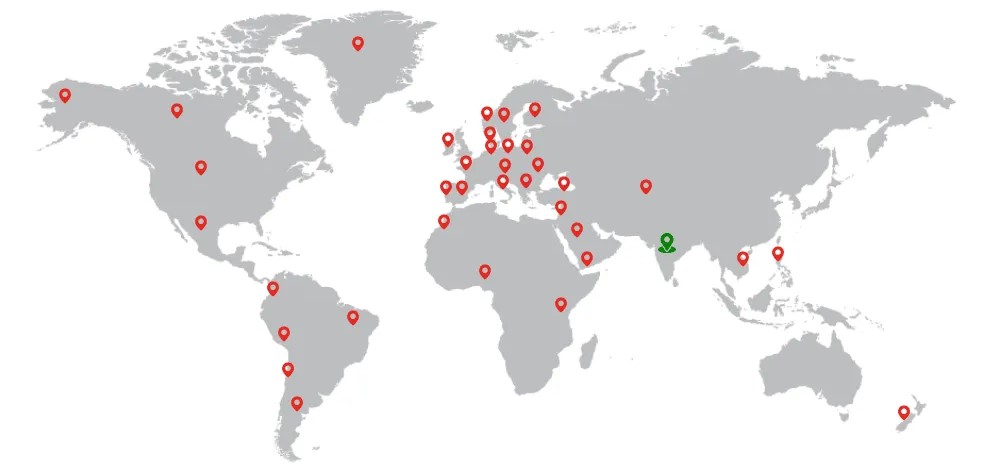
Chosen by startups, SMBs, and global enterprises, we provide world-class AI Agent application development services to businesses across India, the USA, the UK, Canada, Australia, and other international markets.
Projects Delivered
Years in AI & Software Development
Countries Served
Client Retention Rate
WHAT IS AI AGENT DEVELOPMENT?
What Is AI Agent Development And Why Does It Matter for Your Business?
An AI agent is a software system that doesn’t just respond to inputs; it reasons about goals, plans sequences of actions, uses tools and APIs, retains memory across interactions, and executes tasks autonomously to produce real-world outcomes.
This is meaningfully different from traditional automation or even standard chatbots. A rule-based bot follows a fixed script. An AI agent decides what to do based on the situation, the available information, and the end goal. It can browse the web, query databases, write and execute code, send emails, update CRMs, call third-party APIs, handle exceptions, and hand off to other agents or humans when required.
What AI Agent Development Actually Involves:
Building a production-grade AI agent requires more than connecting GPT-4 to an API. It involves:
Goal decomposition breaking high-level tasks into executable subtasks
Memory architecture short-term context windows, long-term vector databases (Pinecone, Weaviate, ChromaDB), episodic recall
Tool/function integration: web search, code execution, CRM writes, calendar management, data retrieval
Reasoning frameworks ReAct (Reasoning + Acting), Chain-of-Thought, Tree-of-Thought, ReWOO
Orchestration layers LangChain, LangGraph, AutoGen, CrewAI, custom orchestration
Guardrails and safety output validation, hallucination mitigation, human-in-the-loop checkpoints
Deployment and monitoring containerized microservices, observability pipelines, latency optimization
When this is done well, you don’t just automate tasks you create a system that handles the cognitive load of complex business workflows.
Business Value: Companies that deploy well-architected AI agents consistently report 40–70% reductions in manual processing time, significantly faster response cycles across customer-facing operations, and the ability to scale operations without proportional headcount growth.
AI AGENT TYPES
Types of AI Agents We Build
Task-Specific Autonomous Agents
Designed for a single, well-defined workflow: invoice processing, lead qualification, content generation, and code review. These agents are focused, fast, and deployable within days. They integrate into existing tools via API and operate without constant supervision.
Conversational AI Agents (Voice & Text)
Agents that handle natural language interactions across chat, email, voice, and messaging platforms. Unlike chatbots, these agents don’t follow trees; they understand intent, retrieve relevant context, perform actions, and maintain coherent conversations across sessions. Deployable on WhatsApp, Slack, web chat, custom apps, or phone systems.
Research & Knowledge Agents
Agents that can search internal knowledge bases, browse the web, extract structured data from documents, synthesize findings, and produce reports. Useful for legal research, competitive intelligence, due diligence, compliance review, and market analysis. These agents use Retrieval-Augmented Generation (RAG) architectures to ground answers in verified sources.
Data Analysis & Decision-Support Agents
These agents connect to data warehouses, BI tools, and operational databases to answer business questions, generate forecasts, flag anomalies, and support decisions. Rather than replacing analysts, they extend analytical capacity, allowing non-technical teams to ask complex questions in plain language.
Process Automation Agents (RPA + AI)
Traditional robotic process automation handles repetitive, rule-based tasks. AI agents extend this to handle exceptions, understand unstructured inputs, make judgment calls, and adapt when processes change. This combination, sometimes called Intelligent Process Automation (IPA), eliminates the brittleness of legacy RPA.
Multi-Agent Systems (MAS)
Complex business problems benefit from architectures where multiple specialized agents collaborate. A supervisor agent breaks work into subtasks, routes it to specialist agents (researcher, writer, validator, and executor), coordinates output, and handles failure states. Multi-agent systems are ideal for workflows that require parallelism, specialization, and error recovery.
AI Copilots
Embedded into your existing software products or internal tools, AI copilots augment human workers rather than replacing them. They provide real-time suggestions, draft communications, summarize data, flag risks, and answer questions in context. Think of GitHub Copilot’s model applied to your specific domain.
Agentic RAG Systems
Retrieval-augmented generation goes beyond simple document Q&A when combined with agent behavior. An agentic RAG system can decide which knowledge sources to query, reformulate queries when results are insufficient, synthesize answers from multiple sources, and cite references all autonomously.
AI Workflow Orchestration Agents
These coordinate entire business workflows triggering actions across CRMs, ERPs, databases, communication platforms, and third-party services based on events, schedules, or AI-determined conditions. The business logic lives in the agent’s planning layer, not in hardcoded integrations.
Domain-Specific Vertical AI Agents
Trained and configured for specific industries, healthcare AI agents that understand clinical terminology and HIPAA constraints, legal agents with knowledge of jurisdiction-specific statutes, and financial agents calibrated against regulatory reporting standards. Domain specialization dramatically improves accuracy and trust in production environments.
OUR AI SERVICES
Our AI Agent Development Services
From custom AI agents and enterprise automation to multi-agent orchestration and RAG-powered knowledge systems, we deliver end-to-end AI agent development services that help businesses automate operations, enhance productivity, and accelerate digital transformation.
Custom AI Agent Development
Build AI agents designed specifically for your business processes, data ecosystem, and technology stack. We handle strategy, architecture, LLM selection, prompt engineering, tool integration, deployment, and continuous optimization to create intelligent solutions tailored to your operational goals.
- Business-specific AI agents
- LLM & prompt engineering
- API & tool integrations
- Deployment & optimization
Enterprise AI Agent Development
Deploy secure, enterprise-grade AI agents with compliance, governance, and scalability built in. We integrate AI into complex enterprise environments while ensuring security, reliability, and seamless connectivity with existing systems.
- SOC 2, HIPAA & GDPR
- SAP, Salesforce & Oracle
- SSO & Identity Management
- Multi-tenant Architecture
AI Workflow Automation
Automate repetitive business operations using intelligent AI agents capable of handling complete workflows from customer onboarding and document processing to HR, finance, and customer support.
- Process Automation
- Customer Onboarding
- Sales Automation
- HR & Finance Workflows
Multi-Agent System Development
Build collaborative AI ecosystems where specialized agents work together to solve complex tasks using orchestration frameworks like CrewAI, AutoGen, and LangGraph.
- CrewAI
- AutoGen
- LangGraph
- Shared Memory Systems
AI Copilot Development
Develop intelligent AI copilots that integrate directly into your software, enabling users to receive contextual suggestions, summaries, recommendations, and AI assistance without leaving their workflow.
- SaaS Integration
- Context-Aware Assistance
- AI Suggestions
- Smart Productivity Tools
Voice AI Agent Development
Create conversational AI agents capable of handling inbound calls, appointment scheduling, customer support, and voice-based business operations using advanced speech recognition and voice synthesis.
- Voice Assistants
- Call Automation
- Speech Recognition
- AI Phone Agents
RAG System Development
Connect your private knowledge base, CRM, databases, documents, and internal systems to AI models using Retrieval-Augmented Generation for highly accurate, context-aware responses with minimal hallucinations.
- Knowledge Base AI
- Vector Databases
- Company Data Search
- Secure AI Retrieval
AI Agent Integration Services
Extend your existing software ecosystem with AI capabilities through secure integrations with CRMs, ERPs, collaboration tools, databases, APIs, and custom applications without rebuilding your infrastructure.
- Salesforce
- HubSpot
- SAP
- Slack & Microsoft Teams
AI Agent Maintenance & Optimization
Ensure long-term AI performance through proactive monitoring, prompt optimization, infrastructure scaling, retraining, and continuous enhancements that keep production AI agents reliable as your business evolves.
- Performance Monitoring
- Prompt Optimization
- Capacity Scaling
- Continuous Improvements
Ready to Build an AI Agent That Delivers Real Business Value?
Whether you’re planning your first AI initiative or scaling enterprise automation, our AI experts help you design, develop, integrate, and optimize intelligent AI agents tailored to your business.
AI AGENT CAPABILITIES
What AI Agents Can Do in Your Business
These aren’t theoretical capabilities; these are production-tested functions deployed across real business environments.
Autonomous Research & Synthesis
Agents browse specified sources, extract structured and unstructured data, cross-reference information, and produce synthesized reports or structured datasets — without a human reading each source.
Document Intelligence
Extract, classify, validate, and act on information inside PDFs, Word documents, spreadsheets, scanned images, and contracts. AI agents can read an invoice and post it to the accounting system, parse a contract and flag non-standard clauses, or process hundreds of insurance claims simultaneously.
Conversational CRM Operations
Sales teams using AI agents can create contacts, update deal stages, log call notes, draft follow-up emails, and pull pipeline reports through natural language — without manually navigating CRM interfaces. The agent handles system interaction; the human handles the relationship.
Intelligent Ticket & Case Handling
For support teams, AI agents triage incoming requests, retrieve relevant knowledge base content, draft or send resolution responses, escalate appropriately, and update ticket status — handling the majority of tier-1 volume without human involvement.
Code Generation & Review
Developer-facing AI agents assist with code generation, test case writing, bug identification, code review, documentation generation, and refactoring suggestions — operating within your codebase context via GitHub integration.
Financial Operations Automation
Reconcile transactions, flag anomalies, generate expense reports, validate invoices against purchase orders, produce financial summaries for specified date ranges, and alert on budget deviations — all through AI agents connected to your accounting and banking systems.
HR & Recruitment Automation
Screen resumes against job requirements, rank candidates, draft interview questions, schedule interviews, send offer letters, and manage onboarding document collection. AI agents reduce time-to-hire and administrative HR load significantly.
Supply Chain & Operations
Monitor inventory levels, trigger reorder actions, track shipment status across carriers, flag delays, update operations dashboards, and notify stakeholders. Agents act as a continuous operational oversight layer.
AI AGENT USE CASES
AI Agent Use Cases by Business Function
Industry Solutions
AI Agent Solutions for Every Industry
Purpose-built AI agents deployed across 16 industries. From clinical workflows to logistics dispatch, we deliver agents that understand your domain, your data, and your compliance requirements.
Healthcare and Medical
Clinical AI agents handle EHR data entry, prior authorization, appointment scheduling, medical coding, and revenue cycle management, reducing administrative burden so clinicians focus entirely on patient care.
Finance and Fintech
Loan origination agents, real-time fraud detection, compliance monitoring across SEBI, RBI, SEC, and FCA, and customer-facing financial assistants that scale with transaction volume without adding headcount.
Real Estate
Property search agents, automated listing description generation, contract review against compliance requirements, document collection automation, and investment market analysis that delivers institutional-grade insights.
Ecommerce and Retail
Dynamic pricing agents, inventory prediction models, personalised product recommendations, 24/7 multilingual customer service, and post-purchase engagement automation that drives repeat revenue.
Education and eLearning
Adaptive tutoring agents, automated assessments with rubric-aligned grading, enrollment management, and 24/7 student support that resolves the personalization-at-scale paradox for EdTech platforms and institutions.
Logistics and Transportation
Real-time dispatch and route optimisation agents, customs documentation processing, exception handling, and proactive customer communication that reduces inbound tracking queries by up to 80 percent.
Legal Services
Legal research agents across LexisNexis, Westlaw, and Manupatra; contract review against standard playbooks; compliance monitoring; and matter management automation that reclaims billable capacity.
Manufacturing
Predictive maintenance agents, quality control automation from sensor and vision data, production planning optimisation, safety compliance monitoring, and end-to-end supply chain visibility.
Insurance
Claims processing agents that reduce cycle time from weeks to days, fraud detection across patterns and third-party data, underwriting support agents, and policy servicing automation for digital and voice channels.
SaaS Platforms and Tech Companies
Product analytics agents, customer success automation, tier-1 technical support agents, personalised onboarding flows, and embedded AI copilots that become core product differentiators increasing stickiness and NPS.
Human Resources and Recruitment
Resume screening and ranking, JD generation, interview scheduling across calendars, onboarding workflow management, attrition risk monitoring, and performance review data aggregation for any team size.
Travel and Hospitality
Reservation management agents, personalised itinerary generation, review response automation, revenue management support, loyalty program engagement, and disruption communication across every guest touchpoint.
Agriculture and Agritech
Crop monitoring via satellite and IoT sensor data, weather-based advisory generation, supply chain coordination for farm produce, real-time market price tracking, and government scheme eligibility and application assistance.
Government and Public Sector
Citizen service request handling, regulatory compliance documentation, public records processing, inter-department communication automation, grievance management, and permit application tracking at scale.
Media and Entertainment
Content recommendation personalisation, editorial workflow automation, social media content generation and scheduling, rights and licensing monitoring, and audience analytics reporting for publishers and platforms.
Energy and Utilities
Grid monitoring and anomaly detection agents, outage prediction and response coordination, compliance reporting automation, asset maintenance scheduling, customer billing support, and demand forecasting.
Every deployment starts with a free discovery call where we map your exact use cases, identify quick wins, and outline a go-live plan tailored to your compliance environment and existing tech stack.
SOLUTIONS BY BUSINESS
AI Agent Solutions by Business Type
AI Agents for Startups
Speed is everything at the startup stage. AI agents let early-stage companies punch above their weight automating customer support, sales outreach, data analysis, and operational processes without the headcount that established companies rely on. We specialize in MVP-stage AI agent deployments that prove ROI quickly and scale cleanly as the business grows.
Typical engagement timelines: 4–8 weeks to production.
AI Agents for Enterprise Enterprise
AI deployments require a different approach, one that accounts for organizational complexity, legacy system integration, data governance, security requirements, and change management. Our enterprise AI practice has experience with Fortune-equivalent companies across India and the US, delivering agents that work within SSO environments, respect data residency requirements, integrate with SAP/Oracle/Salesforce/ServiceNow, and operate under formal SLA agreements.
AI Agents for SaaS Products
If you’re building a software product, embedding AI agent capabilities creates substantial competitive differentiation. We help SaaS founders design AI-native product experiences, including in-product copilots, automated workflow features, AI-powered analytics, and autonomous action capabilities. These aren’t add-on features; they’re core architectural decisions that affect product positioning and pricing power.
AI Agents for B2B Companies
B2B sales cycles are long, research-intensive, and relationship-dependent. AI agents accelerate every stage from identifying and qualifying target accounts, to personalizing outreach, to supporting deal management and post-sale onboarding. B2B companies also benefit significantly from AI agents in account management, renewal tracking, and expansion opportunity identification.
AI Agents for B2C Companies
Scale and personalization are the twin challenges of consumer businesses. AI agents handle managing millions of customer interactions individually while maintaining brand consistency, operating across every digital channel, and continuously improving based on interaction data. From e-commerce to media to consumer apps, AI agents are becoming the standard layer between businesses and their customers.
AI AGENT DEVELOPMENT PROCESS
How We Build AI Agents: Our Development Process
Discovery & Workflow Mapping
Every AI agent project starts with deep discovery. We map your existing workflows, identify automation targets, interview key stakeholders, audit your current data infrastructure, and document the integration points your agent will need. The output is an AI agent blueprint, a detailed specification covering agent architecture, data sources, tool integrations, performance benchmarks, and success criteria.
Architecture Design & LLM Selection
Agent architecture decisions made early have long-term consequences. We design the memory system (short-term context, long-term vector storage, episodic retrieval) and select and evaluate LLMs for the specific task profile (GPT-4o, Claude 3.5 Sonnet, Gemini Pro, Mistral, Llama 3 for on-premise requirements), define the tool stack, and establish the orchestration framework. For multi-agent systems, we design agent roles, communication protocols, and failure recovery logic at this stage.
Prototype Development & Prompt Engineering
The first functional prototype is built and tested against representative data and edge cases. Prompt engineering at this stage is systematic, not iterative guessing. We use structured frameworks for system prompt design, few-shot example curation, chain-of-thought elicitation, and output format specification. Tool calling logic is implemented and tested against live API endpoints.
Integration Development
Connecting the agent to your actual systems' CRM, ERP, databases, communication tools, and third-party APIs. We build bidirectional integrations with appropriate authentication, rate limiting, error handling, and retry logic. Data pipelines are established between your sources and the agent's memory/retrieval systems.
Testing & Quality Assurance
AI agents require specialized testing approaches. Beyond functional QA, we conduct adversarial testing (attempting to elicit inappropriate outputs), consistency testing (verifying responses to semantically similar queries produce coherent results), performance testing (latency, throughput, and cost per operation), and edge case cataloging. Human-in-the-loop checkpoints are validated.
Deployment & Monitoring Setup
Production deployment on your preferred infrastructure: AWS, GCP, Azure, or on-premise. Observability pipelines are established: LLM call logging, cost tracking, latency monitoring, output quality scoring, and user feedback collection. Alerting thresholds are configured for quality degradation signals.
Optimization & Iteration
The first production deployment is the beginning, not the end. We operate post-deployment optimization cycles, analyzing interaction logs, identifying failure patterns, refining prompts and tool logic, and expanding agent capabilities based on usage data. Retainer agreements ensure continuous improvement without the overhead of separate project engagements.

Client Reviews
What Our Clients Say

Kreg Thornley
Marketing Director, Alchemy Spetec Tucker, Georgia, United States
James Guttman
San Francisco, California, United StatesAI AGENT ARCHITECTURE
AI Agent Architecture Concepts
Understanding the architectural components of a production AI agent system helps in evaluating implementations and making informed build decisions.
LLM Core (Reasoning Engine):
The language model that handles reasoning, planning, and natural language generation. Selection criteria include task type (instruction-following vs. multi-step reasoning), latency requirements, cost structure, context window needs, and data privacy considerations. Models we work with: GPT-4o, GPT-4 Turbo, Claude 3.5 Sonnet, Claude 3 Haiku, Gemini 1.5 Pro, Mistral Large, Llama 3.1 (70B, 405B), Cohere Command R+.
Memory Systems:
- Working memory: The active context window of what the agent “knows” in the current conversation or task session.
- Episodic memory: Logs of past interactions, retrievable for context continuity across sessions.
- Semantic memory: Vectorized representations of knowledge stored in databases like Pinecone, Weaviate, Qdrant, ChromaDB, or pgvector, enabling semantic search across large document collections.
- Procedural memory: Stored tools, skills, and execution patterns the agent can invoke.
Tool Layer:
The set of external capabilities available to the agent: web search, code execution, database read/write, API calls, file operations, calendar access, and email send. Tools are the mechanism through which agents affect the real world. Tool design is critical: poorly designed tools create ambiguity and errors; well-designed tools with clear descriptions, parameter schemas, and error responses dramatically improve agent reliability.
Orchestration Framework:
Manages agent execution flow with LangChain, LangGraph, AutoGen, CrewAI, Haystack, or custom implementations. For multi-agent systems, the orchestration layer handles inter-agent communication, task delegation, shared state management, and coordination protocols.
Guardrails & Safety Layer:
Output validation, topic restriction enforcement, PII detection and redaction, hallucination mitigation strategies (grounding responses in retrieved documents, confidence thresholds, and citation requirements), and human-in-the-loop escalation logic.
Observability Layer:
LLM traces (LangSmith, Helicone, Arize), cost monitoring, latency dashboards, output quality metrics, user feedback collection, and alerting pipelines for quality degradation.
AI Agent Technology Stack
Enterprise-grade tools and frameworks powering every layer of our AI agent solutions from LLMs to deployment infrastructure.
AI Agent Development Cost & Investment
The cost of building a production AI agent varies significantly based on complexity, integrations, scale, and ongoing requirements. Here's how the cost drivers actually work.
- Number and complexity of tool integrations — CRM writes are simpler than multi-step ERP workflows
- Volume of documentation for RAG systems — indexing 10,000 documents vs. 100 is a different scope
- Multi-agent orchestration vs. single-agent deployments
- Custom model fine-tuning requirements
- Security and compliance overhead in regulated industries
- Real-time vs. batch processing requirements
- Number of channels — web, mobile, WhatsApp, and voice each add integration scope
- Starting with a focused, well-scoped first agent rather than a broad platform
- Leveraging existing integrations and APIs rather than custom-building all connectors
- Using hosted LLM APIs rather than self-hosted model infrastructure
- Clear, well-documented existing workflows reduce discovery overhead significantly
not a quote request.
WHY CHOOSE US
Why Businesses Choose SquareInfoSoft for AI Agent Development
Deep AI Engineering Expertise: Building reliable AI agents requires expertise across multiple disciplines: LLM behavior and limitations, prompt engineering at a systematic level, software architecture, integration development, and product design. Our team has been building with AI systems since before the generative AI wave, which means we understand both the capabilities and the failure modes in ways that matter for production deployments.
Full-Stack Delivery: We build the entire system, not just the AI layer. Frontend interfaces, backend APIs, database architecture, cloud infrastructure, and integrations and monitoring are all developed in-house by a single team. No coordination overhead between agencies; no gaps in responsibility.
Business-First Approach: An AI agent that’s technically impressive but doesn’t move a business metric is a failed project. Every engagement starts with business objective definition. What specific outcome are we trying to achieve? How will we measure it? What does success look like at 90 days? The technical architecture follows the business logic.
Production Experience: We’ve deployed AI agents in production environments handling real business data, real user interactions, and real operational consequences. We know what breaks in production that looks fine in testing, and we build accordingly. Our clients don’t discover production issues after go-live; we find them in QA.
Transparent Engagement Model: Fixed-scope projects and retainer arrangements available. Regular sprint reviews, shared project management tooling, direct access to the engineers building your system. No black-box development; no surprises on delivery.
Post-Launch Support: AI agents require ongoing attention as LLM APIs evolve, usage patterns change, and edge cases accumulate. Maintenance retainers ensure your agent continues performing at target levels without requiring a new project engagement each time something needs attention.
FAQS
Frequently Asked Questions About AI Agent Development
What is an AI agent, and how is it different from a chatbot?
A chatbot follows predefined conversation flows; if the user says X, respond with Y. An AI agent is fundamentally different: it reasons about goals, decides what actions to take, uses external tools to interact with real systems, maintains memory across sessions, and adapts its behavior based on context. A chatbot tells you a support article exists. An AI agent reads your issue, queries the relevant system, attempts a resolution, and only escalates when it can’t resolve it autonomously.
What kinds of businesses benefit most from custom AI agent development?
Businesses that benefit most share common characteristics: they have high-volume, process-intensive operations; their teams spend significant time on tasks that are information-heavy but don’t require genuine human judgment; and they have data that, if properly leveraged, would drive better decisions. This describes companies in healthcare, finance, legal services, ecommerce, logistics, HR, and SaaS among many others.
How long does it take to build a production AI agent?
A focused, single-purpose AI agent can reach production in 4–8 weeks. More complex agents with multiple integrations, multi-agent architectures, or significant data preparation requirements typically take 8–16 weeks. Enterprise deployments with security, compliance, and change management overhead can run 4–6 months. The variable that most influences the timeline is how well the business processes are documented before development begins.
What is the difference between AI agents and traditional RPA (Robotic Process Automation)?
Traditional RPA automates highly structured, rule-based processes using screen interactions and fixed logic. It breaks when the interface changes or an exception occurs outside the defined rules. AI agents handle unstructured inputs, understand context, make judgment calls, recover from exceptions, and adapt to process changes. AI agents also connect to systems via APIs rather than simulating UI interactions, making them significantly more reliable and maintainable.
Which LLMs do you use for AI agent development?
We select LLMs based on the specific requirements of each project rather than defaulting to a single provider. For complex reasoning tasks requiring reliability, we typically use GPT-4o or Claude 3.5 Sonnet. For high-volume, latency-sensitive applications where cost efficiency matters, Claude 3 Haiku or GPT-4 Turbo are often appropriate. For on-premise requirements in regulated industries, we use open-source models (Llama 3, Mistral) deployed on client-controlled infrastructure.
Can AI agents integrate with our existing CRM, ERP, or internal tools?
Yes, integration with existing systems is typically the core engineering work in an AI agent project. We’ve built integrations with Salesforce, HubSpot, SAP, NetSuite, Microsoft Dynamics, Tally, Zoho, ServiceNow, Jira, Slack, Teams, and many custom-built internal systems. Integration is done via official APIs, webhooks, or database connections depending on what the system supports.
How do you ensure AI agents don't produce incorrect or harmful outputs?
Multiple layers of protection are implemented: prompt engineering techniques that constrain agent behavior within defined parameters; output validation that checks responses against expected formats and content policies; retrieval grounding that anchors responses in verified source documents rather than LLM-generated content; human-in-the-loop checkpoints for high-stakes decisions; and comprehensive logging that enables monitoring and rapid response to quality issues. No AI system is 100% error-free, but well-architected systems with appropriate safeguards achieve accuracy levels suitable for production business operations.
What is a multi-agent system, and when do you need one?
A multi-agent system is an architecture where multiple specialized AI agents collaborate, each handling a component of a complex task. You need multi-agent architecture when a workflow requires parallel processing of multiple workstreams, when different subtasks require different expertise or tools, or when a single-agent context window would be insufficient for the task complexity. For example, a sales intelligence system might deploy separate agents for web research, CRM data analysis, competitor monitoring, and report generation with an orchestrator agent coordinating their work and synthesizing the output.
Can you build AI agents for mobile applications?
Yes. AI agent capabilities can be embedded in mobile applications built with React Native, Flutter, Swift (iOS), or Kotlin (Android). Mobile-embedded AI agents handle in-app user assistance, personalized feature recommendations, content generation, and automated workflows triggered by mobile interactions. We design mobile AI experiences with latency constraints in mind using streaming responses, optimized API calls, and appropriate caching strategies.
What is RAG (Retrieval-Augmented Generation) and why does it matter for AI agents?
RAG is an architecture that enables AI agents to answer questions accurately using your specific, proprietary information rather than relying on the LLM’s training data. The agent first searches a database of vectorized documents (your knowledge base, product documentation, internal policies, and historical records) and retrieves relevant sections, which are then used to ground the LLM’s response. RAG is essential for agents that must provide accurate, company-specific answers and cite sources; it’s what prevents the hallucination problem in knowledge-intensive applications.
How do AI agents handle sensitive or confidential business data?
Data handling is configured based on your security requirements. Options include the following: using private API deployments (Azure OpenAI, AWS Bedrock) where data is not used for model training; on-premise LLM deployment with models running entirely within your infrastructure; PII redaction before data reaches the LLM; role-based access controls that limit what data different agent functions can access; and full audit logging of all data access events. For regulated industries, we implement compliance-specific data handling from the architecture design phase.
What is the cost of running an AI agent in production?
Ongoing operational costs consist primarily of LLM API usage (charged per token), vector database hosting, and cloud infrastructure for the agent application. These costs scale with usage volume. For typical enterprise deployments, LLM inference costs range from a few hundred to a few thousand dollars per month depending on volume and model selection. We provide detailed cost modeling as part of the discovery phase; no client should be surprised by operational costs after deployment.
Can you build AI agents that work across WhatsApp, email, and web chat simultaneously?
Yes, omnichannel AI agents that maintain consistent conversation state across WhatsApp (via WhatsApp Business API), email, web chat, SMS, and voice are a pattern we’ve deployed for multiple clients. The channel layer handles message format translation; the agent core handles reasoning and response generation consistently regardless of which channel the interaction came through. User context is maintained across channels so the agent knows a customer who emailed yesterday is the same person now messaging on WhatsApp.
How do you handle AI agent failures or errors in production?
Production AI agents include explicit error handling at multiple levels: tool call failures trigger retry logic with exponential backoff and fallback strategies; LLM API failures trigger fallback to alternative models or graceful degradation responses; unexpected agent behavior triggers automatic escalation to human handlers; and comprehensive alerting ensures operational teams are notified immediately when error rates exceed defined thresholds. Post-incident, logs are analyzed to identify root causes and implement corrective measures.
Do AI agents get smarter over time?
AI agents improve over time in several ways without requiring full model retraining: the RAG knowledge base can be continuously updated as new documents are added; prompt engineering can be refined based on production interaction data; few-shot examples can be updated based on observed failure patterns; and tool implementations can be improved as integration edge cases are discovered. For use cases where task-specific performance improvement is critical, fine-tuning pipelines can be established using production interaction data under appropriate quality controls.
What industries do you have AI agent development experience in?
Healthcare (clinical documentation, patient scheduling, revenue cycle); fintech (loan origination, fraud detection, compliance); real estate (lead qualification, property management); legal services (research, contract review); e-commerce (customer support, inventory management, personalization); logistics (dispatch, documentation, communication); SaaS (copilots, onboarding, analytics); manufacturing (quality control, predictive maintenance, procurement); education (tutoring, administration, assessment); and HR/recruitment, among others. Over 8+ years and 200+ projects, industry-specific deployment experience is a meaningful differentiator in our practice.
What is the difference between AI agent development and AI automation?
AI automation typically refers to applying AI capabilities to specific, defined tasks, such as classifying emails, extracting invoice data, and generating product descriptions. AI agents go further: they can plan sequences of actions across multiple tools, adapt to changing conditions, handle exceptions through reasoning rather than rules, and pursue goals across extended, multi-step workflows. AI automation is often a component within an AI agent; an AI agent is the broader architecture that orchestrates automation capabilities toward goal completion.
Can you build AI agents that generate and send reports automatically?
Yes, scheduled report generation is a common AI agent use case. Agents can connect to data sources, query for specified metrics and date ranges, generate narrative analysis and data visualizations, format reports appropriately (PDF, email, Slack message, or dashboard update), and deliver to specified recipients on defined schedules. More sophisticated versions trigger reports based on conditions rather than schedules, sending an alert with supporting analysis when a KPI exceeds or drops below defined thresholds.
How do you approach AI agent projects for startups with limited budgets?
Startups benefit from a focused MVP approach identifying the single highest-value automation target, building a well-scoped agent for that specific use case, measuring ROI, and expanding from there. This delivers demonstrable value quickly without the cost and complexity of a comprehensive platform. We’ve helped startups deploy production-ready AI agents in 4–6 weeks at investment levels appropriate for early-stage companies. The conversation starts with “what’s the one process that, if automated, would most directly impact your business metrics?” and builds from there.
What ongoing support do you provide after an AI agent is deployed?
Post-deployment support options include: on-demand support for bug fixes and minor changes; monthly maintenance retainers covering performance monitoring, prompt optimization, and minor enhancements; and strategic retainers that include proactive optimization, new integration development, and expansion of agent capabilities. We also provide handoff documentation and training if clients prefer to manage maintenance internally with their engineering team.
Can AI agents be integrated into our existing mobile app or website?
Yes, agents are integrated as backend services accessed via API, which means they can be incorporated into any existing frontend web applications, mobile apps, internal tools, or customer-facing products. The integration from the frontend perspective is typically a standard API call with streaming response handling. We provide the backend agent infrastructure and API specification; integration into existing frontend code is typically straightforward.
What AI agent use cases are most popular in India right now?
In India, the highest-demand AI agent use cases currently are customer service automation for ecommerce and D2C brands (often on WhatsApp); loan origination and document processing for NBFCs and fintechs; HR recruitment automation for enterprises handling high application volumes; legal document review for corporate legal teams; ERP and accounting workflow automation for manufacturing and trading companies; and healthcare administration automation for hospital networks and telemedicine platforms.
Can AI agents replace human employees?
AI agents are most effective and most responsibly deployed when they handle the information-processing and administrative components of work, freeing human employees for the judgment, relationship, creativity, and accountability-bearing aspects of their roles. The most successful implementations shift human work toward higher-value activity rather than eliminating positions. For operations-heavy departments processing high volumes of routine work, headcount requirements do typically stabilize or reduce, but the business value case doesn’t depend on headcount reduction; it depends on the value of what humans do with reclaimed time.
What makes a good AI agent use case?
Strong AI agent use cases share several characteristics: the task involves a defined goal that can be articulated clearly; there is relevant data available to inform the agent’s decisions; the process involves multiple steps or integrations that currently require human coordination; the volume is high enough that automation delivers meaningful ROI; and the acceptable error rate allows for AI performance levels. The worst AI agent use cases involve highly subjective judgments, novel situations with no precedent, or areas where errors carry severe consequences and existing mitigation approaches are insufficient.
How do you select the right LLM for a specific AI agent project?
LLM selection involves evaluating: task type (instruction following, multi-step reasoning, code generation, document analysis have different model performance profiles); latency requirements (real-time applications favor faster, smaller models); cost structure (high-volume applications require cost modeling across model options); context window requirements (long document processing requires large context windows); data privacy constraints (regulated industries may require private deployment options); and multilingual requirements (some models perform better in specific languages). We typically benchmark candidate models against representative task examples before final selection.
How long does it take to see ROI from an AI agent deployment?
Most clients see measurable ROI signals within the first 30–60 days of production deployment: reduced processing time, lower ticket volume, faster response cycles. Full ROI realization (where productivity gains or cost savings exceed total project investment) typically occurs between 3–9 months depending on deployment scale and baseline operational costs. The clearest ROI cases are high-volume, process-intensive operations where agent throughput can be directly compared to the human time it replaces.
Can you help us figure out where AI agents will have the most impact in our business?
Yes, our discovery engagements often start with an AI opportunity assessment: we review your operational workflows, identify automation opportunities, and rank them by impact and feasibility. and produce a prioritized roadmap. This analysis typically takes 1–2 weeks and gives you a clear picture of where AI agents will deliver the highest return before any development investment is committed. Contact us to discuss this as a starting engagement.
Do you offer AI agent development services for international clients?
Yes. We serve clients across the United States, United Kingdom, Canada, Australia, UAE, Singapore, and other markets in addition to our primary market in India. International engagements are managed through async and scheduled video collaboration. Our team is comfortable operating across time zones and has delivered projects for clients from San Francisco to London to Dubai. Billing is available in USD, GBP, AUD, AED, and INR.
What is the first step to get started with AI agent development?
The first step is a 30-minute strategy call free of charge, no sales pressure. In that conversation, we’ll understand your business context, the process or problem you’re trying to address, your existing technical environment, and your timeline and budget parameters. We’ll give you an honest assessment of feasibility and a rough scope of what an appropriate engagement looks like. If there’s a fit, we’ll propose a discovery engagement or move directly to scoping depending on how well-defined the requirements are. Book that call through the contact form below.
Talk to an AI Agent Developer Today
The competitive advantage in the next five years will belong to businesses that figure out AI agent deployment before their competitors do. Not AI experiments. Not pilot programs that never ship. Production AI agents that handle real workloads, integrate with real systems, and deliver measurable business outcomes.
That's what we build.
Whether you have a specific process in mind or you're still mapping out where AI fits in your business, the conversation starts the same way: a direct, honest discussion about what's possible, what it costs, and what it takes to get there.
Let us Build Something Great
Interested in driving growth with AI Agent Development? Have a general question? We’re just an email away.

