
INTRODUCTION:
AI in Social Media
AI in social media is rapidly transforming how businesses create content, engage audiences, and drive growth in a highly competitive digital environment. From personalized feeds and automated content creation to advanced analytics and predictive targeting, AI is now at the core of modern social media marketing strategies.
Today, platforms like Instagram, TikTok, Facebook, and LinkedIn rely heavily on AI algorithms to determine what content users see, how ads are delivered, and how engagement is measured. For businesses, this means that traditional social media strategies are no longer enough. To stay competitive, brands must adopt AI-driven approaches that improve efficiency, accuracy, and performance.
AI in social media marketing enables businesses to automate repetitive tasks such as content scheduling, caption generation, audience targeting, and performance tracking. It also allows companies to analyze user behavior in real time, predict trends, and deliver highly personalized content that increases engagement and conversion rates.
As social media continues to evolve into a data-driven ecosystem, artificial intelligence is no longer optional. It has become a critical tool for businesses looking to scale their marketing efforts, reduce costs, and maximize return on investment.
In this guide, we will explore how AI is used in social media, the latest trends shaping the industry, real-world use cases, tools, benefits, ROI, and how businesses can leverage AI to achieve sustainable growth.

Boost Your Social Media with AI-Powered Solutions
Automate content, improve engagement, and increase ROI with custom AI solutions tailored to your business.
Get Free AI Strategy ConsultationWHAT IS AI IN SOCIAL MEDIA
What is AI in Social Media? Definition, Meaning, and How It Works
AI in social media refers to the use of advanced technologies such as machine learning, natural language processing, and data analytics to automate, analyze, and optimize social media activities. These technologies enable platforms and businesses to understand user behavior, personalize content, and improve marketing performance.
In simple terms, AI in social media helps platforms decide what content users see, when they see it, and how they interact with it. It powers features like content recommendations, targeted advertisements, automated responses, and real-time analytics.
Social media platforms process massive amounts of data every second, including likes, comments, shares, watch time, and user interactions. Artificial intelligence analyzes this data to identify patterns and predict what users are most likely to engage with.
For businesses, this means AI can be used to create more effective marketing strategies, improve audience targeting, and deliver personalized experiences that increase engagement and conversions.
How AI Works in Social Media Platforms
AI works behind the scenes of social media platforms through a combination of algorithms and data processing systems.
When a user interacts with content, such as liking a post or watching a video, the platform collects this data and feeds it into AI models. These models analyze the data to understand user preferences, interests, and behavior patterns.
Based on this analysis, AI systems rank and recommend content that is most relevant to each user. This is why every user sees a different feed, even when following the same accounts.
AI also continuously learns and improves over time. As more data is collected, the system becomes better at predicting user behavior and delivering personalized experiences.
Core AI Technologies Used in Social Media
AI in social media is powered by several key technologies that work together to deliver intelligent outcomes.
Machine Learning in Social Media
Machine learning enables systems to learn from data and improve performance without being explicitly programmed. It is used to predict user behavior, recommend content, and optimize advertising campaigns.
For example, machine learning models analyze user interactions to determine which posts are likely to perform well and which audiences are most likely to convert.
Natural Language Processing in Social Media
Natural language processing allows AI systems to understand and analyze human language. It is used in chatbots, comment analysis, sentiment detection, and automated responses.
Businesses use NLP to monitor conversations, understand customer feedback, and improve communication with their audience.
Computer Vision in Social Media
Computer vision enables AI to analyze images and videos. It is used for features such as facial recognition, object detection, and visual content analysis.
For example, AI can identify products in images, analyze visual trends, and recommend similar content to users.
Predictive Analytics in Social Media
Predictive analytics uses historical data to forecast future outcomes. In social media, it helps businesses predict trends, identify high-performing content, and optimize campaigns.
This allows companies to stay ahead of trends and make data-driven decisions.
Role of AI in Modern Social Media Marketing
Artificial intelligence plays a central role in modern social media marketing by enabling automation, personalization, and data-driven decision-making.
Businesses can use AI to automate content creation, schedule posts, analyze performance, and optimize campaigns in real time. AI also helps in identifying the right audience, delivering targeted ads, and improving engagement.
As a result, companies can achieve better results with less effort and resources, making AI an essential part of any successful social media strategy.
Artificial intelligence is not just a tool for social media. It is the foundation that powers how platforms operate and how businesses succeed in digital marketing.
Understanding how AI works in social media helps businesses make smarter decisions, adopt the right strategies, and stay competitive in a rapidly evolving landscape.
EVOLUTION OF SOCIAL MEDIA WITH AI
Evolution of Social Media with AI: Before vs After AI Transformation
To understand the true impact of AI in social media, it is important to compare how social media functioned before AI and how it operates today.
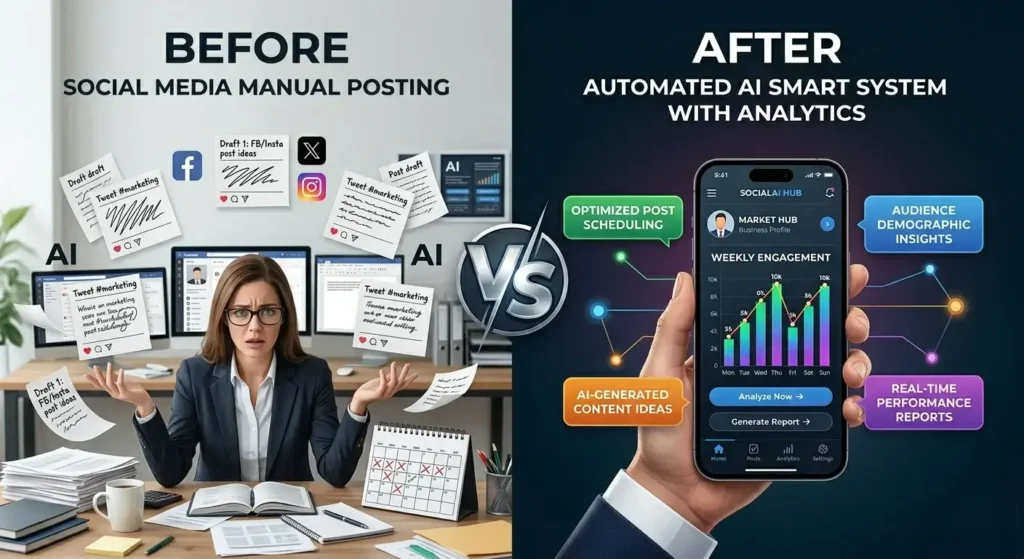
Earlier, social media platforms were primarily chronological and manual. Content was shown based on posting time, and businesses relied heavily on guesswork, manual posting, and limited analytics.
With the introduction of AI, social media has evolved into a highly intelligent, data-driven ecosystem where every piece of content, interaction, and advertisement is optimized in real time.
Social Media Before AI: Manual, Generic, and Limited
Before artificial intelligence became a core part of social media platforms, most processes were manual and lacked personalization.
Content was displayed in chronological order, meaning users saw posts based on when they were published rather than their interests. This limited content relevance and reduced engagement.
Businesses had to rely on manual content creation, basic scheduling tools, and simple analytics. There was little to no ability to predict trends, understand audience behavior deeply, or optimize campaigns in real time.
Marketing strategies were often based on assumptions rather than data, which led to inconsistent performance and lower return on investment.
Customer engagement was also limited, as responding to comments and messages required manual effort. As businesses grew, managing interactions became increasingly difficult.
Social Media After AI: Intelligent, Personalized, and Automated
With the integration of artificial intelligence, social media platforms have transformed into highly personalized and automated systems.
AI algorithms analyze user behavior, including likes, comments, shares, watch time, and interactions, to deliver content that matches individual interests. This has significantly improved user experience and engagement.
Feeds are no longer chronological but are powered by AI-driven recommendation systems. Each user sees a unique feed tailored to their preferences.
Businesses now use AI to automate content creation, schedule posts at optimal times, and analyze performance in real time. This allows marketers to make data-driven decisions and improve campaign effectiveness.
AI also enables advanced audience targeting, ensuring that ads reach the right users at the right time. This improves conversion rates and reduces wasted ad spend.
Customer engagement has also improved with AI-powered chatbots and automated responses that provide instant support and interaction.
Key Differences: Before vs After AI in Social Media
The transformation brought by artificial intelligence can be summarized across several key areas.
Content discovery has shifted from chronological feeds to personalized recommendations powered by AI.
Marketing strategies have evolved from manual and assumption-based approaches to data-driven and predictive systems.
Content creation has moved from fully manual processes to AI-assisted generation, enabling faster and more scalable output.
Customer engagement has improved from delayed manual responses to real-time AI-driven interactions.
Advertising has transformed from broad targeting to highly precise, AI-driven audience segmentation.
Analytics has advanced from basic reporting to real-time insights and predictive analytics.
The evolution of social media with artificial intelligence is not just a technological upgrade. It represents a fundamental shift in how platforms operate and how businesses connect with their audience.
Organizations that adopt AI-driven social media strategies can achieve higher engagement, better targeting, and improved return on investment.
On the other hand, businesses that continue to rely on traditional methods may struggle to keep up with rapidly changing algorithms and user expectations.
LATEST TRENDS IN AI IN SOCIAL MEDIA
Latest Trends in AI in Social Media (2026)
AI in social media is evolving rapidly, and the latest trends show a clear shift toward automation, personalization, and predictive intelligence. Social media platforms are no longer just content-sharing networks. They are becoming intelligent ecosystems powered by advanced AI systems that understand user behavior, preferences, and intent.
Businesses that stay updated with these trends can gain a competitive advantage by adapting their strategies early and leveraging new opportunities for growth and engagement.
Rise of AI Agents in Social Media
One of the most significant trends in artificial intelligence in social media is the emergence of AI agents. These are advanced systems that go beyond basic automation and act as intelligent assistants capable of handling complex tasks.
AI agents can manage comments, respond to direct messages, handle customer queries, and even guide users through the buying process. Unlike traditional chatbots, they understand context, learn from interactions, and improve over time.
For businesses, this means improved customer engagement, faster response times, and the ability to manage large-scale interactions without increasing operational costs.
Generative AI for Content Creation
Generative AI is transforming how content is created for social media. Businesses can now generate captions, images, videos, and even full campaigns using AI-powered tools.
This significantly reduces the time required for content creation and allows teams to produce high-quality content at scale. AI also helps in testing different variations of content to identify what performs best.
As a result, businesses can maintain consistency, improve creativity, and respond quickly to trends.
Social Search and Answer Engine Optimization (AEO)
Social media platforms are increasingly being used as search engines. Users now search for products, services, and information directly on platforms like Instagram and TikTok.
This has led to the rise of Answer Engine Optimization, where content is structured to provide direct, valuable answers to user queries.
AI plays a key role in understanding search intent and ranking content accordingly. Businesses need to optimize their content not just for traditional SEO but also for social search visibility.
Hyper-Personalization and AI-Driven Feeds
Personalization is becoming more advanced with the use of AI. Social media platforms analyze user behavior in real time to deliver highly personalized content feeds.
This includes recommending posts, ads, and videos based on user interests, interactions, and engagement patterns.
For businesses, hyper-personalization means the ability to deliver the right content to the right audience at the right time, improving engagement and conversion rates.
Predictive Analytics and Trend Forecasting
AI is enabling businesses to predict trends before they become popular. By analyzing large volumes of data, AI systems can identify emerging patterns and forecast which topics or content formats are likely to perform well.
This allows businesses to stay ahead of competitors by creating content that aligns with upcoming trends.
Predictive analytics also helps in optimizing campaigns and improving overall marketing strategies.
AI-Powered Advertising and Audience Targeting
Advertising on social media is becoming more efficient with AI-driven targeting. Platforms use AI to analyze user data and identify high-intent audiences.
AI systems can automatically adjust ad creatives, budgets, and targeting parameters to improve performance.
This leads to better return on investment, reduced ad spend waste, and higher conversion rates.
Real-Time Content Optimization
AI tools now enable real-time optimization of content and campaigns. Businesses can monitor performance and make adjustments instantly.
For example, AI can suggest changes in captions, visuals, or targeting based on engagement data. This ensures that campaigns remain effective throughout their lifecycle.
Real-time optimization helps businesses respond quickly to changes and maximize results.
AI for Content Moderation and Brand Safety
With the increasing volume of content, maintaining brand safety has become a challenge. AI is being used to monitor content, detect harmful or inappropriate posts, and ensure compliance with platform guidelines.
AI systems can analyze text, images, and videos to identify potential risks and take action automatically.
This helps businesses protect their brand reputation and maintain a safe online environment.
The latest trends in artificial intelligence in social media indicate a shift toward intelligent, automated, and highly personalized systems. Businesses that embrace these trends can improve efficiency, enhance customer experience, and achieve better results.
Staying ahead of these trends is essential for maintaining a competitive edge in a rapidly evolving digital landscape.
CHALLENGES WITHOUT AI IN SOCIAL MEDIA
Major Challenges Businesses Face Without AI in Social Media
In today’s fast-moving digital landscape, social media is no longer just about posting content. It requires speed, personalization, data analysis, and constant optimization. Businesses that rely on traditional, manual approaches often struggle to keep up with these demands.
Without artificial intelligence in social media, companies face multiple challenges that impact performance, efficiency, and overall growth. These challenges not only affect marketing outcomes but also increase operational costs and reduce competitiveness.
Understanding these problems highlights why AI has become essential for modern social media strategies.

Content Fatigue and Inconsistent Content Production
One of the biggest challenges businesses face without AI is maintaining a consistent flow of high-quality content.
Social media platforms demand frequent posting, platform-specific formats, and creative variation. Creating this volume of content manually is time-consuming and often leads to burnout for marketing teams.
As a result, businesses struggle to stay consistent, which negatively impacts visibility, engagement, and audience growth.
Poor Audience Targeting and Wasted Ad Spend
Without AI-driven targeting, businesses often rely on broad audience segments and assumptions.
This leads to inefficient ad campaigns where budgets are spent on users who are not likely to convert. Without predictive insights, it becomes difficult to identify high-intent audiences.
Over time, this results in higher costs, lower return on investment, and reduced campaign effectiveness.
Lack of Personalization in Content and Engagement
Modern users expect personalized experiences, but without AI, delivering this level of customization is difficult.
Businesses often create generic content that does not resonate with specific audience segments. This leads to lower engagement rates and reduced customer satisfaction.
Without personalization, brands miss opportunities to build stronger connections with their audience.
Slow Response Time and Poor Customer Engagement
Managing comments, messages, and interactions manually becomes challenging as a business grows.
Delayed responses can lead to poor customer experience and missed opportunities. In a competitive environment, users expect quick and relevant responses.
Without AI-powered automation, businesses struggle to maintain consistent and timely engagement.
Inability to Track and Analyze Data Effectively
Social media generates a vast amount of data, including engagement metrics, user behavior, and campaign performance.
Without AI, analyzing this data manually is time-consuming and often leads to incomplete insights. Businesses may miss important trends and opportunities.
This limits their ability to optimize strategies and improve results.
Missing Trends and Viral Opportunities
Social media trends evolve quickly, and timing is critical. Without AI, identifying trends early is difficult.
By the time businesses recognize a trend manually, it may already be saturated or declining. This reduces the chances of going viral and gaining visibility.
AI enables real-time trend detection, but without it, businesses are always one step behind.
Limited Scalability and Growth Challenges
As businesses grow, managing multiple social media platforms becomes more complex.
Without automation, scaling operations requires additional resources, which increases costs and reduces efficiency.
This limits the ability of businesses to expand their social media presence effectively.
Inconsistent Brand Voice and Messaging
Maintaining a consistent brand voice across different platforms and content formats is challenging without AI support.
Manual processes often lead to variations in tone, messaging, and style, which can confuse the audience and weaken brand identity.
AI helps standardize communication, but without it, consistency becomes difficult to maintain.
Reactive Strategy Instead of Proactive Optimization
Without AI, businesses rely on periodic reports and manual analysis. This leads to reactive strategies where decisions are made after results are observed.
In contrast, AI enables proactive optimization by providing real-time insights and predictions.
Businesses without AI struggle to adapt quickly to changes, resulting in missed opportunities and lower performance.
The challenges of managing social media without artificial intelligence highlight the limitations of traditional approaches.
Businesses that fail to adopt AI-driven strategies risk falling behind competitors who leverage automation, data, and predictive insights to achieve better results.
Recognizing these challenges is the first step toward building a more efficient, scalable, and successful social media strategy.
Struggling with Social Media Growth?
Let our AI experts analyze your current strategy and provide smart solutions to improve engagement and performance.
Get AI Solution for Social MediaAI SOLUTIONS FOR SOCIAL MEDIA MARKETING
AI Solutions for Social Media Marketing: Automation, Personalization, and Growth Strategies
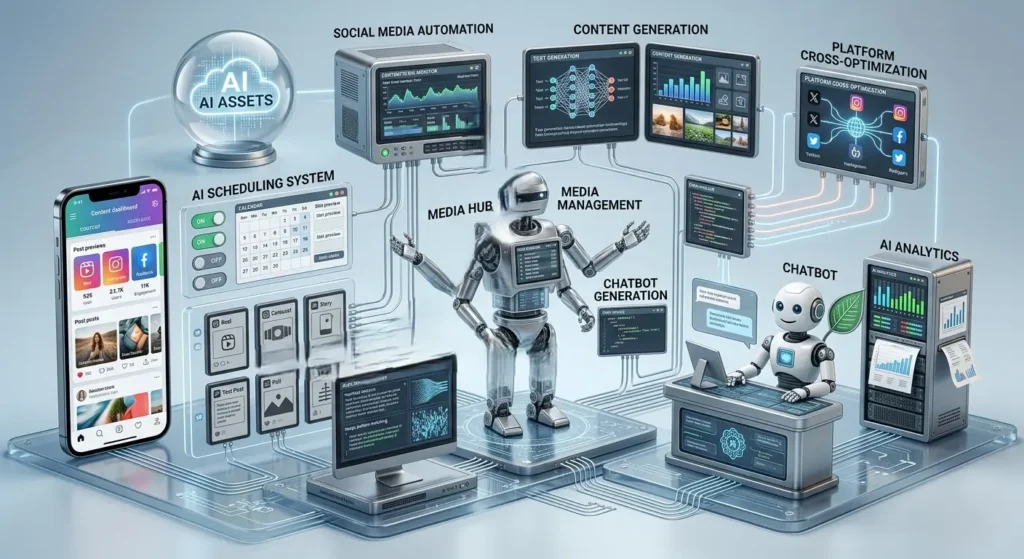
Artificial intelligence in social media is not just about solving problems. It provides powerful solutions that help businesses automate workflows, improve targeting, create high-performing content, and scale their marketing efforts efficiently.
Modern AI solutions go beyond basic automation. They analyze data in real time, adapt strategies dynamically, and continuously optimize performance. This allows businesses to move from manual execution to intelligent, data-driven marketing.
AI-Powered Content Creation and Optimization
Content is the foundation of social media, and AI has transformed how it is created and optimized.
AI tools can generate captions, hashtags, images, and videos tailored to specific platforms such as Instagram, TikTok, and LinkedIn. These tools analyze engagement data to recommend the best formats, tone, and posting times.
AI also enables A/B testing at scale, allowing businesses to test multiple variations of content and identify what performs best.
This leads to higher engagement, improved reach, and more effective content strategies.
AI-Driven Audience Targeting and Segmentation
One of the most valuable applications of artificial intelligence in social media is audience targeting.
AI analyzes user behavior, interests, demographics, and interactions to create highly specific audience segments. This allows businesses to deliver personalized content and advertisements to users who are most likely to engage and convert.
Advanced AI systems can also identify lookalike audiences and predict user behavior, improving campaign effectiveness.
As a result, businesses can reduce ad spend waste and achieve better return on investment.
Social Media Automation and Scheduling
Managing multiple social media platforms manually is time-consuming and inefficient. AI-powered automation tools streamline this process by handling repetitive tasks such as scheduling posts, managing content calendars, and publishing content at optimal times.
These systems analyze historical data to determine when audiences are most active and automatically schedule posts for maximum visibility.
Automation allows businesses to maintain consistency, save time, and focus on strategic activities.
AI Chatbots and Automated Customer Engagement
Customer interaction is a critical part of social media marketing, and AI chatbots play a key role in improving engagement.
AI-powered chatbots can respond to comments, messages, and inquiries in real time. They provide instant support, answer frequently asked questions, and guide users through the buying process.
Unlike traditional chatbots, modern AI systems understand context and deliver more natural, human-like responses.
This improves customer experience, reduces response time, and increases conversion rates.
Predictive Analytics and Trend Forecasting
AI enables businesses to move from reactive strategies to proactive decision-making.
Predictive analytics analyzes historical data and identifies patterns to forecast future trends. This allows businesses to create content that aligns with upcoming trends and stay ahead of competitors.
AI also helps in predicting campaign performance, allowing marketers to optimize strategies before launching campaigns.
This results in better planning, improved outcomes, and higher efficiency.
AI-Powered Advertising and Campaign Optimization
Advertising is one of the most impactful areas where AI is used in social media marketing.
AI systems automatically optimize ad campaigns by adjusting targeting, budgets, and creatives based on performance data.
Platforms like Meta and TikTok use AI to identify high-intent users and deliver ads at the right time.
AI also tests multiple variations of ads and selects the best-performing ones, improving conversion rates and reducing costs.
Real-Time Analytics and Performance Tracking
AI-powered analytics tools provide real-time insights into campaign performance.
Businesses can track metrics such as engagement, reach, conversions, and audience behavior instantly. AI systems also identify trends, anomalies, and opportunities for improvement.
This enables businesses to make data-driven decisions and continuously optimize their strategies.
AI for Content Moderation and Brand Safety
Maintaining a safe and positive online presence is essential for brands.
AI systems monitor comments, messages, and user-generated content to detect harmful or inappropriate behavior. They can automatically filter spam, flag inappropriate content, and ensure compliance with platform guidelines.
This helps businesses protect their brand reputation and maintain a healthy online community.
Artificial intelligence in social media provides a complete ecosystem of solutions that transform how businesses operate and grow.
By combining automation, personalization, and data-driven insights, AI enables businesses to achieve better results with less effort.
Organizations that adopt these solutions can scale faster, improve engagement, and maximize return on investment.
Ready to Automate Your Social Media?
We build AI systems that create content, optimize campaigns, and scale your marketing effortlessly.
Start AI ImplementationAI USE CASES ACROSS SOCIAL MEDIA PLATFORMS
AI Use Cases in Social Media Platforms: Instagram, TikTok, LinkedIn, and Facebook
Artificial intelligence in social media works differently across platforms, as each platform has its own algorithms, audience behavior, and content formats. Businesses need to understand how AI functions on each platform to maximize engagement, reach, and conversions.
From short-form video optimization on TikTok to professional content targeting on LinkedIn, AI plays a critical role in shaping content visibility and performance.
AI in Instagram Marketing
Instagram heavily relies on AI to determine what content appears in feeds, explore pages, and reels.
AI analyzes user behavior such as likes, shares, comments, saves, and watch time to recommend content that aligns with individual preferences.
Businesses can use AI to optimize hashtags, captions, and posting times. AI tools also help in generating visually appealing content and identifying trending formats.
AI-driven insights allow brands to understand audience preferences and create content that increases engagement and reach.
AI in TikTok Content Strategy
TikTok is one of the most AI-driven platforms, where content discovery is almost entirely based on algorithmic recommendations.
The platform uses AI to analyze watch time, user interactions, and content performance to decide which videos go viral.
Businesses can use AI to identify trending sounds, hashtags, and content formats. AI tools also help in editing videos, generating captions, and optimizing content for better performance.
This enables brands to create viral content and reach a wider audience quickly.
AI in LinkedIn Marketing
LinkedIn uses AI to personalize content feeds and recommend posts, jobs, and connections.
AI helps businesses target professionals based on industry, job role, skills, and interests. This makes LinkedIn highly effective for B2B marketing.
AI-driven analytics provide insights into content performance, audience engagement, and lead generation.
Businesses can use AI to optimize content strategy, improve targeting, and generate high-quality leads.
AI in Facebook Advertising and Engagement
Facebook uses advanced AI systems for content ranking, ad targeting, and user engagement.
AI analyzes user data to deliver personalized content and advertisements. It also helps in optimizing ad campaigns by adjusting targeting, creatives, and budgets in real time.
Businesses can use AI to automate ad management, improve audience segmentation, and increase conversion rates.
AI-powered chatbots also enhance customer engagement by providing instant responses and support.
Cross-Platform AI Strategy for Businesses
While each platform has its unique features, a successful social media strategy requires a unified AI-driven approach across all platforms.
Businesses can use AI to:
- Analyze performance across multiple platforms
- Maintain consistent branding and messaging
- Optimize content for different formats
- Automate workflows and scheduling
A cross-platform AI strategy ensures that businesses can maximize reach, improve efficiency, and achieve better results.
Artificial intelligence in social media is not limited to a single platform. It is a comprehensive system that enables businesses to optimize their presence across multiple channels.
Understanding platform-specific AI use cases allows businesses to create targeted strategies, improve engagement, and drive better outcomes.
AI IN SOCIAL MEDIA TRENDING PLATFORMS BY COUNTRY AND REGION WISE
AI in Social Media Platforms by Country and Region (Global Trends 2025–2026)
The impact of artificial intelligence in social media varies across countries, as user behavior, platform preferences, and content trends differ significantly by region. Understanding these regional trends helps businesses build more targeted and effective global marketing strategies.
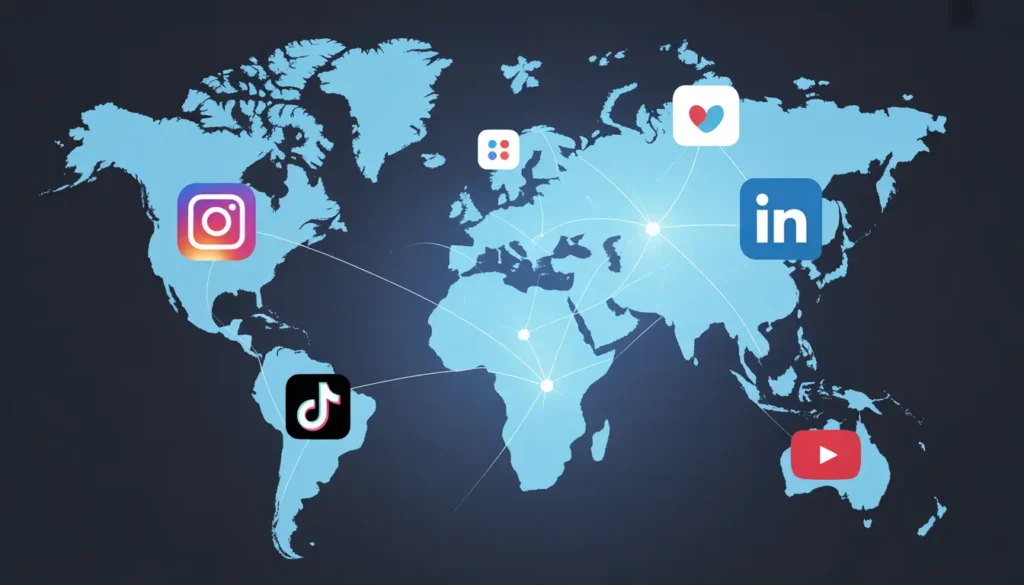
AI in Social Media Platforms in the United States
In the United States, platforms like YouTube and Facebook dominate in terms of overall usage, with YouTube reaching over 80 percent of adult users.
For younger audiences, Instagram and TikTok are leading platforms, driven by short-form video content and AI-powered recommendations.
AI plays a critical role in content discovery, ad targeting, and engagement optimization across these platforms.
AI in Social Media Platforms in the United Kingdom and Europe
In the UK and Europe, WhatsApp and Facebook lead in total user base, while TikTok and Instagram are the fastest-growing platforms among younger demographics.
Reddit has also seen significant growth, becoming a major platform for discussions and community engagement.
AI helps optimize content visibility, personalize feeds, and improve engagement across these platforms.
AI in Social Media Platforms in Canada
In Canada, TikTok, Instagram, and Facebook dominate the social media landscape.
Emerging local platforms such as Gander Social are gaining attention, focusing on privacy and localized content experiences.
AI supports targeted marketing, content personalization, and performance optimization in this region.
AI in Social Media Platforms in Germany
In Germany, WhatsApp is the most widely used platform, while Instagram and TikTok are rapidly growing.
AI is used for content recommendations, ad targeting, and engagement tracking, especially among younger audiences.
AI in Social Media Platforms in India
India has one of the largest and fastest-growing social media markets.
Platforms like Instagram, YouTube, WhatsApp, and Facebook dominate usage.
Regional platforms such as ShareChat and Moj are highly popular for local language content.
AI enables personalization, regional targeting, and content recommendation at scale.
AI in Social Media Platforms in Africa (Nigeria Example)
In Nigeria, TikTok is highly popular for viral content, while Instagram is widely used for influencer marketing.
Facebook remains dominant for general usage, and WhatsApp is the leading communication platform.
AI supports content discovery, engagement tracking, and targeted advertising.
AI in Social Media Platforms in Asia (China, Vietnam, Thailand)
Asia has unique platform ecosystems.
In China, WeChat, Douyin, and Xiaohongshu dominate.
In Vietnam, platforms like Zalo, TikTok, and Facebook are widely used.
In Thailand, LINE and Facebook dominate, while TikTok is the fastest-growing.
AI in these regions focuses heavily on social commerce, live streaming, and personalized recommendations.
Artificial intelligence in social media is deeply influenced by regional behavior and platform preferences. Businesses that adapt their strategies based on country-specific trends can achieve better targeting, higher engagement, and improved return on investment.
A global AI strategy combined with local insights enables businesses to scale effectively across different markets.
AI TOOLS FOR SOCIAL MEDIA AUTOMATION
Best AI Tools for Social Media Automation, Content Creation, and Marketing (2026)
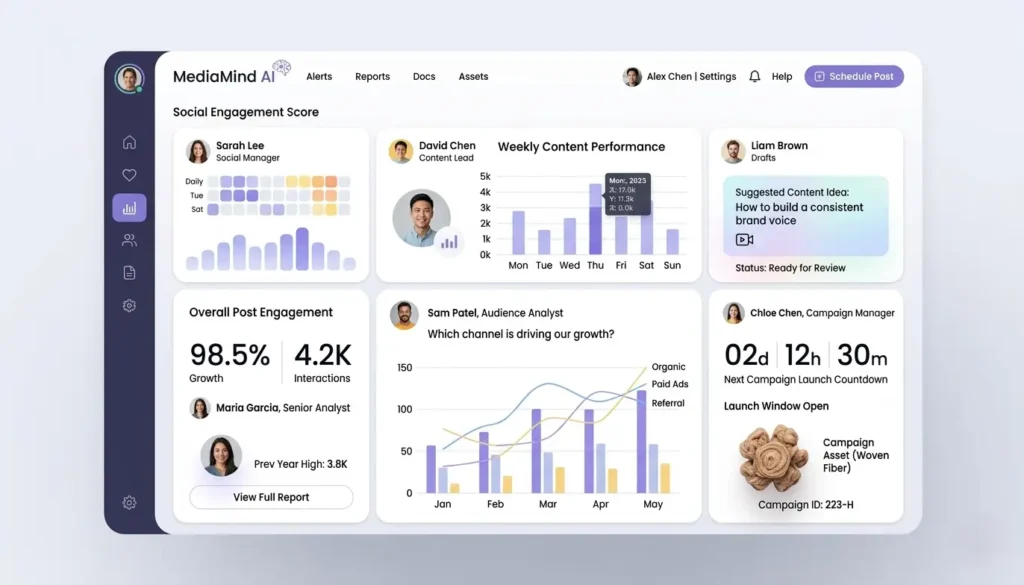
Artificial intelligence in social media is powered by a wide range of tools that help businesses automate tasks, create content, analyze performance, and optimize campaigns. These AI tools are designed to simplify complex processes and improve efficiency, making them essential for modern social media marketing.
From content generation and scheduling to analytics and customer engagement, AI tools enable businesses to manage their social media presence more effectively and achieve better results.
AI Tools for Content Creation
Creating engaging content consistently is one of the biggest challenges in social media marketing. AI tools help businesses generate high-quality content quickly and efficiently.
Tools like ChatGPT are widely used for generating captions, post ideas, and scripts. These tools understand context and help create content tailored to different platforms.
Canva provides AI-powered design features that allow users to create visuals, social media posts, and marketing creatives with ease.
Jasper AI is another popular tool for generating marketing copy, captions, and long-form content optimized for engagement.
These tools reduce content creation time and improve creativity, enabling businesses to maintain consistency and quality.
AI Tools for Social Media Scheduling and Automation
Managing multiple social media platforms requires efficient scheduling and automation tools.
Buffer and Hootsuite are widely used for scheduling posts, managing content calendars, and automating publishing.
AI features in these tools analyze audience activity and recommend optimal posting times to maximize engagement.
Automation tools help businesses maintain consistency, reduce manual effort, and improve overall productivity.
AI Tools for Analytics and Performance Tracking
Understanding performance is essential for optimizing social media strategies.
Sprout Social provides advanced analytics and reporting features that help businesses track engagement, reach, and performance.
Google Analytics can also be integrated to track traffic and conversions from social media platforms.
AI-powered analytics tools provide real-time insights and help businesses make data-driven decisions.
AI Tools for Social Listening and Sentiment Analysis
Social listening tools help businesses monitor conversations, track brand mentions, and understand audience sentiment.
Brandwatch and Talkwalker use AI to analyze large volumes of data and provide insights into customer opinions and trends.
These tools help businesses improve their strategies, respond to feedback, and maintain a positive brand image.
AI Tools for Chatbots and Customer Engagement
Customer engagement is a key part of social media marketing, and AI chatbots help automate interactions.
ManyChat and Tidio allow businesses to create automated responses, handle queries, and engage with users in real time.
These tools improve response time, enhance customer experience, and increase conversion rates.
AI Tools for Video and Short-Form Content Creation
Video content is dominating social media, and AI tools are making video creation easier.
Pictory and Lumen5 help businesses create videos from text content quickly.
These tools are especially useful for platforms like TikTok, Instagram Reels, and YouTube Shorts.
How to Choose the Right AI Tools for Your Business
Selecting the right AI tools depends on business goals, budget, and platform focus.
Businesses should consider:
- Content requirements
- Target platforms
- Automation needs
- Analytics capabilities
- Integration with existing systems
Choosing the right combination of tools ensures maximum efficiency and better results.
AI tools are not just productivity enhancers. They are strategic assets that enable businesses to scale their social media marketing efforts.
By using the right tools, companies can automate processes, improve content quality, and achieve better engagement and ROI.
BENEFITS OF AI IN SOCIAL MEDIA MARKETING
Key Benefits of Artificial Intelligence in Social Media Marketing for Businesses
Artificial intelligence in social media is transforming how businesses approach marketing, engagement, and growth. By leveraging AI-powered tools and technologies, companies can achieve better results with less effort, making their strategies more efficient and scalable.
The benefits of AI in social media go beyond automation. They include improved decision-making, enhanced customer experiences, and measurable business outcomes that drive long-term success.
Improved Content Quality and Consistency
One of the most significant benefits of AI in social media marketing is the ability to create high-quality content consistently.
AI tools assist in generating captions, visuals, and videos tailored to specific platforms and audiences. They also analyze performance data to recommend improvements, ensuring that content remains relevant and engaging.
This helps businesses maintain a strong online presence without overwhelming their teams.
Enhanced Audience Targeting and Personalization
AI enables businesses to understand their audience at a deeper level.
By analyzing user behavior, preferences, and interactions, AI systems create detailed audience segments. This allows businesses to deliver personalized content and advertisements that resonate with specific users.
Personalization improves engagement rates, builds stronger relationships, and increases conversion rates.
Increased Efficiency and Time Savings
Managing social media manually requires significant time and effort. AI automates repetitive tasks such as scheduling posts, responding to messages, and analyzing data.
This allows marketing teams to focus on strategy, creativity, and growth instead of routine tasks.
As a result, businesses can operate more efficiently and achieve better outcomes with fewer resources.
Better Decision-Making with Data-Driven Insights
AI-powered analytics provide real-time insights into social media performance.
Businesses can track engagement, identify trends, and measure the effectiveness of campaigns instantly. AI also provides recommendations for optimization based on data analysis.
This enables companies to make informed decisions and continuously improve their strategies.
Higher Engagement and Customer Interaction
AI improves customer engagement by enabling faster and more relevant interactions.
Chatbots and automated systems respond to user queries instantly, while AI-driven content recommendations keep users engaged.
This leads to improved customer satisfaction and stronger brand relationships.
Cost Reduction and Improved Marketing Efficiency
AI helps reduce marketing costs by optimizing campaigns and minimizing wasted resources.
By targeting the right audience and automating processes, businesses can achieve better results with lower investment.
This improves overall marketing efficiency and maximizes return on investment.
Scalability and Business Growth
AI allows businesses to scale their social media operations without significantly increasing resources.
Automation and data-driven strategies enable companies to manage multiple platforms, handle large audiences, and expand their reach effectively.
This supports sustainable growth and long-term success.
Competitive Advantage in the Market
Businesses that adopt artificial intelligence in social media gain a competitive edge over those that rely on traditional methods.
AI enables faster decision-making, better targeting, and more effective campaigns, allowing companies to stay ahead in a competitive market.
Early adopters of AI are more likely to lead their industries and capture market share.
The benefits of artificial intelligence in social media extend across every aspect of marketing and business operations.
Organizations that leverage AI effectively can improve efficiency, enhance customer experiences, and achieve measurable growth.
Adopting AI is not just about improving performance. It is about building a future-ready business.
ROI OF AI IN SOCIAL MEDIA
Return on Investment (ROI) of Artificial Intelligence in Social Media Marketing
For businesses investing in digital marketing, one of the most important questions is whether artificial intelligence in social media delivers real return on investment. While AI requires initial implementation and integration, its long-term value significantly outweighs the cost.
AI improves efficiency, enhances targeting, and optimizes campaigns in real time, leading to measurable improvements in performance and profitability.
Reduction in Operational Costs
One of the most immediate benefits of AI in social media is cost reduction.
By automating repetitive tasks such as content scheduling, data analysis, and customer responses, businesses can reduce the need for manual effort and large teams.
This lowers operational expenses while maintaining or even improving performance.
Higher Engagement and Conversion Rates
AI-driven personalization and targeting lead to better engagement.
When users see content that is relevant to their interests, they are more likely to interact, engage, and take action.
This results in higher conversion rates, whether it is clicks, sign-ups, or purchases.
Improved Advertising Performance
AI significantly enhances the effectiveness of social media advertising.
AI systems analyze user data to identify high-intent audiences and deliver ads at the optimal time. They also test multiple variations of ads and automatically optimize campaigns based on performance.
This reduces wasted ad spend and improves overall return on investment.
Faster Content Production and Campaign Execution
AI tools enable businesses to create and publish content more quickly.
This allows companies to respond to trends in real time and maintain a consistent presence across platforms.
Faster execution leads to better visibility and increased opportunities for engagement.
Data-Driven Decision Making
AI provides real-time insights into performance, enabling businesses to make informed decisions.
Instead of relying on assumptions, companies can use data to optimize strategies, improve campaigns, and achieve better results.
This reduces risk and increases the likelihood of success.
Scalability Without Increasing Costs
AI allows businesses to scale their social media operations without significantly increasing costs.
Automation and intelligent systems enable companies to manage larger audiences, multiple platforms, and more complex campaigns efficiently.
This makes growth more sustainable and cost-effective.
Measurable Business Outcomes
The impact of AI in social media can be measured through key performance indicators such as engagement rates, conversion rates, cost per acquisition, and return on ad spend.
Many businesses report improvements such as increased engagement, reduced costs, and higher revenue after implementing AI-driven strategies.
These measurable outcomes demonstrate the value of AI as a long-term investment.
The return on investment of artificial intelligence in social media is not limited to financial gains. It also includes improved efficiency, better customer experience, and stronger brand positioning.
Businesses that adopt AI can achieve higher performance, reduce costs, and scale their operations effectively, making AI a critical component of modern social media strategies.
Want to Know AI Cost for Your Social Media?
Get a quick estimate and expert guidance based on your business goals and platform requirements.
Get Free Cost EstimationAI IN SOCIAL MEDIA ACROSS INDUSTRY
How Artificial Intelligence in Social Media is Transforming Different Industries
Artificial intelligence in social media is not limited to a single industry. It is transforming how businesses across different sectors engage with audiences, create content, and drive growth.
Each industry uses AI differently based on its goals, audience behavior, and content strategy. Understanding these industry-specific applications helps businesses adopt the right approach and maximize results.
Explore AI Across Industries
Artificial Intelligence is transforming industries beyond social media. Discover how businesses are using AI to automate processes, improve efficiency, and deliver smarter user experiences.
AI in Business
Automate operations and improve decision-making.
AI in Education
Personalized and adaptive learning solutions.
AI in Healthcare
Smart diagnostics and predictive analytics.
AI in Fitness
Personalized workouts and health tracking.
AI in Construction
Improve planning, safety, and operations.
AI in Fashion
Trend analysis and smart recommendations.
AI in Travel
Smart booking and personalized trips.
AI in Spirituality
Personalized engagement experiences.
AI in Social Media for E-commerce and Retail
In the e-commerce and retail industry, AI plays a key role in personalized marketing and product discovery.
Businesses use AI to recommend products, create targeted advertisements, and optimize content for higher conversions. Social media platforms powered by AI help brands showcase products to the right audience based on browsing behavior and preferences.
AI also enables automated customer support, improving user experience and increasing sales.
AI in Social Media for Healthcare
AI in the healthcare industry, AI is used to share educational content, improve patient engagement, and build trust.
Healthcare organizations use AI to analyze audience behavior and deliver relevant information such as health tips, awareness campaigns, and service updates.
AI-powered chatbots help answer patient queries and provide quick responses, improving accessibility and communication.
AI in Social Media for Travel and Hospitality
The travel industry uses AI to deliver personalized recommendations, promote destinations, and engage travelers.
AI analyzes user preferences, search behavior, and travel trends to create targeted campaigns. Businesses use AI to recommend travel packages, optimize content, and improve engagement.
Social media platforms powered by AI help travel brands reach potential customers at the right time with the right offers.
AI in Social Media for Fashion Industry
AI in the fashion industry, AI is used for trend analysis, visual content optimization, and influencer marketing.
AI systems analyze user behavior and social media trends to identify popular styles and preferences. Brands use this data to create content that aligns with current trends and audience interests.
AI also helps in recommending products and improving customer engagement through personalized content.
AI in Social Media for Education and EdTech
AI In the education sector, AI is used to deliver personalized learning content, promote courses, and engage students.
Educational platforms use AI to analyze user interests and recommend relevant content, improving engagement and retention.
Social media powered by AI helps institutions reach students with targeted campaigns and valuable content.
AI in Social Media for Fitness and Wellness
The fitness industry uses AI to create personalized content, track user engagement, and promote health programs.
AI helps businesses deliver customized workout plans, nutrition tips, and motivational content based on user preferences.
Social media platforms enable fitness brands to connect with their audience and build strong communities.
AI in Social Media for Construction and Real Estate
AI In the construction and real estate industry, AI is used to showcase projects, generate leads, and target potential buyers.
Businesses use AI to analyze user behavior and deliver property recommendations, promotional content, and updates.
AI-driven campaigns help improve visibility and attract high-quality leads.
HOW AI IMPLEMENT IN SOCIAL MEDIA
How to Implement Artificial Intelligence in Social Media Marketing: Step-by-Step Strategy
Implementing artificial intelligence in social media is not just about using tools. It requires a clear strategy, proper planning, and alignment with business goals.
Many businesses fail to achieve results because they adopt AI without a structured approach. To maximize the benefits of AI, companies need to identify the right use cases, select appropriate tools, and continuously optimize their strategies.
This section provides a step-by-step approach to successfully implementing AI in social media marketing.
Step 1: Define Clear Business Goals
The first step in implementing AI is to define clear objectives.
Businesses need to identify what they want to achieve, such as increasing engagement, improving conversions, reducing costs, or automating processes.
Having clear goals helps in selecting the right AI solutions and measuring success effectively.
Step 2: Identify Key Challenges and Opportunities
Before implementing AI, businesses should analyze their current social media performance and identify challenges.
These may include low engagement, inefficient content creation, poor targeting, or lack of insights.
Understanding these problems helps in determining where AI can add the most value.
Step 3: Choose the Right AI Tools and Technologies
Selecting the right tools is critical for successful implementation.
Businesses should choose AI tools based on their goals, target platforms, and budget. This may include tools for content creation, scheduling, analytics, or customer engagement.
It is important to ensure that these tools integrate well with existing systems.
Step 4: Build a Data-Driven Strategy
AI relies on data to function effectively. Businesses need to collect, organize, and analyze data from their social media platforms.
This includes engagement metrics, audience behavior, and campaign performance.
A data-driven approach enables better decision-making and improves the effectiveness of AI systems.
Step 5: Automate Repetitive Tasks
One of the key advantages of AI is automation.
Businesses should start by automating repetitive tasks such as content scheduling, posting, and responding to common queries.
This saves time and allows teams to focus on strategic activities.
Step 6: Personalize Content and Campaigns
AI enables businesses to deliver personalized experiences to their audience.
By analyzing user behavior and preferences, businesses can create targeted content and campaigns that resonate with specific segments.
Personalization improves engagement and conversion rates.
Step 7: Monitor Performance and Optimize Continuously
AI implementation is not a one-time process. Businesses need to continuously monitor performance and make adjustments.
AI tools provide real-time insights that help identify what is working and what needs improvement.
Continuous optimization ensures long-term success.
Step 8: Scale and Expand AI Capabilities
Once initial implementation is successful, businesses can scale their AI efforts.
This may include expanding to multiple platforms, integrating advanced analytics, and adopting new AI technologies.
Scaling allows businesses to maximize the value of AI and achieve sustainable growth.
Common Mistakes to Avoid
While implementing AI, businesses should avoid common mistakes such as relying too heavily on automation without strategy, ignoring data quality, and not aligning AI with business goals.
Avoiding these mistakes helps in achieving better results and reducing risks.
Implementing artificial intelligence in social media requires a balance between technology and strategy.
Businesses that follow a structured approach can successfully integrate AI into their marketing efforts and achieve measurable results.
A well-planned implementation ensures that AI delivers long-term value and supports business growth.
CHALLENGES OF AI IMPLEMENTATION IN SOCIAL MEDIA
Challenges of Implementing Artificial Intelligence in Social Media and How to Overcome Them
While artificial intelligence in social media offers significant benefits, implementing it successfully is not always straightforward. Many businesses face technical, operational, and strategic challenges during the adoption process.
Understanding these challenges is essential for organizations that want to implement AI effectively and avoid common pitfalls. By identifying potential issues in advance, businesses can plan better, reduce risks, and achieve better results.
Data Quality and Availability Issues
Artificial intelligence relies heavily on data, and poor data quality can significantly impact results.
Many businesses have fragmented or inconsistent data across different platforms. Without proper data collection and organization, AI systems may produce inaccurate insights or ineffective recommendations.
To overcome this, businesses should focus on collecting clean, structured data and using centralized systems for better data management.
High Initial Investment and Budget Concerns
One of the main challenges businesses face is the cost of implementing AI.
Developing and integrating AI solutions requires investment in tools, infrastructure, and expertise. For small and medium-sized businesses, this can be a significant concern.
However, starting with smaller use cases and scaling gradually can help manage costs effectively. Cloud-based AI solutions also reduce upfront investment.
Integration with Existing Systems
Integrating AI tools with existing social media workflows and systems can be complex.
Businesses often use multiple platforms and tools, and ensuring seamless integration requires careful planning.
Using tools that support APIs and compatibility with existing systems can simplify this process.
Lack of Skilled Talent and Expertise
Implementing AI requires specialized knowledge in areas such as machine learning, data analysis, and automation.
Many businesses face challenges in finding skilled professionals who can manage AI systems effectively.
Partnering with experienced AI development teams or investing in training can help overcome this challenge.
Over-Reliance on Automation
While automation is beneficial, relying too heavily on AI can reduce the human touch in communication.
Social media is about building relationships, and purely automated interactions may feel impersonal.
Businesses should maintain a balance between automation and human interaction to ensure authenticity.
Data Privacy and Security Concerns
With increasing use of AI, data privacy and security have become critical issues.
Businesses must ensure compliance with data protection regulations and protect user information.
Implementing strong security measures and following best practices helps build trust and avoid legal issues.
Maintaining Brand Voice and Consistency
AI-generated content may sometimes lack consistency in tone and messaging.
Without proper guidelines, businesses may struggle to maintain a strong brand identity across platforms.
Using AI tools with clear brand guidelines and human review processes helps maintain consistency.
Measuring Performance and ROI Accurately
Tracking the performance of AI initiatives can be challenging.
Businesses may struggle to measure the exact impact of AI on engagement, conversions, and revenue.
Using proper analytics tools and defining clear KPIs helps in evaluating performance effectively.
The challenges of implementing artificial intelligence in social media are real, but they are manageable with the right approach.
Businesses that plan strategically, invest in the right tools, and focus on continuous improvement can overcome these challenges and achieve successful outcomes.
Addressing these challenges proactively ensures that AI delivers maximum value and supports long-term growth.
COST OF AI IN SOCIAL MEDIA
Cost of Artificial Intelligence in Social Media Marketing: Pricing, Factors, and Investment Guide
One of the most common questions businesses ask before adopting artificial intelligence in social media is about the cost. While AI offers significant long-term benefits, understanding the investment required is essential for planning and decision-making.
The cost of implementing AI in social media marketing varies depending on business goals, complexity, tools, and level of customization. Instead of viewing it as an expense, businesses should consider AI as a strategic investment that delivers long-term value.
Key Factors That Affect AI Cost in Social Media
The cost of AI implementation is influenced by multiple factors, and each business may have different requirements.
Scope and Complexity of the Solution
The complexity of AI solutions plays a major role in determining cost.
Basic solutions such as content automation or chatbot integration require less investment, while advanced systems involving predictive analytics, personalization engines, and multi-platform automation require higher investment.
More complex solutions involve more development time, advanced technologies, and specialized expertise.
Type of AI Tools and Technologies Used
The choice of tools also affects cost.
Using pre-built AI tools for scheduling, analytics, and content generation is more cost-effective compared to building custom AI solutions.
Custom solutions provide more flexibility and scalability but require higher initial investment.
Data Requirements and Management
AI systems depend on data to function effectively.
If a business already has structured data, implementation is faster and more cost-efficient. However, if data needs to be collected, cleaned, and organized, it adds to the overall cost.
Data preparation is often one of the most time-consuming aspects of AI implementation.
Integration with Existing Systems
Integrating AI tools with existing social media platforms and business systems can increase costs.
Businesses using multiple tools or legacy systems may require additional development effort to ensure smooth integration.
Proper integration is essential for achieving optimal performance.
Team Expertise and Development Approach
The cost of implementation also depends on whether businesses use in-house teams or external development partners.
Hiring skilled professionals or working with experienced agencies ensures better quality but may impact overall cost.
However, this often leads to more efficient implementation and better results.
Estimated Cost Range for AI in Social Media
While exact pricing varies, businesses can consider general cost categories.
- Basic AI implementation with tools and automation requires a lower investment and is suitable for small businesses or startups.
- Mid-level solutions involving analytics, personalization, and multi-platform management require moderate investment.
- Advanced AI solutions with custom development, predictive analytics, and full automation require higher investment but deliver greater value.
These ranges depend on business needs, scale, and objectives.
Cost vs Value: Long-Term Business Impact
The true value of artificial intelligence in social media lies in its long-term impact.
AI helps businesses reduce operational costs, improve efficiency, and increase revenue. Over time, the return on investment often exceeds the initial cost.
Businesses that adopt AI early gain a competitive advantage and achieve sustainable growth.
How to Optimize AI Investment
Businesses can optimize their investment in AI by adopting a strategic approach.
Starting with small, high-impact use cases allows companies to test the effectiveness of AI before scaling.
Using cloud-based tools reduces infrastructure costs and simplifies implementation.
Partnering with experienced development teams helps avoid costly mistakes and ensures better outcomes.
The cost of artificial intelligence in social media should not be seen as a barrier. It is an investment in growth, efficiency, and competitiveness.
Businesses that focus on long-term value rather than short-term cost are more likely to achieve success and maximize the benefits of AI.
AI CASE STUDIES IN SOCIAL MEDIA
AI Case Studies in Social Media: Real-World Applications and Business Results
Understanding artificial intelligence in social media becomes more impactful when we look at real-world implementations. While strategies and tools provide direction, case studies demonstrate how AI solutions work in practical scenarios.
Real implementations help businesses understand how challenges can be solved, what features are required, and how AI delivers measurable results.
At Square Infosoft, we build AI-powered solutions that help businesses improve engagement, automate workflows, and scale efficiently. Below are real-world case studies that highlight how AI can transform social media and digital platforms.
Case Study 1: AI-Powered Content Automation and Engagement Platform
Problem
Businesses managing social media at scale often struggle with content consistency, audience engagement, and time-consuming manual processes.
Creating content regularly, responding to users, and analyzing performance requires significant effort. This leads to delays, inconsistent posting, and reduced engagement.
Solution
We developed an AI-powered platform that automates content creation, engagement, and performance tracking.
The system uses machine learning and natural language processing to generate captions, suggest content ideas, and optimize posting schedules based on audience behavior.
It also includes AI-driven engagement tools that respond to user queries and interactions in real time.
Key Features
The platform includes AI-based content generation that creates captions, posts, and ideas tailored to different platforms.
It uses predictive analytics to identify the best time to post and the type of content that performs well.
Automated engagement tools respond to comments and messages instantly, improving interaction with users.
Real-time analytics dashboards provide insights into performance, helping businesses optimize strategies continuously.
Business Impact
This solution significantly improves content consistency and reduces manual workload.
Businesses experience higher engagement rates, faster response times, and improved campaign performance.
Automation allows teams to focus on strategy and growth instead of repetitive tasks.
Case Study 2: AI-Based Personalized Learning and Content Platform (Social Engagement Model)
Problem
Platforms that rely on user engagement often struggle with personalization and retention.
Users may lose interest if content is not tailored to their preferences, leading to lower engagement and reduced platform growth.
Solution
We developed an AI-powered platform that uses personalization and engagement strategies similar to social media platforms.
The system includes an AI copilot that interacts with users, answers questions, and generates content dynamically.
It also uses behavioral data to recommend personalized content and learning paths.
Key Features
AI-driven personalization that adapts content based on user behavior and preferences.
Content generation tools that create flashcards, summaries, and recommendations.
Gamification features such as streaks, rewards, and leaderboards to increase engagement.
Performance tracking and analytics to monitor user activity and optimize strategies.
Business Impact
This solution improves user retention and engagement by delivering personalized experiences.
Businesses benefit from higher user activity, better conversion rates, and scalable growth.
The platform demonstrates how AI can be used to create engaging, social-like experiences.
Case Study 3: AI-Powered Content Processing and Video Intelligence System
Problem
Businesses dealing with video content and user-generated media often face challenges in processing, summarizing, and extracting insights.
Manual handling of content is time-consuming and inefficient.
Solution
We developed an AI-driven system that processes video and audio content, converts it into structured data, and generates summaries and insights.
This system can be used for social media content optimization, repurposing, and analytics.
Key Features
Automated transcription and content extraction from video and audio.
AI-generated summaries and key insights for quick understanding.
Content repurposing tools that convert videos into short-form content.
Analytics features to track performance and engagement.
Business Impact
This solution reduces manual effort and improves content efficiency.
Businesses can repurpose content for multiple platforms, increasing reach and engagement.
AI-driven insights help optimize content strategies and improve performance.
These case studies demonstrate that artificial intelligence in social media is not just a concept but a practical solution that delivers real results.
By combining AI technologies with business needs, organizations can build scalable, efficient, and high-performing systems.
Businesses that invest in real-world AI implementation gain a competitive advantage and achieve long-term growth.
AI DEVELOPMENT SERVICES FOR SOCIAL MEDIA
Artificial Intelligence Development Services for Social Media: Custom AI Solutions for Businesses, Startups, and Agencies
AI in social media delivers real results only when it is implemented with the right strategy, technology, and execution. While many businesses understand the value of AI, they often struggle to build and integrate solutions that align with their goals.
At Square Infosoft, we specialize in developing AI-powered social media solutions that help businesses automate workflows, improve engagement, and scale efficiently. Our approach focuses on understanding business requirements and delivering customized solutions that drive measurable outcomes.
We work with startups, enterprises, and agencies worldwide to build intelligent systems that transform social media marketing.
Custom AI Solutions for Social Media Marketing
Every business has unique requirements, and a generic approach does not deliver optimal results.
We develop custom AI solutions tailored to your social media strategy, including content automation systems, audience targeting engines, and performance optimization platforms.
Our solutions are designed to improve efficiency, enhance user experience, and deliver long-term value.
AI-Powered Mobile and Web App Development
We specialize in building AI-powered mobile and web applications that integrate seamlessly with social media platforms.
Our expertise includes Android, iOS, and Flutter app development, as well as scalable web applications that support automation, analytics, and engagement features.
These applications enable businesses to manage social media operations more effectively and scale their digital presence.
AI Content Automation and Personalization Systems
Content is the backbone of social media, and we build AI systems that automate content creation and personalization.
Our solutions include AI-driven caption generation, content recommendations, and personalized user experiences based on behavior and preferences.
This helps businesses deliver relevant content and improve engagement across platforms.
AI Chatbots and Engagement Automation
We develop AI-powered chatbots that enhance customer interaction and support.
These systems can handle comments, messages, and inquiries in real time, providing instant responses and improving user experience.
Our chatbot solutions are designed to be intelligent, scalable, and aligned with your brand voice.
AI Analytics and Performance Optimization
Data-driven decision-making is essential for success in social media marketing.
We build AI analytics platforms that provide real-time insights into performance, audience behavior, and campaign effectiveness.
These systems help businesses optimize strategies, improve ROI, and achieve better results.
Industry-Specific AI Solutions
We provide AI solutions tailored to different industries, ensuring that businesses get solutions aligned with their specific needs.
Our experience includes:
- Social media solutions for e-commerce and retail
- AI systems for healthcare engagement and awareness
- Travel and hospitality marketing automation
- Fashion and influencer marketing optimization
- Education and EdTech engagement platforms
- Fitness and wellness content personalization
This industry-focused approach ensures better results and higher efficiency.
Technology Expertise and Development Stack
We use modern technologies and frameworks to build scalable and reliable AI solutions.
Our expertise includes:
- Machine learning and predictive analytics
- Natural language processing for content and chatbots
- Backend development and API integration
- Cloud platforms such as AWS and Google Cloud
- Mobile app development using Flutter, iOS, and Android
This ensures that our solutions are future-ready and scalable.
End-to-End AI Development Process
We follow a structured process to ensure successful implementation.
Our process includes:
- Understanding business goals and requirements
- Identifying use cases and opportunities
- Designing system architecture
- Developing and training AI models
- Integrating with social media platforms
- Testing and deployment
- Continuous monitoring and optimization
This approach ensures high-quality solutions and measurable results.
Why Choose Square Infosoft for AI Development
Choosing the right partner is critical for successful AI implementation.
At Square Infosoft, we combine technical expertise with business understanding to deliver solutions that work in real-world scenarios.
We focus on:
- Custom solutions tailored to your needs
- Scalable and high-performance systems
- Seamless integration with existing workflows
- Continuous support and optimization
Our goal is to help businesses successfully adopt artificial intelligence and achieve long-term growth.
Transform Your Social Media Strategy with AI
Partner with our AI experts to build scalable, data-driven social media solutions that deliver real results.
Contact Our AI Experts TodayFUTURE OF AI IN SOCIAL MEDIA
Future of Artificial Intelligence in Social Media: Trends, Innovations, and Predictions (2026–2030)
Artificial intelligence in social media is evolving at a rapid pace, and the next few years will bring even more transformative changes. What we see today is only the beginning of a shift toward fully automated, intelligent, and highly personalized social media ecosystems.
As platforms continue to advance their AI capabilities, businesses must prepare for a future where automation, predictive intelligence, and immersive experiences become the norm.
Understanding these future trends helps organizations stay ahead of the curve and make strategic investments that drive long-term growth.
AI Agents Becoming Social Media Managers
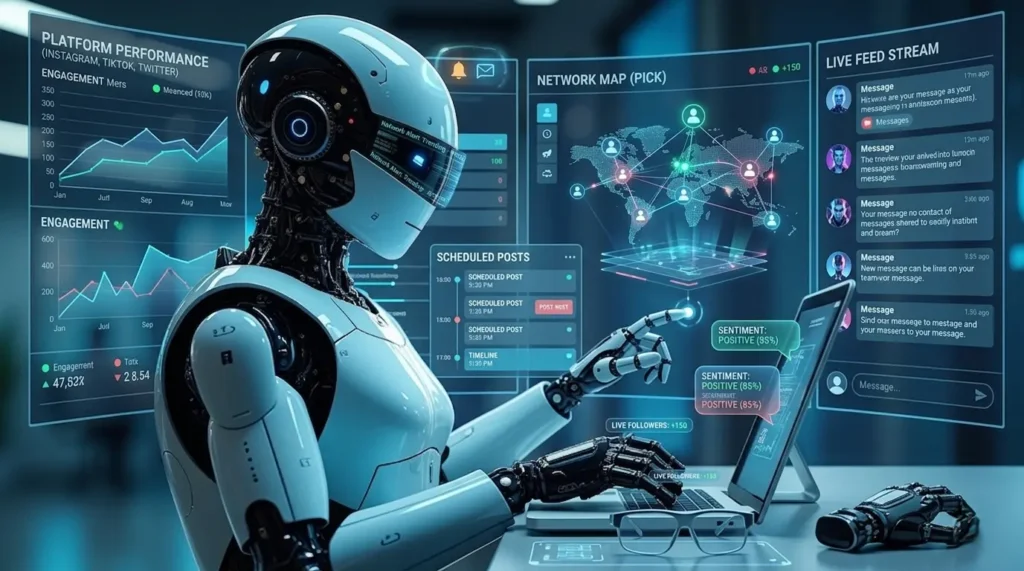
One of the biggest changes in the future of AI in social media will be the rise of AI agents.
These systems will go beyond automation and act as full-scale social media managers. They will create content, schedule posts, respond to users, analyze performance, and optimize campaigns without human intervention.
Businesses will rely on AI agents to manage entire social media operations, improving efficiency and reducing costs.
Hyper-Personalized Content at Scale
Personalization will become more advanced with AI.
Social media platforms will deliver highly customized content experiences based on individual user behavior, preferences, and intent.
Businesses will be able to create dynamic content that adapts in real time, ensuring that each user sees content that is most relevant to them.
This will significantly improve engagement and conversion rates.
AI-Driven Social Search and Discovery
Social media platforms are increasingly becoming search engines.
Users are searching for products, services, and information directly on platforms like Instagram, TikTok, and YouTube.
AI will play a central role in understanding search intent and delivering accurate results. This will lead to the growth of social search optimization and answer-driven content strategies.
Businesses will need to optimize content for both traditional search engines and social media platforms.
Integration of AI with AR, VR, and Immersive Experiences
The future of social media will include more immersive experiences powered by AI and technologies such as augmented reality and virtual reality.
Brands will create interactive content, virtual try-ons, and immersive campaigns that enhance user engagement.
AI will analyze user behavior within these environments to deliver personalized experiences.
This will open new opportunities for marketing and customer interaction.
Predictive Content and Trend Automation
AI will enable businesses to predict trends before they become popular.
Instead of reacting to trends, companies will create content in advance based on predictive insights.
AI systems will analyze data across platforms and identify emerging patterns, allowing businesses to stay ahead of competitors.
This will lead to more proactive and strategic content creation.
Voice and Conversational AI in Social Media
Voice-based interactions and conversational AI will become more prominent.
Users will interact with social media platforms through voice commands, and AI systems will provide responses and recommendations.
Chatbots and virtual assistants will become more advanced, offering natural and human-like conversations.
This will improve accessibility and user experience.
AI-Powered Social Commerce Expansion
Social media platforms are becoming major e-commerce channels.
AI will enhance social commerce by providing personalized product recommendations, optimizing shopping experiences, and improving conversion rates.
Features such as live shopping, automated recommendations, and AI-driven pricing strategies will become more common.
Businesses will need to adapt their strategies to take advantage of these opportunities.
Ethical AI and Data Privacy Focus
As AI becomes more powerful, ethical considerations and data privacy will become more important.
Businesses will need to ensure transparency, fairness, and compliance with regulations.
Building trust with users will be essential for long-term success.
AI systems will need to be designed responsibly to avoid bias and protect user data.
The future of artificial intelligence in social media is not just about technology. It is about how businesses adapt to changing user behavior, embrace innovation, and build strategies for long-term success.
Organizations that invest in AI today and prepare for future trends will be better positioned to lead in their industries.
AI is not just shaping the future of social media. It is shaping the future of digital marketing as a whole.
FAQ’s
Frequently Asked Questions About Artificial Intelligence in Social Media
What is AI in social media?
AI in social media refers to the use of technologies such as machine learning, natural language processing, and data analytics to automate, analyze, and optimize social media activities. It helps businesses understand user behavior, personalize content, and improve marketing performance.
How is AI used in social media marketing?
AI is used in social media marketing for content creation, audience targeting, automation, analytics, and customer engagement. Businesses use AI to generate posts, schedule content, analyze performance, and deliver personalized experiences to users.
What are the benefits of AI in social media?
The benefits of AI in social media include improved efficiency, better audience targeting, enhanced personalization, faster content creation, reduced costs, and higher engagement rates. AI also enables data-driven decision-making and scalable growth.
Which AI tools are best for social media?
Some of the best AI tools for social media include content generation tools, scheduling platforms, analytics tools, and chatbot systems. These tools help automate processes, improve content quality, and optimize marketing strategies.
Is AI important for social media marketing?
Yes, AI is essential for modern social media marketing. It enables businesses to automate workflows, analyze data, and deliver personalized content. Without AI, it becomes difficult to compete in a fast-paced digital environment.
How much does AI cost for social media?
The cost of AI in social media depends on the tools, level of automation, and business requirements. Basic tools are affordable, while advanced AI solutions may require higher investment. However, the long-term ROI makes AI a valuable investment.
How can businesses start using AI in social media?
Businesses can start by identifying their goals, selecting the right tools, and implementing AI for tasks such as content creation, scheduling, and analytics. Starting with small use cases and scaling gradually is the best approach.
What is the future of AI in social media?
The future of AI in social media includes advanced automation, AI agents, hyper-personalization, predictive analytics, and integration with technologies like AR and VR. AI will continue to play a central role in shaping social media strategies.
How can AI improve my social media business results?
Artificial intelligence improves your social media results by automating content creation, optimizing posting strategies, and targeting the right audience. It helps increase engagement, generate more leads, and improve overall return on investment by using data-driven insights.
Do I need technical knowledge to use AI in social media?
No, you do not need technical expertise to use AI in social media. Most AI tools are user-friendly and designed for marketers and business owners. If you require advanced solutions, working with an experienced AI development team ensures smooth implementation without technical complexity.
Can AI handle my entire social media management?
AI can handle a large part of social media management, including content scheduling, analytics, and customer responses. However, for best results, a combination of AI automation and human creativity is recommended to maintain brand voice and authenticity.
How long does it take to implement AI in social media?
The implementation timeline depends on the complexity of the solution. Basic AI tools can be set up within a few days, while custom AI solutions may take a few weeks to develop and integrate. A phased approach ensures faster results and smoother adoption.
Is AI suitable for startups and small businesses?
Yes, AI is highly beneficial for startups and small businesses. It helps reduce manual work, improve efficiency, and compete with larger companies. With affordable AI tools and scalable solutions, even small businesses can achieve significant growth.
Will AI replace human social media managers?
AI will not replace human social media managers but will enhance their capabilities. It automates repetitive tasks and provides insights, allowing professionals to focus on strategy, creativity, and relationship building.
How secure is AI for handling my business data?
AI systems can be highly secure when implemented correctly. Using trusted tools, secure cloud platforms, and proper data protection practices ensures that your business and customer data remain safe.
Can AI help generate leads from social media?
Yes, AI plays a major role in lead generation. It helps identify high-intent users, optimize campaigns, personalize content, and automate responses, increasing the chances of converting users into leads.
What platforms can AI integrate with?
AI solutions can integrate with major social media platforms such as Instagram, Facebook, LinkedIn, TikTok, and YouTube. Custom integrations can also be developed based on business requirements.
How do I choose the right AI solution for my business?
Choosing the right AI solution depends on your business goals, target audience, and budget. It is important to start with clear objectives and select tools or services that align with your needs. Consulting with AI experts can help you make the right decision.
Can AI improve my social media ads performance?
Yes, AI significantly improves ad performance by optimizing targeting, creatives, and budgets. It continuously analyzes data and adjusts campaigns to deliver better results and higher conversions.
What kind of businesses benefit the most from AI in social media?
Almost every business can benefit from AI in social media, including startups, e-commerce brands, agencies, service providers, and enterprises. Businesses that rely on digital marketing and customer engagement see the highest impact.